

Trump "Deal Imminent"…President Lee "All Issues Facing Difficulties"
Summary
- On the eve of the Korea-U.S. summit, President Lee Jae-myung said there are still significant differences on key issues such as the $350 billion U.S. investment condition.
- There are suggestions that negotiations could be prolonged beyond the APEC summit, and a proposal for an 'EU-style negotiation' regarding the investment method was mentioned.
- Experts warned that if negotiations are delayed it could be disadvantageous for Korea, and they advised careful attention to relations with both the U.S. and China.
Korea-U.S. summit D-1…Negotiations between the two countries still in the fog
Some expect negotiations to be prolonged beyond APEC
Lee: "It must not bring 'catastrophic results' to Korea
Delay does not necessarily mean failure"
Seeking a 'European-style negotiation' rather than a Japanese-style one?
Unlike Japan, the EU has private investment lead
Trade officials' working-level staff are also in contact with the U.S.
A dramatic late deal or partial agreement is possible
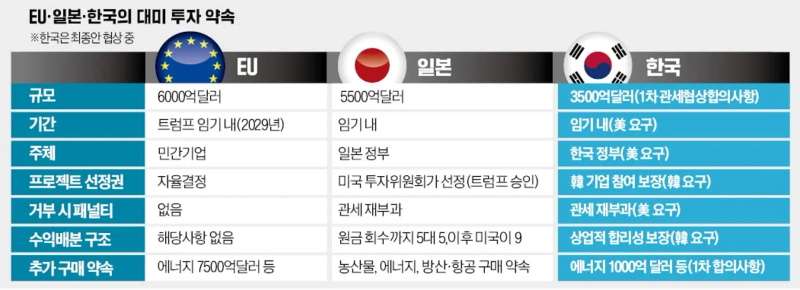
One day before the Korea-U.S. summit, tariff negotiations have again slipped into the fog. President Lee Jae-myung revealed in an interview with foreign media that the core issue of the $350 billion U.S. investment condition remains a sticking point, saying "everything is still an obstacle," highlighting a significant gap in perception with U.S. President Donald Trump, who said "a deal with Korea is imminent." Analysts are split between viewing the president's remarks as a strategy to extract maximum concessions from the U.S. ahead of a last-minute grand compromise and the view that negotiations could be prolonged beyond the Asia-Pacific Economic Cooperation (APEC) summit.
◇ "A deal at APEC may be difficult"
In an interview with Bloomberg published on the 26th (local time), the president said regarding the $350 billion-scale U.S. investment, "All issues, including the method, schedule, scale of investment, loss sharing and dividend distribution, remain obstacles." This can be interpreted to mean negotiations are at odds over key items such as the proportion of cash and the investment deadline.
The president also emphasized, "It is natural that the U.S. seeks to maximize its own interests, but it must not be to a level that brings 'catastrophic results' to Korea." Compared to Kim Yong-beom, the presidential office policy chief, who returned from the U.S. after the final face-to-face talks on the 24th and said, "Everything was resolved except for one or two issues," there is a noticeable difference in tone. Because the president's interview took place on the 24th, some analysts believe it likely reflects the outcomes of negotiations involving Kim Yong-beom, Minister Kim Jeong-gwan of the Ministry of Trade, Industry and Energy, and U.S. Secretary of Commerce Howard Lutnick.
Diplomatic circles noted the president's comment that "there is something to learn from the EU's (negotiations with the U.S.)." A trade specialist who requested anonymity said, "The Japanese-style U.S. investment, where the government directly provides cash, is completely different from the EU-style U.S. investment led by private companies with government support," and interpreted it as the president expressing concern about the Japanese-style approach in which the government promises cash and then reduces the amount. If the government proposes an EU-style negotiation to the U.S., observers say the direction of the talks could change and it may take even longer to reach a deal. However, the dominant analysis is that it is unlikely the U.S., which is pressuring Korea to sign a Japan-style U.S. investment memorandum of understanding (MOU), would accept such a proposal.
◇ 'Holdout' strategy, is a last-minute agreement possible?
The president said, "Discussions are ongoing and there are differences in opinion, but 'delay' does not necessarily mean failure," not completely ruling out the possibility of a last-minute compromise. He said, "A comprehensive agreement has been reached and we are fine-tuning the details, so please be patient," and added, "The U.S. is an ally and a friend, and I believe it will produce a reasonable result that everyone can accept."
A government official said, "We are at the stage of exchanging views at the working-level up to the last moment," adding, "At present, all possibilities are open, including a 'dramatic deal' and a 'partial agreement.'"
Most trade experts analyzed that if negotiations extend beyond the APEC summit, it could be unfavorable for Korea. They argue that the U.S. may want to present a 'comprehensive agreement' with countries other than the EU and Japan as an outcome of President Trump's Asia tour, so its stance could change sharply after APEC. Heo Jeong, president of the Korean Society for International Trade (Sogang University professor), analyzed, "For the U.S., negotiations with China are more of a priority than with Korea," adding, "If China shows some concessions at the summit and Korea misses the timing, the U.S. may not engage in negotiations later."
Regarding China's sanctions on Hanwha Ocean's U.S. subsidiary, he said, "It is regrettable to be sanctioned for cooperating with the U.S., and it is likely a signal that similar incidents could continue in the future," stressing, "(Korea's) basic stance is to value the U.S. while maintaining good relations with China." He also described Korea's situation as "being caught between millstones, as if China and the U.S. are each pulling on one arm."
Reporters Kim Dae-hoon / Han Jae-young / Kim Rian daepun@hankyung.com

Korea Economic Daily
hankyung@bloomingbit.ioThe Korea Economic Daily Global is a digital media where latest news on Korean companies, industries, and financial markets.