

"KOSPI Still Cheap" Surprise at an Unusual Announcement…Why the Ministry of Economy and Finance?
Summary
- The Ministry of Economy and Finance judged that the KOSPI is still undervalued despite surpassing the 4,000 level, and officially mentioned a 'buy the dip' strategy.
- According to Bloomberg data, Korea's price-to-book ratio (PBR) is lower than major countries, indicating high valuation appeal.
- The ministry said there is sufficient room for further upside based on foreign ownership ratios and capital market revitalization policies, and expects funds to flow into the KOSPI up to 5,000.
MOEF Recommends 'Buy the Dip' for the KOSPI
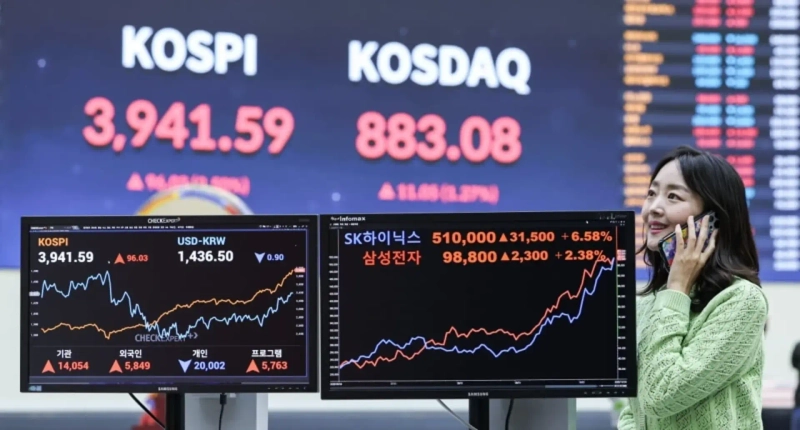
"Buy when it falls (Buy the Dip)."
A representative investment adage commonly used in the U.S. stock market appeared in an official document from the Ministry of Economy and Finance. It is unusual for such an expression to appear in a typically bureaucratic government report. Some have said it reads like a securities analyst report.
In an "economic trend briefing" distributed on the 28th, the Ministry of Economy and Finance said, "Although the KOSPI has surpassed the 4,000 level, it is still undervalued," and mentioned a 'buy the dip' strategy. It is unusual for the government to publicly express optimism about the stock market.
On the same day, the Bank of Korea announced that real GDP growth for the third quarter of this year recorded 1.2%. This is the highest in a year and a half since the first quarter of last year (1.2%). It also slightly exceeded the Bank of Korea's prior estimate (1.1%).
The Ministry attributed this 'surprise growth' to the effects of the supplementary budget and consumption coupons as stimulus measures, and to the recent stock market rise. Kim Jae-hoon, Director-General for Economic Policy at the Ministry of Economy and Finance, explained, "Stock market revitalization stimulates private consumption through the wealth effect," adding, "If the stock market becomes lively, fund subscriptions increase and production in the financial and service sectors expands."
The wealth effect refers to the phenomenon where rising asset prices revive consumption and investment sentiment, leading people to open their wallets. As asset values rise, borrowing capacity also increases, which boosts spending. According to the Bank of Korea, if the KOSPI rises by 1%, private consumption during that period increases by 0.06%.
The government judged that the KOSPI still has significant room to rise. According to Bloomberg calculations, as of the 27th, Korea's price-to-book ratio (PBR) was 1.32 times, lower than the United States (5.55), India (3.64), Taiwan (3.1), Japan (2.57), the United Kingdom (2.25), and China (1.6). The Ministry cited analyses from major foreign investment banks such as JP Morgan and Morgan Stanley, saying, "The Korean stock market still has high valuation appeal," and emphasized the need to respond with a 'buy the dip' strategy.
Even considering the foreign ownership ratio, there is room for further increases. As of the 27th, the foreign ownership ratio was 34.9%, below the previous peak of 36.1% in August 2024. Kim Jae-hoon said, "Although the exchange rate has exceeded 1,400 won, a recovery in the real economy centered on semiconductors and policies to revitalize the capital market are working in combination," and predicted, "The inflow of foreign capital will continue."
He added, "I expect market funds to flow from real estate into productive sectors including the capital market, enabling the KOSPI to reach 5,000."
Reporter Kim Ik-hwan lovepen@hankyung.com

Korea Economic Daily
hankyung@bloomingbit.ioThe Korea Economic Daily Global is a digital media where latest news on Korean companies, industries, and financial markets.