

Korea–U.S. tariff talks 'fateful day'… U.S.–Japan 'golden age of the alliance'
Summary
- President Trump described the U.S.-Japan trade agreement, which includes Japan's US$550 billion investment in the United States, as "a very fair agreement."
- The U.S. and Japan signed a document on the supply of critical minerals and rare earths, signaling a strengthening of the rare earths alliance.
- It was noted that Japan's infrastructure investments, such as power projects and energy development, are likely to focus on low-risk areas.
Trump·Takaichi first meeting
Trump "The trade agreement is very fair"
Takaichi "The greatest alliance"
Strengthening cooperation on defense, rare earths, etc.
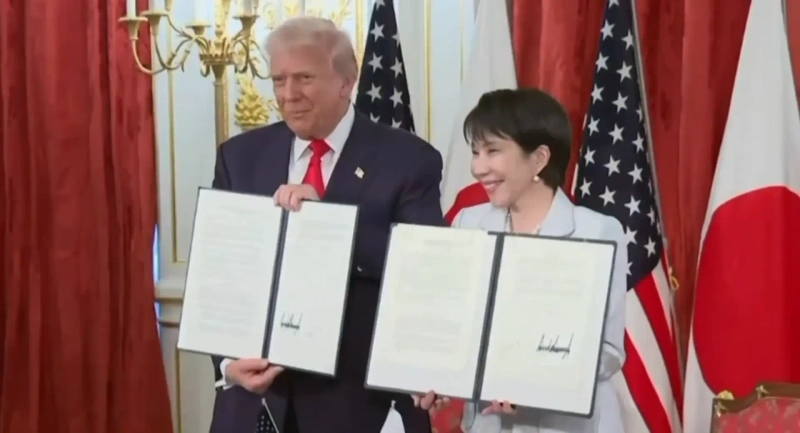
U.S. President Donald Trump and Japanese Prime Minister Sanae Takaichi held their first summit in Tokyo on the 28th, showcasing the U.S.-Japan alliance. The summit was seen as bringing the two countries closer together.
President Trump and Prime Minister Takaichi held talks at the Moto-Akasaka State Guest House in Tokyo that day. In his opening remarks, President Trump said, "We (the United States and Japan) are allies at the strongest level," and added, "U.S.-Japan relations will become stronger than ever." Prime Minister Takaichi replied, "Japan and the U.S. will be the greatest alliance in the world," and said, "We will together create a new golden age of the Japan-U.S. alliance to make Japan and the United States stronger and more prosperous."
President Trump described the U.S.-Japan trade agreement, which includes Japan's US$550 billion investment in the United States, as "a very fair agreement." This was interpreted as preemptively blocking possible Japanese requests for revisions to the negotiation terms. In this regard, U.S. Commerce Secretary Howard Lutnick said in an interview with the Nihon Keizai Shimbun the day before that Japan's U.S. investment funds are likely to be directed to low-risk infrastructure such as power projects and energy development.
President Trump also revealed, "We have secured very large new orders for military equipment," disclosing Japan's orders for U.S.-made weapons. He added, "We know that Japan intends to significantly strengthen its defense capabilities." This was seen as partly supporting Prime Minister Takaichi's moves toward 'militarization.' Prime Minister Takaichi conveyed her intention to nominate President Trump for the Nobel Peace Prize, citing reasons such as stabilizing the situation in the Middle East and mediating ceasefire agreements in Thailand and Cambodia.
After the talks, the U.S. and Japan signed a document on the stable supply of critical minerals and rare earths. Amid Chinese pressure through export controls on rare earths, the United States and Japan strengthened their "rare earths alliance." Presidents Trump and Takaichi also signed a document to faithfully implement the items of the U.S.-Japan trade agreement. After the summit, the two leaders rode together on Marine One to the Yokosuka U.S. Naval Base. They boarded the U.S. nuclear-powered aircraft carrier USS George Washington together to demonstrate the U.S.-Japan alliance.
Tokyo=Il-gyu Kim / Washington=Sang-eun Lee, correspondents black0419@hankyung.com

Korea Economic Daily
hankyung@bloomingbit.ioThe Korea Economic Daily Global is a digital media where latest news on Korean companies, industries, and financial markets.