

87-minute tariff negotiations narrow differences… Trump "Will finalize soon"
Summary
- It reported that at the Korea–U.S. summit, there are expectations that tariff negotiations between the two countries will be concluded soon.
- It stated that the main issues are currently a 25% reduction in automobile tariffs and an investment agreement worth $350 billion for the United States.
- It reported that if tariffs are maintained, there are concerns about the chain effects on domestic automakers and downstream industries.
Growing expectations of a settlement
Trump: "Will reach an agreement soon during the tour"
Expresses optimistic outlook amid opaque negotiations
Lee: "Support for U.S. investment and the revival of manufacturing"
Until a deal is reached, cars must pay a 25% tariff
Chain effects extend to parts, steel and other downstream industries
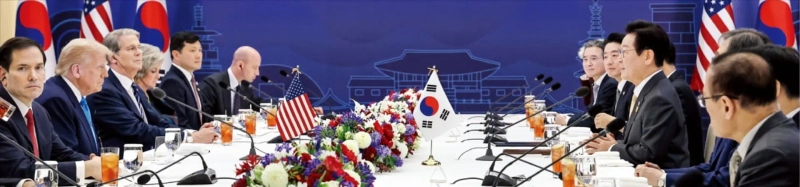
The Korea–U.S. summit held at the Gyeongju National Museum on the 29th has strengthened expectations that tariff talks between the two countries will be concluded soon. Observers say that President Lee Jae-myung and President Donald Trump confirmed a considerable level of mutual trust in the field of 'manufacturing cooperation,' narrowing the gap over the $350 billion investment to the United States. The key is whether the current 25% automobile tariff will be reduced to 15% and whether an investment agreement (MOU) detailing the U.S. investment will be signed.
◇ South Korea–U.S. are manufacturing allies
The two leaders held a summit for 1 hour and 27 minutes and focused on narrowing the differences over U.S.-bound investment that had been hard to close. President Trump said in a special speech at the APEC CEO Summit ahead of the summit, "I think I will 'soon finalize' agreements with Malaysia, Cambodia, Japan and now Korea during this tour."
President Lee said at the summit, "The U.S. stock index has hit an all-time high, and it seems a truly new and great America has been created," and "Korea will also support the revival of American manufacturing through increased investment in the United States and expanded purchasing, and actively pursue shipbuilding cooperation." He emphasized, "Investment to the United States will not only help the South Korean and U.S. economies develop, but will also greatly contribute to deepening the long-standing Korea–U.S. alliance in practical terms."
President Trump responded that he wants to continue cooperating with President Lee, saying, "I hope the clouds between the two countries will clear away one by one."
The negotiations between the two countries were opaque up to the 'final final' stage. Since the last in-person negotiation on the 22nd in Washington DC between Trade Minister Kim Jeong-gwan and U.S. Commerce Secretary Howard Lutnick, trade authorities have engaged in various technical-level talks. This atmosphere continued until the previous evening, and the government was reportedly generally negative about an agreement. The reason was that the gap between the two countries over the $350 billion investment to the United States — the biggest hurdle to concluding the investment agreement — had not been narrowed.
In response to South Korea's concern that "the foreign exchange market could be shocked," the U.S. backed down to a structure of investing $200 billion over eight years, while South Korea reportedly countered, saying, "The cash proportion must be reduced further." Earlier, Japan promised a $550 billion investment to the United States and accepted a condition in which funds would be remitted if the U.S. designated the investment destinations. However, South Korea has rejected the Japanese-style model of providing all cash and entrusting the lead on U.S. investment to the United States.
◇ Trump: "Korea is a friend and ally"
Although the talks did not reach a final agreement that day, the two leaders displayed considerable goodwill, and observers say a positive atmosphere has been created that could lead to a final accord and tariff reductions. President Trump said, "Korea is a valuable friend and ally of the United States," and praised, "The Korean people have created an economic miracle."
However, the question is whether the two countries will reach a final trade agreement that pledges a 25% tariff on automobiles. If the 25% automobile tariff continues, concerns have been raised that the cascading effects impacting domestic vehicle manufacturers as well as parts, materials, steel, electronics and other downstream industries could be amplified.
Separately from this patch-up, there is analysis that the United States may again intensify pressure regarding its own investment. In his special speech, President Trump told businesspeople, "I tell companies that don't want to pay tariffs to build factories in the United States," and reiterated, "If you build in the United States, the tariff is 0%."
Gyeongju — Kim Dae-hoon/Han Jae-young reporters daepun@hankyung.com

Korea Economic Daily
hankyung@bloomingbit.ioThe Korea Economic Daily Global is a digital media where latest news on Korean companies, industries, and financial markets.