

"Will it be concluded within the year"…Corporate uncertainty remains
Summary
- Due to delays in South Korea–U.S. tariff talks, the domestic automotive industry still bears a 25% tariff to the U.S.
- Documentation failed for applying Most-Favored-Nation (MFN) treatment to domestic semiconductors and pharmaceuticals, leaving industry uncertainty unresolved.
- There is concern that the U.S. could impose 100% tariffs on semiconductors and derivatives, and may raise the reciprocal tariff rate back to 25%, potentially affecting related industries.
Tariffs on semiconductors and pharmaceuticals next year 100%
'Most-Favored-Nation' not even documented
U.S. may raise reciprocal tariff to 25%
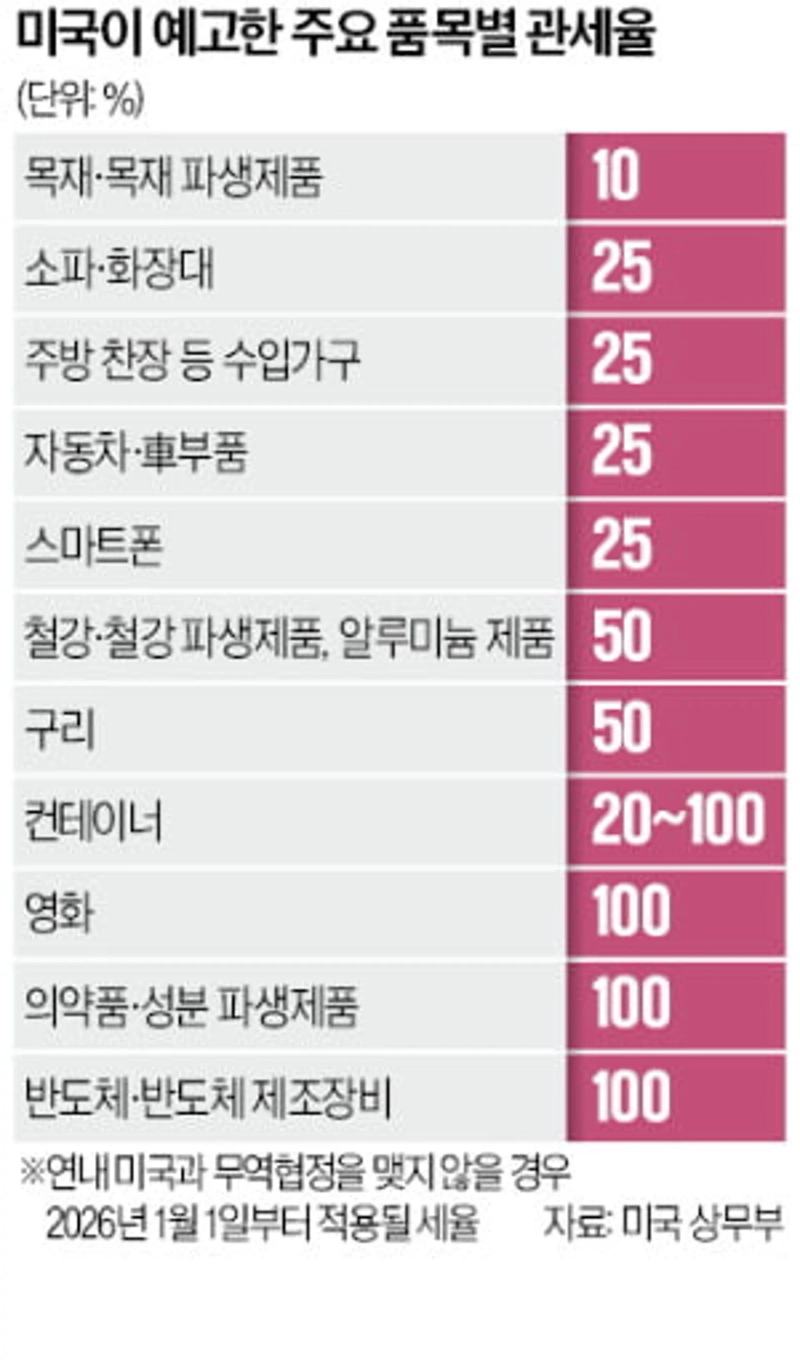
With South Korea and the United States failing to finalize tariff talks on the sidelines of the APEC leaders' meeting, the domestic automotive industry has to bear a 25% tariff to the U.S., higher than Japan and the European Union's 15%. Moreover, there are concerns that the promised application of Most-Favored-Nation (MFN) treatment for key items such as semiconductors and pharmaceuticals, pledged by the U.S. during the first-round agreement in July, could be delayed.
According to the Ministry of Trade, Industry and Energy on the 29th, the U.S. is expected to impose item tariffs of up to 100% on semiconductors and pharmaceuticals. In the first-round agreement in July, South Korea agreed to lower reciprocal tariffs from 25% to 15% and received a verbal promise of MFN treatment. MFN means a pledge not to treat a country less favorably than others. That promise remained verbal and was not documented. By contrast, Japan and the EU codified MFN to remove uncertainty.
The industry expects that even if Korea faces tariffs on semiconductors from the U.S., the immediate damage may not be large. Exports of semiconductors to the U.S. amounted to USD 10.68 billion (about 15 trillion won) last year, accounting for only 7.5% of the total. Given a supplier-dominant market, there is analysis that the tariff impact will be passed on to buyers.
However, the industry has been worried that the U.S. might impose tariffs on derivative products containing semiconductors, based on the value added by semiconductors in such products. If only Korean semiconductor-derived products face a 100% tariff, front-end industries such as mobile phones and displays would inevitably be affected.
The situation is no different for pharmaceuticals. Product groups where price competitiveness is important, such as generics and biosimilars, could see Korean companies' low-price strategies shaken if high tariffs are applied.
In the worst case, there are concerns that the U.S. could raise the reciprocal tariff rate on South Korea back to 25% to put pressure on Korea. Following the tentative agreement in July, a 15% reciprocal tariff has been imposed on U.S. import items from August 7.
Gyeongju=Reporters Kim Dae-hoon / Ha Ji-eun daepun@hankyung.com

Korea Economic Daily
hankyung@bloomingbit.ioThe Korea Economic Daily Global is a digital media where latest news on Korean companies, industries, and financial markets.