

"Cars·parts tariffs reduced to 15%…Semiconductors negotiated to be not disadvantaged compared to Taiwan"
Summary
- With the Korea-U.S. tariff negotiations concluded, the auto and parts industries reported that tariffs have been reduced from 25% to 15%, expecting an annual cost reduction of about 3 trillion won.
- Korean semiconductor companies will receive export tariffs that are not disadvantageous compared to Taiwan, so tariff burdens are expected to be limited.
- Generics and certain key Korean industries will receive tariff-free treatment.
Korea-U.S. tariff negotiations concluded…may apply as early as November
Hyundai Motor·Kia, Q3 loss of 2.5 trillion won
If a 15% tariff rate like Japan·EU is applied
Annual cost reduction of about 3 trillion won expected
Hyundai Motor: "We will pursue quality innovation and strengthen fundamentals"
Korean semiconductor firms also breathe a sigh of relief
Samsung·Hynix have small share of exports to the U.S., analysis says tariff impact will not be large
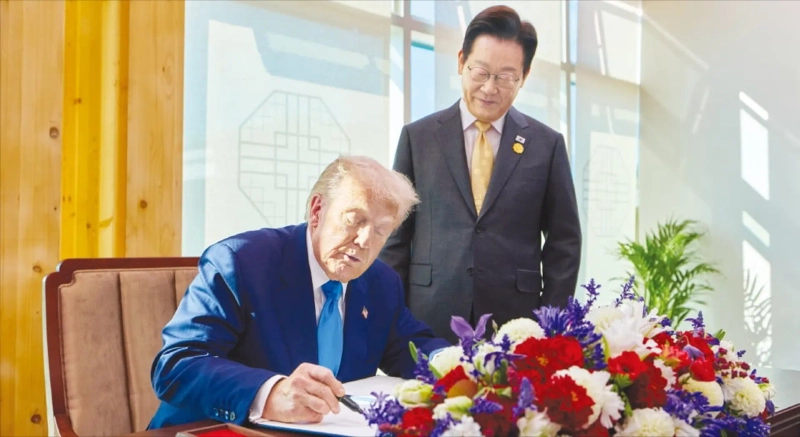
Korea and the U.S. reached agreement on detailed tariff negotiation terms at the Asia-Pacific Economic Cooperation (APEC) summit, giving domestic automakers and the semiconductor industry some relief. Hyundai Motor and Kia, which have been paying a 25% tariff higher than Japan and the European Union's 15%, are analyzed to be able to save about 3 trillion won annually under this agreement. Semiconductors will be treated so as not to be disadvantaged compared to Taiwan, the major competitor, and generics and other new Korean growth industries will receive tariff-free treatment.
◇Cars "Save 3 trillion won annually"
The auto industry is the biggest beneficiary of the dramatic Korea-U.S. tariff agreement. Hyundai Motor and Kia's tariff loss in the last quarter amounted to 1.6142 trillion won. This amount is estimated to rise to 2.4 trillion won in the current quarter. Until July, they managed by selling inventory accumulated before the tariff was imposed, but from August they bore the full 25% tariff. NICE Credit Rating estimated that bearing a 25% tariff for a full year would result in annual losses of 8.4 trillion won. That figure far exceeds Toyota (6.2 trillion won) and Volkswagen (4.6 trillion won), which pay only a 15% tariff. If a 15% tariff rate is applied, this cost would be 5.3 trillion won, a reduction of 3.1 trillion won. It would not be greatly disadvantaged compared with Toyota or Volkswagen.
The reduced tariff rate is likely to apply from the 1st of next month or December 1st. The effective date will be backdated to the 1st day of the month in which a special law for U.S.-bound investments is submitted to the Korean National Assembly. Kim Yong-beom, director of policy at the Presidential Office, said, "As soon as the Korean and U.S. industry ministers sign the tariff negotiation terms and finish briefing the National Assembly, legislative work will proceed."
Hyundai Motor Group issued a statement saying, "We thank the government for its dedicated efforts in reaching this difficult agreement," and explained, "While pursuing various measures to minimize the impact of current tariffs, we will further strengthen our fundamentals through technological innovation."
The auto parts industry also breathed easier. Last year U.S. auto parts exports amounted to $8.222 billion (about 11.7 trillion won), so at a 25% tariff the annual tariff cost for parts makers would reach $2.0555 billion (about 2.9 trillion won). If tariffs are reduced to 15%, that amount would fall to $1.23333 billion (about 1.75 trillion won). Tire makers such as Hankook Tire, Kumho Tire, and Nexen Tire, which shouldered tariff costs in the 100 billion won range in Q3, will see a reduced tariff burden.
◇Semiconductors to be treated similarly to Taiwan
Korean semiconductor companies will receive export tariffs that are not disadvantageous compared to Taiwan, their main competitor. Taiwan, which has not concluded tariff talks with the U.S., currently pays a 20% tariff on all items, but semiconductors are classified separately and excluded from tariffs. The industry believes the possibility of high tariffs on semiconductors is low given semiconductors are Taiwan's main export item.
Analysts also say the impact will not be large because Samsung Electronics and SK Hynix do not directly export a large proportion of semiconductors to the U.S. The chips produced by the two companies are first exported to smartphone and PC assembly firms in China, Taiwan, Vietnam, etc., and then sent to the U.S. For example, SK Hynix's high-bandwidth memory (HBM) is assembled into AI accelerators at Taiwan's TSMC factories and then exported to the U.S. In that case, the party required to pay tariffs would be TSMC, not SK Hynix. However, there remains the possibility of indirect pressure, such as the U.S. demanding higher local production shares. The Trump administration has increased pressure on Taiwan, saying it will bring 50% of Taiwan's semiconductor production capacity to the U.S.
Pharmaceuticals and timber will receive most-favored-nation treatment. In addition, generics (generic drugs), aircraft parts, and natural resources not produced in the U.S. will receive tariff-free treatment.
Gyeongju = Kim Wooseop / Yang Gil-seong / Park Eui-myung / Ha Ji-eun reporters duter@hankyung.com

Korea Economic Daily
hankyung@bloomingbit.ioThe Korea Economic Daily Global is a digital media where latest news on Korean companies, industries, and financial markets.