

PiCK
Won–dollar exchange rate plunges after sudden Korea–U.S. tariff deal…falls below 1,420 won
Summary
- Korea–U.S. tariff deal concluded news sent the won–dollar exchange rate plunging below 1,420 won in after-hours trading on the 29th.
- The two countries announced that of the $350 billion U.S.-bound investment fund, $200 billion will be invested in cash with an annual cap of $20 billion.
- Details such as tariff reductions on Korean-made automobiles and the large investment fund could have additional effects on the exchange rate.
Korea–U.S. tariff talks concluded…agreed on details of trade negotiations
$200 billion in cash, the remaining $150 billion to be投入 into 'Masuga'
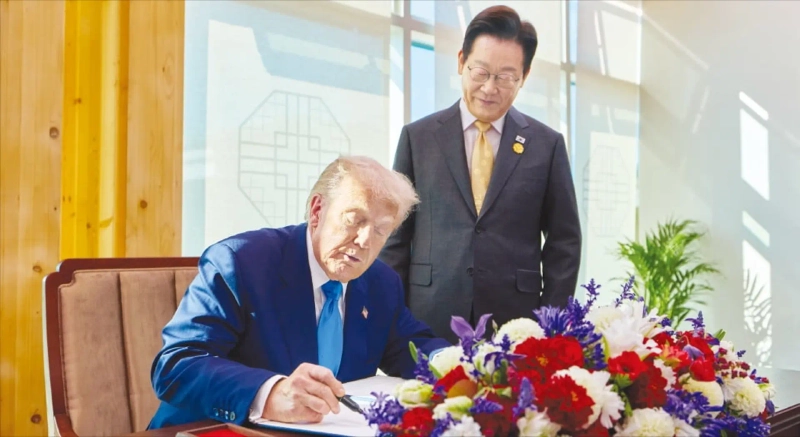
The won–dollar exchange rate plunged in after-hours trading on the 29th as news of the Korea–U.S. tariff deal emerged. At the Asia-Pacific Economic Cooperation (APEC) leaders' meeting, the two countries agreed on the details of the tariff negotiations, deciding to invest $350 billion to the U.S. market, with $200 billion invested in cash and an annual cap of $20 billion.
As of 9:35 p.m. that day, the won–dollar exchange rate in after-hours trading was 1422 won 60 jeon, down 10 won 10 jeon from the previous closing price.
Earlier in daytime trading, the won–dollar exchange rate had shown weakness as markets watched the outcome of the Korea–U.S. tariff talks. The market opened down 5 won 40 jeon at 1432 won 30 jeon, traded sideways in the low 1430 won range, and closed the session down 6 won at 1431 won 70 jeon.
In after-hours trading when news of the Korea–U.S. tariff results broke, the rate fell further. In the foreign exchange after-hours market, the won–dollar rate briefly dropped to 1419 won 60 jeon. This was the first time the won–dollar rate fell below 1,420 won since the 21st.
President Lee Jae-myung and U.S. President Donald Trump met in Gyeongju, North Gyeongsang Province, and agreed on the tariff negotiation details that had been deadlocked since a provisional agreement at the end of July. They finalized details of tariff reductions on Korean-made automobiles (25%→15%) and the composition method of the $350 billion U.S.-bound investment fund. The two leaders also discussed security issues, including an increase in South Korea's defense spending and the acquisition of nuclear-powered submarines, and agreed to hold follow-up consultations.
On the core issue of the $350 billion U.S. fund, $200 billion will be direct cash investments, and the remaining $150 billion will be投入 into the 'Masuga (to make U.S. shipbuilding great again)' project. The $200 billion in direct equity investments will be made in tranches so that the annual cap does not exceed $20 billion. Kim Yong-beom, policy chief at the presidential office, said, "If instability in the foreign exchange market is a concern, we have prepared separate grounds to request adjustments to the payment timing and amounts," and added, "The memorandum of understanding (MOU) wording is almost finalized."
Oh Jung-min, Hankyung.com reporter blooming@hankyung.com

Korea Economic Daily
hankyung@bloomingbit.ioThe Korea Economic Daily Global is a digital media where latest news on Korean companies, industries, and financial markets.