

Powell's Unexpected 'Hawkish' Remarks…"A December Cut Is Not a Done Deal" [FedWatch]
Summary
- Jerome Powell's hawkish remarks weakened expectations for a December rate cut and led markets to start placing more weight on a hold.
- Powell announced the end of quantitative tightening and plans to shift holdings into short-term Treasury bills to accelerate liquidity withdrawal.
- On the AI investment boom, Powell said the current situation differs from the dot-com bubble and emphasized actual corporate profits and business models.
FOMC cuts rates on the 29th (local time)
U.S. benchmark rate to 3.75~4.0% annually
Powell's hawkish remarks dampen the stock market
Wall Street starts betting on a December hold
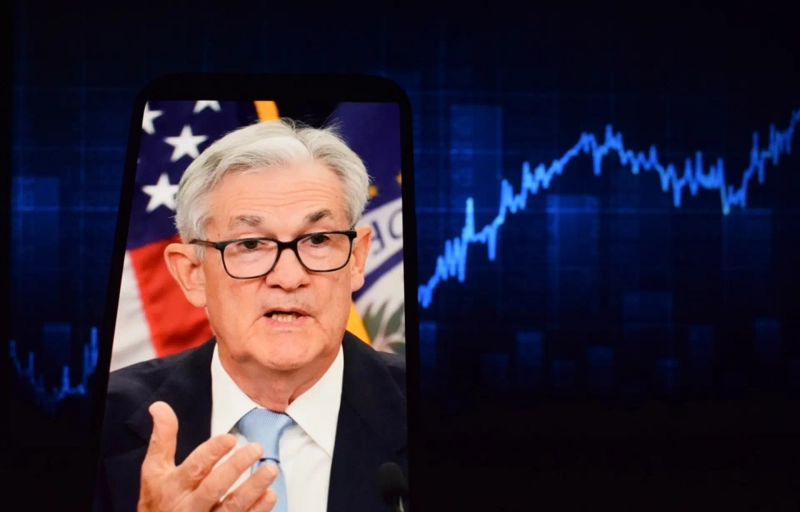
The U.S. central bank (Fed) on the 29th (local time) at the Federal Open Market Committee (FOMC) cut rates by 0.25% point, but the market reaction was lukewarm. Market participants had expected an additional rate cut at the next December FOMC, but Fed Chair Jerome Powell made it clear that "a December rate cut is not a done deal." Powell's unexpectedly hawkish remarks prompted the market to rapidly start betting on a hold in December. According to FedWatch, the probability of a December hold, which stood at 9.1% the day before, rose to over 70% as of 3:00 p.m. Korea time on the 30th.
No decision made on the December meeting
In its statement the FOMC said it "decided to lower the target range for the federal funds rate to 3.75~4.0% by 0.25% point." It explained this was due to "increased downside risks to employment over recent months."
Chair Powell also said at the press conference that "the labor market is clearly cooling, and downside risks to employment have increased in recent months." He noted in particular that "since early this year, the pace of job gains has noticeably slowed," adding that "much of this slowdown appears to reflect weaker labor supply due to low immigration and lower labor force participation, but labor demand has also clearly weakened."
Normally, when Chair Powell expresses this level of concern about the risk of an economic slowdown, markets tend to expect additional rate cuts and respond positively, but this time was different. Powell drew a line under expectations of a December rate cut.
Powell said, "An additional policy rate cut at the December (FOMC) meeting is not a given," and added, "It is important to recognize that point clearly." He also said, "The key is that no decision has been made yet for December."
Possibility of a rate increase emerges
Powell's unexpectedly hawkish remarks poured cold water on a market that had been expecting further rate cuts this year. The Dow Jones Industrial Average and the S&P 500 opened sharply higher on optimism about the artificial intelligence (AI) boom, but Powell's remarks were interpreted as hawkish and erased the gains.
According to the Chicago Mercantile Exchange (CME) FedWatch, as of 3:00 p.m. on the 30th, the futures market priced the probability of a rate hold at the December FOMC at 70.4% and even the probability of a rate increase at 29.6%.
U.S. Treasury yields also reacted immediately. The U.S. 10-year Treasury yield rose to 4.08% near the close of the New York market, up 9bp (1bp = 0.01% point) from the previous session, moving into the 4% range. The U.S. 2-year Treasury yield, which is sensitive to Fed policy, jumped 10bp to 3.60% at the same time.
Powell also said, "We have cumulatively cut rates by 150bp over the past year, and current rates are broadly within the range of estimates of neutral rates," adding, "So there has been growing talk of 'taking a pause.'"
Quantitative tightening to end in December
Powell announced that "the net run-off of securities held will end effective December 1." This was interpreted as a measure to respond to the economic slowdown and increased employment risks.
He explained, "We will not reinvest principal payments from agency securities; instead, we will invest those proceeds in short-term Treasury bills to shorten the portfolio's average maturity and, over time, shift the balance sheet toward Treasury securities."
This remark means that when agency bonds such as mortgage-backed securities (MBS) held by the Fed mature, the Fed will not use the proceeds to repurchase the same assets but will absorb liquidity. In other words, by allowing assets to mature without replacement, the Fed plans to gradually shrink its balance sheet (asset size) and slowly reduce market liquidity. In particular, Powell's statement about shifting into short-term Treasuries was interpreted as an intention to shorten the average maturity of holdings to recover liquidity more quickly and to reconfigure the asset composition toward a simpler, safer, Treasury-centric structure.
Meanwhile, Powell said that the recent AI investment boom is different from the dot-com bubble. He argued that many of today's highly valued companies have real profits and business models. He said, "Investment in AI-related areas such as data centers and equipment is indeed a major pillar of growth, but consumption accounts for a much larger share," and added, "U.S. consumption is continuing particularly among higher-income households."
New York=Shin-Young Park, correspondent nyusos@hankyung.com

Korea Economic Daily
hankyung@bloomingbit.ioThe Korea Economic Daily Global is a digital media where latest news on Korean companies, industries, and financial markets.