

Securities firms' research heads: "KOSPI 5000 possible next year… market stimulus measures must be consistent"
Summary
- Experts said they expect the KOSPI index could exceed the 5,000 level next year.
- They said that continuous government support such as market-friendly policies and tax benefits is necessary for the uptrend to continue.
- They said that if policies like the 150 trillion won National Growth Fund succeed, a positive trickle-down effect on the stock market can be expected.
Korea Exchange Research Center Heads Meeting
"There is room for an additional 20% increase in market cap"
"Policy support such as tax reform must continue"
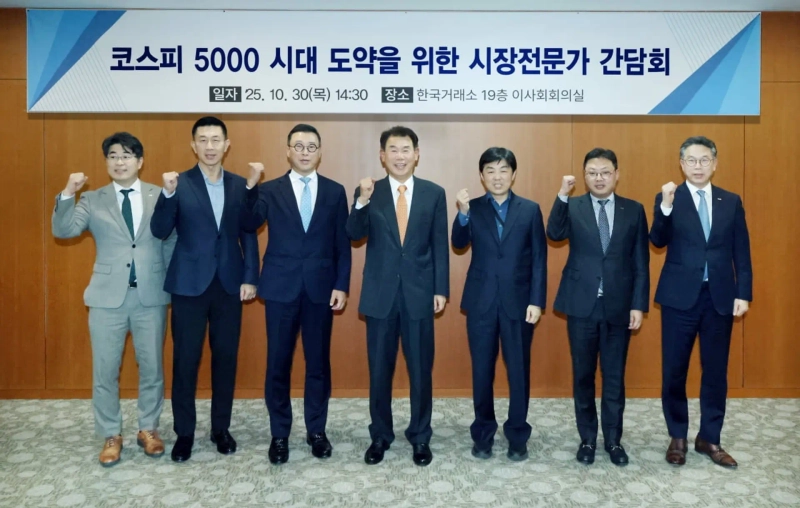
As the KOSPI index keeps breaking record highs day after day, experts said that for the rally to continue the government's market-friendly policies must consistently support it. If favorable market conditions persist, the KOSPI could exceed the 5,000 level next year.
The heads of research centers from major securities firms who attended the 'Market Experts Roundtable for Launching the KOSPI 5000 Era' hosted by the Korea Exchange on the 30th at its Yeouido, Seoul office voiced these views.
The roundtable was attended by Korea Exchange Chairman Jeong Eun-bo, as well as Park Hee-chan, Research Center Head at Mirae Asset Securities, Lee Jong-hyung, Research Center Head at Kiwoom Securities, Lee Byung-geon, Research Center Head at DB Financial Investment, Ko Tae-bong, Head of Research at iM Securities, Choi Kwang-hyuk, Research Center Head at LS Securities, and Kim Jin-guk, Chief Economist at Citibank Korea.
Park Hee-chan, head of the research center, said at the roundtable, "Global credit expansion is at its highest level, and with U.S. rate cuts unfolding, global liquidity conditions are favorable," adding, "Internally, the upward revision trend in some sectors centered on semiconductors is positive, and the government's policy determination continues, so the market's downside is being strengthened."
However, they diagnosed that for the KOSPI's upward trend to continue, the government's market-friendly policies need to translate into tangible benefits. Park said, "We should move in a direction that strengthens shareholder returns through efficient reallocation of capital, such as lowering dividend income taxes," and added, "There need to be tax benefits to encourage liquidity flow into the stock market so that long-term investment can take place."
He also added, "There is also a need to reestablish mid- to long-term industrial policies to improve companies' growth potential and global competitiveness."
Lee Byung-geon also said, "A comprehensive approach to dividend-related taxation is necessary," explaining, "Many investors use exchange-traded funds heavily, and a significant portion goes to dividend income, so capital gains are not being fully enjoyed."
Kim Jin-uk, the chief economist, said, "Foreign investors are very interested in whether measures such as mandatory treasury stock cancellation and separate taxation of dividend income will be handled in a pro-market direction in the November National Assembly," and emphasized, "Whether these two issues are handled well in next month's National Assembly and whether governance improvements are realized in the mid to long term will strengthen foreign investors' confidence."
It was also anticipated that the government's 150 trillion won National Growth Fund would serve as a primer for stock market gains. Ko Tae-bong said, "To get the KOSPI to 5000, we need to connect one more pipeline," adding, "That is the 150 trillion won National Growth Fund of the AI three-major-power project, and if it succeeds there will be a trickle-down effect."
He continued, "In the U.S., the stock market trended upward while layering on technologies that beat inflation in the 1990s," and emphasized, "Korea also needs corporate restructuring, and I believe the most important factor for achieving a KOSPI of 5000 is using the National Growth Fund to help healthy companies grow."
Participants generally viewed the KOSPI's upside next year around the 4,500 level, though they said it could rise higher in some cases.
Lee Jong-hyung said, "I had previously given a relatively high KOSPI projection and it was reached faster than expected," adding, "Assuming three conditions are met, I see the (next year's upside) at 4500."
The specific conditions cited were: △maintenance of U.S. market liquidity and strong AI investment momentum △continued profit growth at Samsung Electronics and SK Hynix △the government's steady market support efforts.
Choi Kwang-hyuk said, "As KOSPI earnings estimates rise quickly, I have revised the outlook for the first half of next year to 4400–4600," adding, "However, if U.S. growth temporarily declines next year, there is a possibility the U.S. could address exchange rate issues."
Park Hee-chan said, "I think there could be more than a 20% increase in market capitalization compared to now," and Lee Byung-geon also judged, "The KOSPI has already come to the top end of the band (forecast range), and there is room for about another 20% increase from here."
Ko Tae-bong said, "If the trickle-down effects of the National Growth Fund are used to create growth and if all citizens trust that wealth can rise through the stock market, 5000 would be possible."
Reporter Ko Jung-sam, Hankyung.com jsk@hankyung.com

Korea Economic Daily
hankyung@bloomingbit.ioThe Korea Economic Daily Global is a digital media where latest news on Korean companies, industries, and financial markets.