

Summary
- It reported that the United States and China agreed to a 'trade truce', temporarily resolving issues of tariffs and rare earth supplies.
- It reported that the United States lowered tariffs on Chinese products by 10 percentage points, and China said it would suspend export controls on rare earths for one year.
- Despite the agreement, it said that sparks of the trade war remain, and there is a continued possibility of resumption of rare earth controls and tariff increases in the future.
Trump–Xi 100-minute meeting
Face-to-face in Busan for the first time in 6 years and 4 months
US reduces tariff rate on China by 10%P
China to supply rare earths and import soybeans
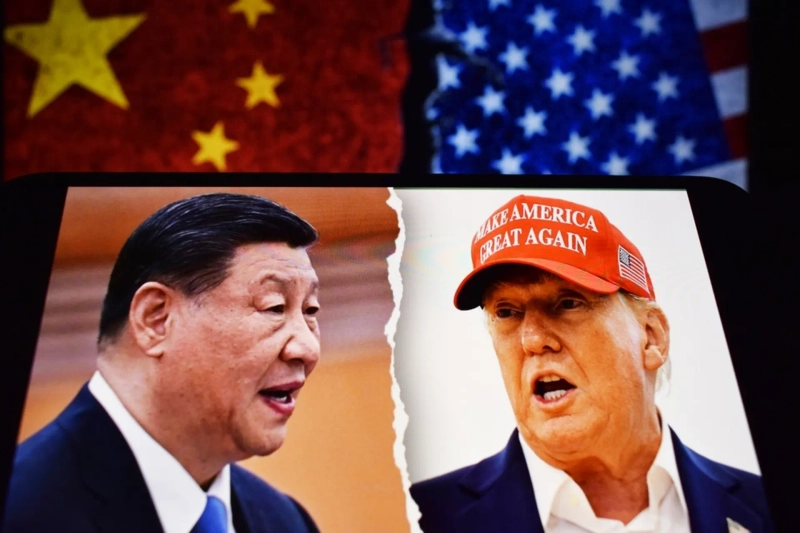
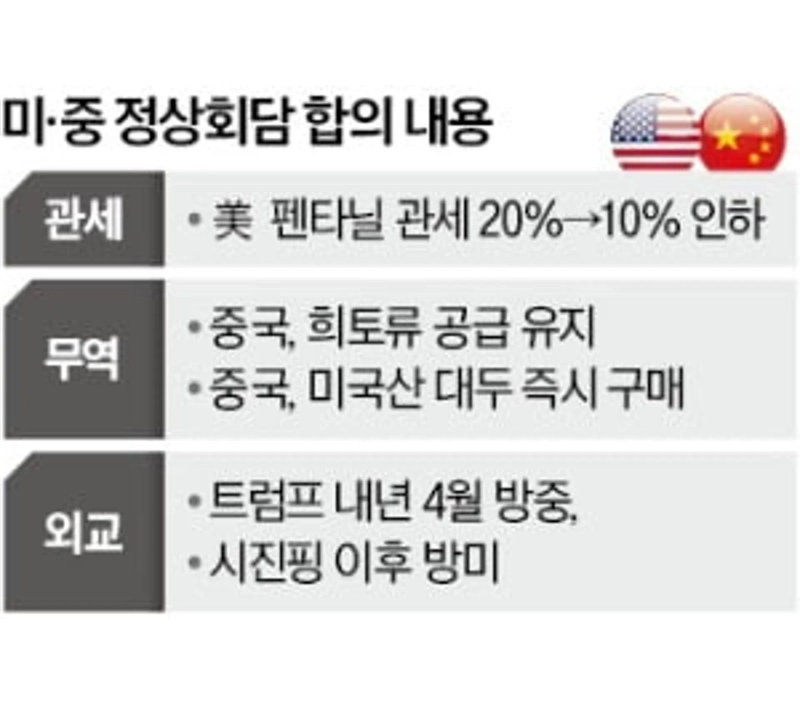
After Donald Trump returned to the presidency, the US-China trade war that had continued for about nine months has paused for now. President Trump and Chinese President Xi Jinping met for 100 minutes on the 30th at Busan Gimhae Air Base. The two leaders agreed that China would suspend its export controls on rare earths in exchange for the United States lowering the 'fentanyl tariff'—imposed on the grounds of China's responsibility for the distribution of fentanyl (a synthetic drug)—from 20% to 10%.
President Trump said on his plane returning to the United States after the summit with Chairman Xi, "All issues regarding rare earths have been resolved." Jamieson Greer, representative of the United States Trade Representative (USTR), explained, "We focused on China's export controls on rare earths and China agreed to continue supplying rare earths."
President Trump also said, "China has agreed to immediately buy a huge amount of (U.S.) soybeans and various agricultural products." He added, "I judged that China is taking strong measures on the fentanyl issue," and announced that the fentanyl tariff would be immediately reduced by 10% points. As a result, the tariffs the United States levies on Chinese imports will be reduced from 55% to 45% (fentanyl tariff 10% + base tariff 10% + tariffs before Trump's return to power 25%).
President Trump also said, "I will visit China in April next year to meet Chairman Xi." He said that afterward Chairman Xi would visit Palm Beach, Florida, where President Trump has his residence, or Washington DC. President Trump said, "We agreed on almost everything." Chairman Xi said, "(The U.S. and China) must not fall into a vicious cycle of mutual retaliation."
The meeting between President Trump and Chairman Xi was the first face-to-face encounter in 6 years and 4 months since the G20 summit in Osaka, Japan in June 2019. The two leaders are assessed to have for the time being sealed the tariff war at this Busan meeting.
Praised as '12 out of 10'... but the 'one-year truce' failed to remove the trigger
The world watched the '100-minute negotiation'... US-China conflict for now sealed
"It was a 12 out of 10 meeting." (Donald Trump, President of the United States)
"China's development will go along with the 'MAAG (Make America Great Again)' vision." (Xi Jinping, President of China)
President Trump and Chairman Xi met on the 30th and for now sealed the trade war that had continued for nine months. However, there are concerns that the embers of conflict still remain.
"Dialogue is better than confrontation"
The meeting atmosphere was reported to be warm. President Trump arrived at the meeting hall before Chairman Xi. After the meeting, he praised Chairman Xi to reporters as a "great leader" and "a friend for a very long time." In his remarks, Chairman Xi gave a bit of lip service by praising MAGA.
At the US-China summit that day, China agreed to suspend export controls on rare earths and the United States agreed to lower tariffs on Chinese products by 10% points. With both sides agreeing to a 'trade truce,' many assess that global economic risk has been significantly eased.
China also hinted at the possibility of partially easing semiconductor export controls that it had regarded as sensitive. However, President Trump said that Nvidia's latest AI chip, Blackwell, is "not (a subject of easing)."
By showing several cards to pressure the United States—such as resuming rare earth export controls and halting purchases of U.S. soybeans—China signaled through this meeting that it wanted to appease the United States and return to a friendly relationship. According to Xinhua News Agency, Chairman Xi stated during the talks that China's economic growth would create wider space for cooperation with the United States.
Chairman Xi said, "We have never sought to challenge anyone or replace their position." The remark sounded like an acknowledgment of U.S. primacy.
Both sides reluctant to prolong the trade war
Before the summit, the two countries repeatedly traded threats and de-escalations. However, neither side could afford to prolong this war. The United States found it difficult to withstand rare earth controls. When China stopped importing soybeans, U.S. soybeans began to rot in storage, increasing dissatisfaction among President Trump's base. Above all, each time US-China tensions escalated, the stock market plunged, which was not the outcome the Trump administration wanted.
China also did not want a prolonged trade war. With a slowdown in the real estate market and weak domestic demand, achieving an annual growth rate of around 5% this year became uncertain. Especially with Chairman Xi preparing for a fourth term, there was a need to ease trade tensions with the United States and secure stable exports and foreign exchange to maintain growth.
China may resume rare earths attack
The New York Times analyzed the talks as, "A one-year suspension of export controls provides much more breathing room compared to the prior practice of 90-day suspensions." However, that does not mean the embers have completely died out. President Trump told reporters, "There are no obstacles regarding rare earths," adding, "The one-year suspension will be extended after a year as we have done, and I think it will be extended routinely."
Nevertheless, because China has not abandoned controls over strategic materials such as rare earths, conflict could reignite at any time. Although the United States lowered tariffs on China by 10% points, it still imposes tariffs of 45% or more on Chinese products (fentanyl tariff 10% + base tariff 10% + pre-Trump return average tariff 25%). Currently, the United States imposes a 10% base tariff on China, but if the trade war is not fully resolved, this tariff could be raised to 34%.
Washington = Sang-eun Lee / Beijing = Eun-jung Kim correspondents selee@hankyung.com

Korea Economic Daily
hankyung@bloomingbit.ioThe Korea Economic Daily Global is a digital media where latest news on Korean companies, industries, and financial markets.