

The day after the agreement… Rutnick "Semiconductor tariffs not included"
Summary
- U.S. Secretary of Commerce Howard Rutnick reportedly said that semiconductor tariffs were not included in the Korea-U.S. tariff negotiations, which has caused controversy.
- The presidential office said it will soon publish an official document stating the agreement to 'not be treated less favorably than Taiwan.'
- Industry is on alert over whether the U.S. will impose semiconductor tariffs and warned that if high tariffs are levied on Taiwan, costs could be passed on to the domestic semiconductor industry.
U.S. appears to have considered tariff talks with Taiwan
The presidential office dismisses 'reports of disagreement'
"Not treated less favorably than Taiwan
Announced based on the agreement"
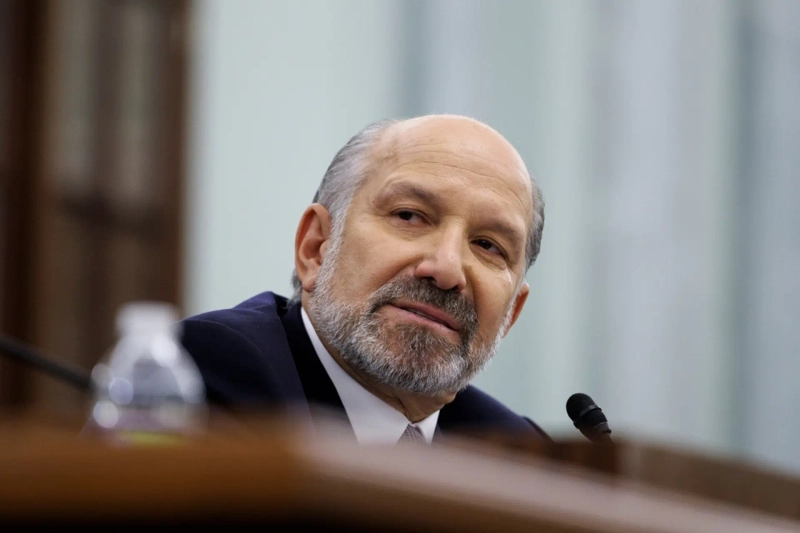
U.S. Secretary of Commerce Howard Rutnick posted a message suggesting that "semiconductor tariffs were not agreed upon," related to the Korea-U.S. tariff negotiations finalized on the 29th, sparking controversy.
In a post on X on the 29th (local time) explaining the Korea-U.S. tariff negotiation agreement, Rutnick said "semiconductor tariffs are not part of this agreement." The U.S. government is pushing for the imposition of 100% item tariffs on semiconductors. The day before, Kim Yong-beom, the presidential office policy chief, disclosed the agreement, saying "Semiconductor tariffs will be applied at a level that is not less favorable compared to Taiwan."
Rutnick's remarks could be interpreted as an intention by the U.S. government to renegotiate with Korea when deciding on item tariffs for semiconductors. As the controversy spread, Kim Nam-jun, the presidential office spokesman, explained on the 30th that "the announced content is based on mutual agreement and the related documentation work is in its final stages." He said the joint fact sheet to be released soon after the bilateral summit will include wording that semiconductors "will not be treated less favorably than Taiwan."
Japan and the European Union (EU) secured most-favored-nation treatment (not treated less favorably than other countries) on semiconductor tariffs in earlier tariff negotiations with the U.S. Trade experts explain that because Japan and the EU have minimal semiconductor exports to the U.S., the U.S. may have placed little value on granting them most-favored-nation treatment. It is argued that because the U.S. relies on Taiwan and Korea for imports of high-value-added semiconductors, Taiwan and Korea are the targets of semiconductor tariff policy.
Some interpret Rutnick's remarks as taking into account that the U.S. and Taiwan are still negotiating semiconductors. There is also analysis that "not being treated less favorably than Taiwan" is effectively no different from most-favored-nation treatment.
Companies are more alert to whether the U.S. will impose tariffs on semiconductors than to most-favored-nation treatment. High-bandwidth memory (HBM), the main product of Samsung and SK Hynix, is assembled into AI servers at TSMC factories in Taiwan and sold to U.S. big tech companies such as Google and Amazon. A semiconductor industry source said, "Korea's direct semiconductor exports to the U.S. account for only 7% of total exports, so the impact is limited," but added, "If high tariffs are imposed on Taiwan, costs could be passed on to domestic semiconductor companies." Kyung Hee-kwon, a research fellow at the Korea Institute for Industrial Economics & Trade, interpreted it as "the U.S. is trying to bring Taiwan and Korea in line over semiconductors."
Kim Dae-hoon/Park Eui-myeong reporters daepun@hankyung.com

Korea Economic Daily
hankyung@bloomingbit.ioThe Korea Economic Daily Global is a digital media where latest news on Korean companies, industries, and financial markets.