

November 1 South Korea–China summit… 'FTA, North Korea issues' likely to be on the negotiation table
Summary
- The South Korea–China summit is likely to mention accelerating the South Korea–China Free Trade Agreement (FTA) services and investment negotiations.
- The two leaders are expected to focus on establishing a new institutional foundation for economic cooperation and resolving livelihood issues.
- President Lee is expected to emphasize that the introduction of nuclear-powered submarines is for defensive purposes and focus on restoring trust with China.
Attention on Lee–Xi first meeting
Discussion on livelihood issues, Korean Peninsula denuclearization
Lee expected to appeal for support of North Korea 'E·N·D'
May also explain measures against anti-China protests
Will the 'misunderstanding' about nuclear-powered submarines be cleared up?
Government "It's not because of China", explanation
China's Foreign Ministry "Fulfill nuclear non-proliferation obligations"
Lee likely to emphasize defensive purpose for introduction
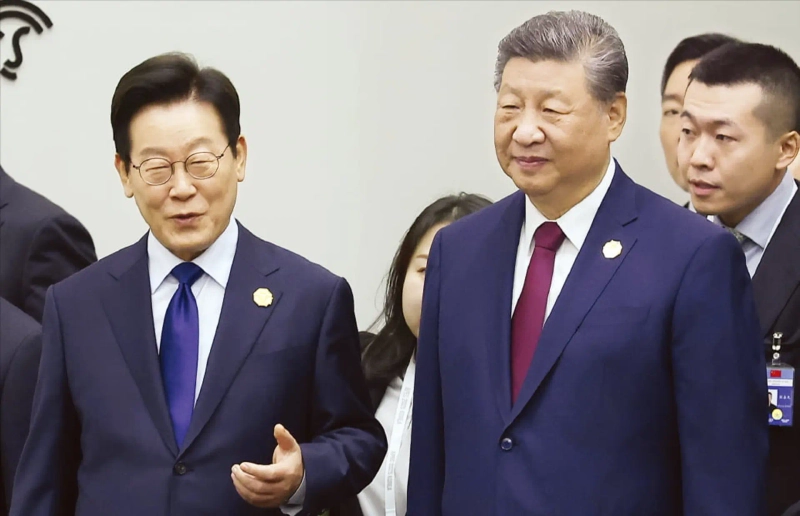
President Lee Jae-myung will hold his first South Korea–China summit with Chinese President Xi Jinping on the 1st. In the first meeting taking place on the sidelines of the Asia-Pacific Economic Cooperation (APEC) leaders' meeting in Gyeongju, North Gyeongsang Province, the two leaders will discuss livelihood issues and denuclearization of the Korean Peninsula. The president is expected to focus on dispelling China's misunderstandings about the introduction of nuclear-powered submarines while proposing the restoration of mutual trust.
Kang Yoo-jung, spokesperson for the Presidential Office, said at a briefing in Gyeongju on the 31st, "Under the motto that livelihood is most important, the two leaders agreed to discuss livelihood issues facing the two countries and peace realization issues such as denuclearization of the Korean Peninsula." The president is expected to appeal for support for a North Korea policy direction such as the 'END (exchange, normalization of relations, denuclearization) initiative.'
It is also of interest whether the topic of introducing nuclear-powered submarines, which the president requested at the South Korea–US summit on the 29th, will come up. Our government has said, "It was not intended with China in mind," but China may perceive that US-led alliances are encircling China in the Indo-Pacific. If related dialogue arises, the president is expected to explain that it is for defensive purposes.
China's Foreign Ministry the previous day stated in principle, "We hope that South Korea and the US will substantially fulfill their nuclear non-proliferation obligations and work to promote regional peace and stability." In response, our Foreign Ministry said the same day, "What we intend to develop and operate are conventionally armed nuclear-propelled submarines," and "this complies with the obligations of the Nuclear Non-Proliferation Treaty (NPT)."
Diplomatic experts analyze that restoring trust between the leaders is essential to narrow the differences between the two countries. To this end, the president is expected to show willingness for relationship improvement, such as explaining measures against anti-China protests in Korea. Attention is also focused on whether the nine-year Hallyu ban imposed by Chinese authorities (restrictions on the Korean Wave) will be lifted through direct talks between the leaders. Since this is the leaders' first meeting, sensitive issues such as illegal structures in the West Sea installed by China may not be raised.
At the summit, remarks calling for acceleration of the Korea–China Free Trade Agreement (FTA) services and investment negotiations, which began in 2017 but have seen no progress, are also expected. In an interview with Xinhua News Agency released on the 30th, the president said, "I hope a new institutional foundation for economic cooperation between the two countries will be established."
Since President Xi, in his APEC plenary speech, called for defending the multilateral trading system, there is a possibility of agreeing to accelerate FTA negotiations. Xi's remarks can be interpreted as criticism of the Trump administration for pursuing protectionism, such as imposing 'tariff bombs,' and retreating from multilateral organizations. His speech was made while former President Donald Trump did not attend the plenary session and had left for the United States. The two countries are expected not to issue a joint document after the summit and to convey the results through separate press releases or briefings.
Gyeongju = Kim Hyung-kyu / Bae Seong-su reporters khk@hankyung.com

Korea Economic Daily
hankyung@bloomingbit.ioThe Korea Economic Daily Global is a digital media where latest news on Korean companies, industries, and financial markets.