
Editor's PiCK
Five Major Banks "Seizing Won-Denominated Coins"… Alliances with Platforms and Exchanges Have Begun
공유하기
- Regulators allowed won-denominated stablecoin issuance to be a bank subsidiary business, accelerating the race among the five major banks to secure market position.
- Success depends on securing partnerships with platforms and virtual asset exchanges, and linkage with major platforms can maximize network effects.
- Securities firms and card companies are also preparing to participate in the won-denominated stablecoin ecosystem.
- The article was summarized using an artificial intelligence-based language model.
- Due to the nature of the technology, key content in the text may be excluded or different from the facts.
Authorities Allow 'Won-Denominated Coin Issuers' to Be Incorporated as Bank Subsidiaries
Banking Sector's Calculations over Won Coins Grow More Complex
Issuers' Equity Can Be Held Directly
Heavy Burden for Single Largest Shareholder Participation
Likely Formation of Multiple-Bank Consortiums
Intense Competition to Secure Platform Users
Hana Bank Reaches Agreements with Naver and Dunamu
KB Kookmin-Bithumb, Shinhan-Korbit Account Partnerships
Woori Expands Collaboration with Samsung Wallet

The domestic financial sector's war over "won-denominated stablecoins" is gearing up for a full-scale opening. This follows the gradual emergence of the contours of the Digital Asset Framework Law, which will set the rules of the game. With large-scale alliances involving platforms, virtual asset exchanges, securities firms, and card companies anticipated around the five major banks — KB Kookmin, Shinhan, Hana, Woori, and NongHyup — competition for position in the financial sector is expected to intensify.
◇ Under-the-surface Competition Comes to the Fore
According to the financial sector on the 6th, regulators appear to be moving toward including won-denominated stablecoin issuance in the list of business types for bank subsidiaries as an exception to the "15% equity regulation under the Bank Act," which has made the banks' calculations even more complex. Won-denominated stablecoins are not a simple new business but an area that requires a comprehensive redesign of payment, platform, and digital asset strategies.
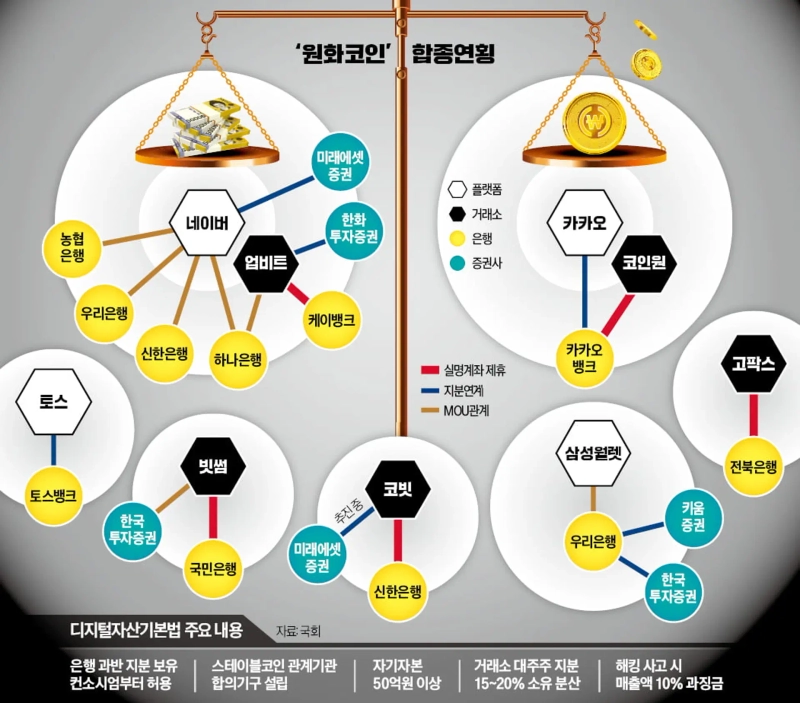
While banks would effectively be able to directly hold equity in issuers, it is expected that the option of establishing a standalone issuer will be ruled out. The success or failure of won-denominated stablecoins depends more on their use cases and distribution networks than on issuance itself. A senior official in the financial sector said, "Initially, whether there is linkage with platforms or exchanges that hold a large number of users is likely to determine the pace of won-denominated stablecoin adoption," adding, "For banks, a consortium structure to spread market risk and maximize network effects is a realistic choice."
◇ Platform Partnerships Are Key
Although banks are expected to take the lead, analysis says the key to success will depend on who secures the platforms. Scenarios of alliances and rivalries based on realistic partnerships are being discussed for each bank.
The biggest point of interest is which bank will join forces with the Naver–Dunamu alliance. Each is number one in the platform and virtual asset exchange markets respectively, making a partnership capable of an overwhelmingly strong start in terms of user base and distribution channels. Hana Bank has intersectional relationships with both Naver and Dunamu. With Naver, it jointly launched a platform-linked demand deposit account. With Dunamu, it recently signed an MOU to jointly develop financial services using blockchain technology. It would be burdensome for Hana Bank to secure a majority stake in a consortium alone, so attention is focused on which bank it will partner with. Naver also has collaborative relationships with Shinhan, Woori, and NongHyup banks.
Kakao and Toss are also regarded as powerful partners in the won-denominated stablecoin competition. Both platforms have internet bank subsidiaries, but direct equity relationships or strategic partnerships with the five major banks are limited. Therefore, once won-denominated stablecoin institutionalization becomes full-fledged, banks are expected to accelerate competitive negotiations with these platforms.
KB Kookmin Bank has been consistently mentioned as a possible collaborator with Bithumb, as they have account partnerships that create points of contact. A combination with Bithumb, which has a large user base, could accelerate coin spread. Shinhan Bank is naturally linked with Korbit, with which it has an account partnership, but alliance scenarios with other banks are also being discussed. Woori Bank's possible collaboration with Samsung Wallet is attracting market attention.
As the country's four major financial groups have all set the preemption of the digital asset ecosystem as a core goal this year, the competition over won-denominated stablecoins is expected to sharpen. Yang Jong-hee, chairman of KB Financial Group, said in his New Year's address, "We must first secure customers and business opportunities in the newly forming digital asset space." Jin Ok-dong, chairman of Shinhan Financial Group, also stated, "We must secure leadership in the digital asset ecosystem." Ham Young-joo, chairman of Hana Financial Group, said, "We must proactively design the complete ecosystem [for won-denominated stablecoins]." Im Jong-ryong, chairman of Woori Financial Group, said, "We will respond proactively to regulatory changes surrounding digital assets."
◇ Securities and Card Companies Also Eyeing Opportunities
Securities firms and card companies are also actively moving. Mirae Asset is targeting the entire digital asset value chain by pursuing both the Naver–Dunamu alliance and the acquisition of Korbit. Korea Investment & Securities recently signed an MOU with Bithumb to strengthen their cooperation.
Hanwha Investment & Securities and Kiwoom Securities are linked by equity relationships with Dunamu and Woori Financial Group, respectively, raising expectations for collaboration. A securities industry official said, "Securities firms have strengths in designing investment products, tokenized securities (STO), and distribution structure design, so they can play an important role in the won-denominated stablecoin ecosystem." Major card companies are also reported to be contacting banks to seek opportunities.
Mi-hyun Cho / Hyung-gyo Seo reporters mwise@hankyung.com