

Editor's PiCK
People Power Party: “Digital assets are a private-sector achievement…don’t hobble them with administrative regulation”
공유하기
Summary
- The People Power Party’s Special Committee on Stock and Digital Asset Value-Up said it has publicly raised concerns to the government over the direction of regulation surrounding the digital asset industry.
- Chair Kim Sang-hoon said the government, citing anti-money laundering (AML) and other reasons, has hesitated to revitalize the market, undermining industrial competitiveness.
- Kim stressed that the '20% cap on major shareholders’ stakes in virtual asset service providers' could weaken investment incentives and industrial competitiveness, and that a review is needed.
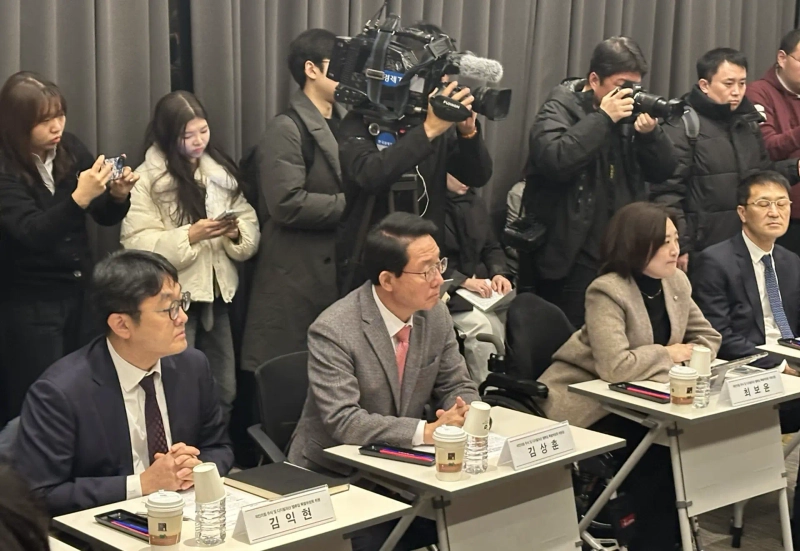
The People Power Party’s “Special Committee on Stock and Digital Asset Value-Up” publicly challenged the government over the direction of regulation surrounding the digital asset industry. The party said that excessively constraining a digital asset market that has grown under private-sector leadership with administrative regulation could undermine the industry’s competitiveness.
The People Power Party’s Special Committee on Stock and Digital Asset Value-Up held a “policy roundtable with the digital asset industry” on the 14th at DreamPlus in Gangnam-gu, Seoul.
In opening remarks at the meeting, committee chair Kim Sang-hoon said, “Since the previous administration, discussions on revitalizing the asset market have continued through consultations between the party and the government,” adding, “But the government has consistently shown a hesitant stance on market revitalization, citing reasons such as anti-money laundering (AML).”
He added, “The digital asset market is, in both name and reality, an industry formed on various achievements built up by the private sector,” but noted that “nevertheless, repeated policy signals that seemed to deny privately accumulated achievements—such as the 2018 controversy over shutting down exchanges and the so-called ‘Park Sang-ki chaos,’ along with remarks that ‘virtual assets have no intrinsic value’—significantly dampened the market.”
He continued, “Over the same period, major countries overseas steadily laid the institutional groundwork to foster the digital asset market as next-generation financial infrastructure,” adding, “As a result, the status of digital assets in the global financial order has risen sharply.”
He also offered strong criticism of the “20% cap on major shareholders’ stakes in virtual asset service providers,” which has recently triggered fierce backlash from the digital asset industry.
Kim said, “I heard news that a government proposal is at the drafting stage that would suddenly limit major shareholders’ stakes in asset exchanges to 20%,” adding, “I understand that representatives from exchanges and the fintech industry will also convey concerns about this.”
He stressed, “We need to seriously reflect on what it means for the Korean market to restrict achievements built by the private sector through administrative regulation,” adding, “A review is needed as to whether forced dispersion of ownership is truly a direction that enhances industrial competitiveness and investment incentives.”

![[Market] Bitcoin tops $96,000 for the first time in two months…short-covering demand grows as inflation steadies](https://media.bloomingbit.io/PROD/news/9d8918a1-728c-412c-9379-d557b0c7f291.webp?w=250)
![Dimon warns political pressure on Fed would push rates higher [Fed Watch]](https://media.bloomingbit.io/PROD/news/temp/temp-5be6b1eb-5cd4-452d-9acf-1e64df19507b.webp?w=250)