
Editor's PiCK
PPP launches head-on criticism of 'virtual-asset exchange ownership cap'…"Don’t hobble us with regulation"
공유하기
Summary
- The People Power Party said the Financial Services Commission’s push to cap controlling shareholders’ equity stakes in digital-asset exchanges could shrink the digital-asset market and weaken industrial competitiveness.
- DAXA and the industry said attempts to artificially change ownership structures could lead to a broader contraction of the domestic digital-asset industry and negatively affect exchange mergers and acquisitions (M&A).
- Criticism was raised that the government proposal allowing stablecoin issuance only for consortia in which banks hold a majority stake blocks private innovation and runs counter to trends in the global stablecoin market.

The People Power Party (PPP) has publicly challenged the Financial Services Commission’s (FSC) push to impose limits on controlling shareholders’ equity stakes in digital-asset exchanges. The party warned that overly constraining a digital-asset market that has grown under private-sector leadership could undermine the industry’s competitiveness.
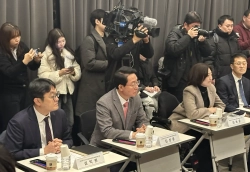
Kim Sang-hoon, a PPP lawmaker who chairs the party’s Special Committee on Stocks and Digital Assets Value-Up, made the remarks on the 14th at a “policy roundtable with the digital-asset industry” hosted by the committee at Dreamplus Gangnam in Seocho-gu, Seoul. “Even though the digital-asset market has grown led by the private sector, the government has consistently shown hesitation about revitalizing the market, citing reasons such as anti-money laundering (AML),” he said.
In opening remarks, Kim noted that “as policy signals such as the 2018 controversy over shutting down exchanges and remarks that ‘virtual assets have no intrinsic value’ were repeated, achievements accumulated by the private sector were dismissed,” adding that “as a result, the market contracted sharply.” He continued, “Over the same period, major countries overseas have viewed digital assets as next-generation financial infrastructure and worked to build institutional foundations,” and added that “as a result, the status of digital assets in the global financial order has changed markedly.”
The biggest issue raised at the roundtable was a potential “cap on controlling shareholders’ stake in digital-asset exchanges,” which is expected to be included in the government draft of the Digital Asset Basic Act led by the FSC. The FSC has maintained that a single controlling shareholder’s ownership stake in a digital-asset exchange should be limited to 15–20%, in line with the level applied to alternative trading systems (ATS) under the Capital Markets Act. The rationale is that, since digital-asset exchanges effectively serve as financial-market infrastructure with a quasi-public-goods character, the structure in which operating profits such as fees are excessively concentrated in a specific individual should be improved.
However, the proposal has sparked strong backlash from the industry. DAXA—the Digital Asset Exchange Alliance, whose members include Dunamu, Bithumb, Coinone, Korbit, and Streami (Gopax)—issued a statement on the 13th, saying, “Attempts to artificially change private companies’ ownership structures could lead to a broader contraction of the digital-asset industry.”
If the regulation is introduced through a legal revision, most major domestic exchanges would find it difficult to avoid restructuring their ownership. It is also expected to directly affect large companies pursuing exchange mergers and acquisitions (M&A). Naver, through its financial affiliate Naver Financial, holds 100% of Dunamu’s shares, meaning a redesign of the structure would be inevitable if the controlling-shareholder cap were applied. Mirae Asset, which is pursuing the acquisition of Korbit, is also likely to face the same issue.
The special committee said the potential market impact of such regulation should be examined more closely. Kim said, “We need to seriously reassess whether restricting privately built achievements through administrative regulation truly moves in the direction of strengthening industrial competitiveness and investment incentives,” adding, “We also need to reexamine whether a forced dispersion of ownership is the solution.”
Concerns were also voiced in the subsequent closed-door discussion. PPP lawmaker Choi Bo-yoon, a member of the special committee, said in a back briefing after the session, “Industry concerns were raised that the cap on controlling shareholders’ stakes in exchanges could amount to reverse discrimination against the domestic market,” and added, “There was also discussion about whether it is appropriate to apply the existing framework used to regulate the stock market as-is to the digital-asset market.” She continued, “We will listen sufficiently to the industry and discuss it carefully at the National Assembly level.”
There was also discussion of a plan to allow stablecoin issuance only by consortia in which banks hold a majority stake (50%+1). The FSC had previously, through coordination with the Bank of Korea, moved toward including the provision in the government draft. However, the government draft has faced criticism—seen as regulation that runs counter to global standards and blocks private innovation—and has encountered difficulties in coordination with the National Assembly.
On this, Choi said, “The global stablecoin market is growing led by non-bank private platforms such as Circle and Tether,” adding, “Industry opinions were raised that, taking this into account, issuance in Korea should also be led by the private sector.” She added, “We will continue to consider, after hearing diverse views, what direction is better.”
Hwang Doo-hyun, BloombergBit reporter cow5361@bloomingbit.io