

Bank of Korea "Digital currency experiments verify payment efficiency…Pilot project to tokenize government subsidies also underway"
Summary
- The Bank of Korea said it conducted a Phase 1 demonstration to verify the payment system efficiency of central bank digital currency (CBDC) with seven commercial banks.
- Phase 2 demonstrations aimed at the tokenization of government subsidies are currently underway, and they said they will secure execution transparency with smart contract and blockchain-based systems.
- The Bank of Korea also said it is participating in the Bank for International Settlements (BIS)-led project 'Agora' to experiment with the international payment efficiency of tokenized deposits and central bank digital currency.
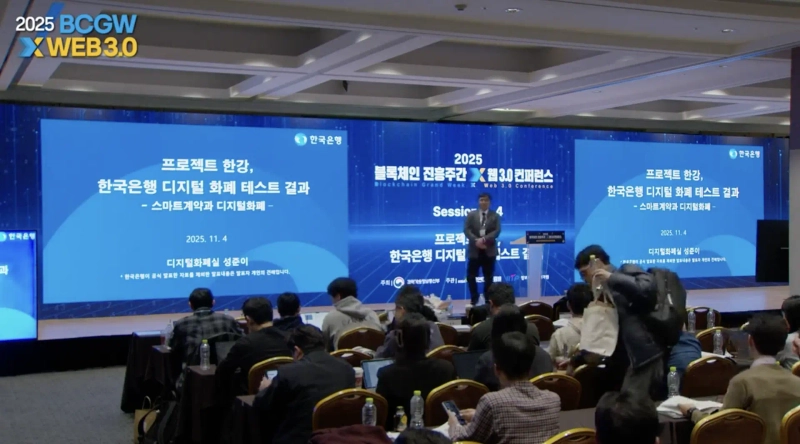
"CBDC (central bank digital currency) has now moved beyond the research stage and entered a phase of verifying the efficiency of actual payment systems. In Phase 1, experiments were conducted focusing on digital currency for inter-institutional payments, and we are currently pursuing Phase 2 demonstrations such as the tokenization of government subsidies."
On the 4th, at the '2025 Blockchain Promotion Week X Web 3.0 Conference' held at COEX in Gangnam, Seoul, Seong Jun-yi, team leader of the Bank of Korea's Digital Currency Office, said this during the session titled 'Project Hangang, Bank of Korea Digital Currency Test Results.'
In his presentation, Team Leader Seong disclosed the Phase 1 results of 'Project Hangang,' a real-transaction test of central bank digital currency led by the Bank of Korea. The test focused on digital currency for settlement between financial institutions, and seven commercial banks participated: Shinhan, Nonghyup, Kookmin, Woori, Hana, Industrial Bank of Korea (IBK), and Busan Bank. The experiment took place for about three months from April to the end of June.
Through this test, the Bank of Korea verified the real-transaction efficiency of CBDC for inter-institutional settlement, and in some scenarios it simulated payment environments using consumer-participation digital vouchers. Three smart contract–based vouchers were issued—Seoul Youth Culture Pass, Busan Silla University–exclusive voucher, and Daegu Education and Culture Voucher—and on- and offline payment experiments were conducted.
Team Leader Seong said, "This demonstration experiment focused on verifying whether deposit tokens can perform the function of reserve balances." He also explained that during the experiment they checked whether interoperability between systems was secured, including transaction processing using smart contracts, inter-account linking, and ledger consistency verification.
The Bank of Korea is currently pursuing Phase 2 of 'Project Hangang.' In cooperation with the Ministry of Economy and Finance, it is conducting a 'pilot project for tokenizing government subsidies' that manages the disbursement process of government subsidies on a blockchain basis. This project aims to manage the public finance disbursement process with smart contracts to prevent fraudulent claims and strengthen the transparency of disbursements. Team Leader Seong explained, "This system is based on a permissioned (private) blockchain, where only authorized institutions can participate as nodes to validate transactions," and added, "This approach secures both reliability and security."
Meanwhile, the Bank of Korea is also participating in 'Project Agora,' an international payment cooperation project led by the Bank for International Settlements (BIS). This project is an experiment to improve the efficiency of large-scale cross-border remittances and trade settlements using tokenized deposits and institutional central bank digital currency, aiming to apply smart contracts instead of the existing SWIFT-based messaging method to enable automatic settlement and clarify responsibility structures.

Minseung Kang
minriver@bloomingbit.ioBlockchain journalist | Writer of Trade Now & Altcoin Now, must-read content for investors.