

PiCK
Phase-2 virtual asset law, a step toward delay?…Ruling party "Will finalize party position within the year"
Summary
- The Financial Services Commission failed to meet the deadline to submit the government proposal for Phase-2 virtual asset legislation.
- The Democratic Party said that if the government proposal is delayed, it will finalize the party position within the year based on lawmakers' proposed bills.
- Industry observers predict that it will be physically difficult for the Phase-2 virtual asset bill to be processed within the year.
Authorities miss government bill 'deadline'
Democratic Party "Decide party position within the year centered on TF"
Delay in government bill due to conflict between authorities
Unable to narrow differences over issuers, etc.
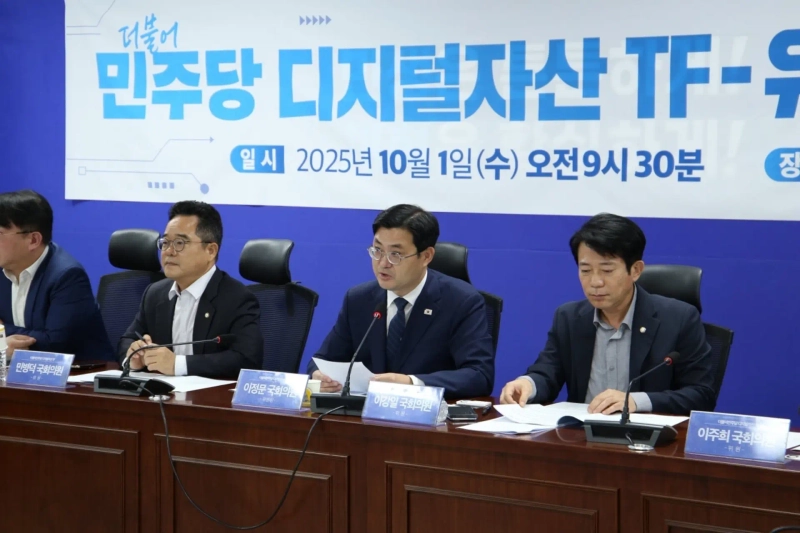
The Financial Services Commission failed to meet the deadline to submit the government proposal for Phase-2 virtual asset legislation, which had been scheduled for the 10th. The ruling Democratic Party said that if the government proposal is delayed, it will decide the party position within the year based on bills proposed by lawmakers.
Democratic Party lawmaker Min Byeong-deok told Bloomingbit on the day that "Even if the government proposal is not submitted, we plan to review lawmakers' bills at tomorrow's (11th) 'Digital Asset Task Force (TF)' meeting" and that "I believe it is fully possible to finalize the party position within the year." The Democratic Party's Digital Asset TF meeting will be held at 9 a.m. on the 11th.
Lee Jeong-mun, who chairs the Digital Asset TF for the Democratic Party, also said that the 'speed' of handling the bills is important. A staffer at his office said, "If the government proposal is submitted, we are prepared to process it quickly," but added, "If the government proposal continues not to be submitted, there is no choice but to set the direction at the party level centered on the bills that have been proposed."
The Phase-2 virtual asset bill is intended to cover gaps left by last July's enacted "Act on the Protection of Virtual Asset Users." The bill is expected to include regulation of stablecoin issuance and distribution, issuer reserve asset requirements, disclosure and listing standards, among other items. As of today, Democratic Party lawmakers Min Byeong-deok, Lee Kang-il, Park Sang-hyuk, An Do-geol, and Kim Hyun-jung, and People Power Party lawmakers Kim Jae-seop and Kim Eun-hye have proposed Phase-2 virtual asset bills.
The Democratic Party had planned to consolidate and review bills based on the government proposal that the Financial Services Commission was to submit by today. However, the Financial Services Commission informed the National Assembly that "submission within the deadline is difficult," effectively missing the government's proposal 'deadline.'
Observers analyze that the delay in preparing the government proposal stems from differences between the Financial Services Commission and the Bank of Korea over who should be the issuer of won-denominated stablecoins. The Bank of Korea argues that for payment stability and monetary policy reasons, commercial banks should hold more than 51% of the consortium shares issuing stablecoins. In contrast, the Financial Services Commission, citing the EU's MiCA law and the example of fintech companies issuing yen-denominated stablecoins in Japan, is leaning toward an approach that includes not only banks but also fintech firms, payment companies, and big tech as potential issuers.
There is also a tug-of-war over supervisory authority. The Bank of Korea has demanded the establishment of a "consensus body of related agencies" at the stablecoin approval stage and expanded powers for inspection requests and joint inspection participation. In response, the Financial Services Commission called it an "unnecessary overlapping regulation."
Industry insiders say that despite the ruling party's 'rapid processing' stance, it will likely take considerable time for the Phase-2 virtual asset bill to clear the National Assembly. An industry source said, "Given the schedule, processing within the year is physically impossible," explaining, "Even if the government proposal is submitted late, it must go through the Political Affairs Committee bill subcommittee, the Judiciary Committee review, and the plenary session, and it is realistically difficult since it is already mid-December." The source added, "If differences between the Bank of Korea and the Financial Services Commission are not narrowed and the government proposal continues not to be submitted, the ruling party will ultimately have no choice but to determine the direction as a party position."
Jin-wook, Bloomingbit reporter wook9629@bloomingbit.io

Uk Jin
wook9629@bloomingbit.ioH3LLO, World! I am Uk Jin.