

"Stablecoins, beyond payments to core financial infrastructure"…LayerZero holds roundtable
Summary
- "Stablecoins" are evolving beyond a simple payment method into a core layer of financial infrastructure, Im Jong-gyu, Head of LayerZero, stated.
- LayerZero said that through the OFT standard, unlike existing bridge methods, cross-chain asset transfers are possible with high security and a simplified structure.
- With fintech and traditional finance accelerating stablecoin strategies, new business opportunities are expected to open at the service layer.
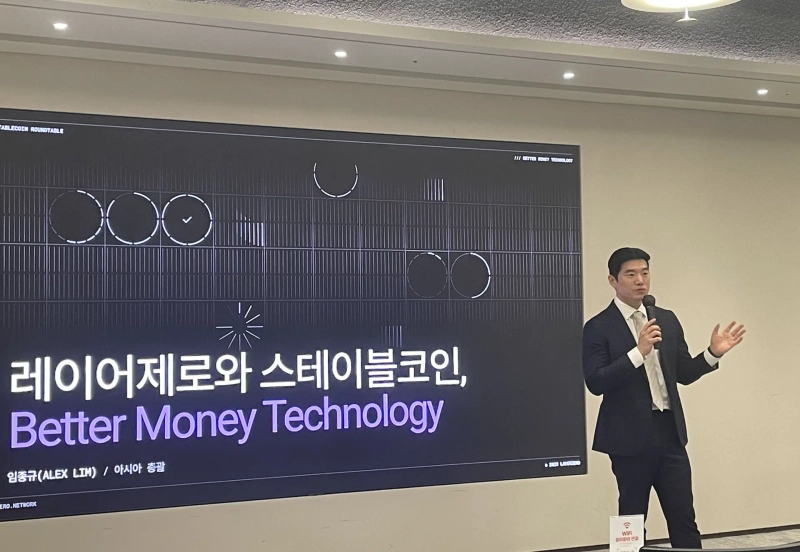
The stablecoin roundtable hosted by global blockchain interoperability protocol LayerZero (LayerZero·ZRO) was held on the 16th at the Centropolis Conference in Jongno-gu, Seoul.
The event, titled 'Stablecoin: Better Money Technology,' was organized to discuss the changes stablecoins and on-chain payments will bring to the overall financial and payment infrastructure and the directions for future expansion. Around 50 industry experts, mainly crypto asset officers from domestic financial institutions and fintech companies, attended to share global stablecoin trends and the potential of the Korean market.
Im Jong-gyu (Alex Lim), Head of LayerZero Asia·Pacific (APAC) (photo), said in his keynote that "stablecoins are entering a stage where they change the structure of foreign exchange and cross-border payments, beyond being a simple payment method." He added, "With more than 300 blockchain networks currently in existence, if stablecoins can move between networks with low fees and high speed, they can function not as an auxiliary tool of financial infrastructure but as a core layer."
LayerZero proposed the OFT (Omnichain Fungible Token) standard as a way to enable this change. Unlike the existing bridge method that deposits crypto assets and converts them into other wrapped assets, OFT allows movement between blockchains without changing the nature of the asset. It is a structure in which the same asset moves between chains, like a passport being stamped, and LayerZero plays the piping role that makes this possible. By not going through intermediate bridges or separate issuing entities, the structure becomes simpler, and based on high security, it is evaluated that an environment is created where stablecoins can be naturally used across multiple networks.
Im said regarding institutions preparing to issue stablecoins that "it is important to design and launch them to be well connected from the start, rather than attaching them to multiple chains later," and added, "Using the OFT standard makes it relatively easy to implement such a structure." He also said, "At the distribution stage, the forthcoming 'Value Transfer API' will make it easy to integrate payment or swap functions into services."
Kang Hee-chang, co-founder of Pofilus, who spoke later, pointed out new business opportunities that will open after issuing stablecoins. He said, "Stablecoin strategies are rapidly taking shape among fintech companies and traditional financial institutions," and predicted, "Stablecoins are opening new opportunities in service layers related to distribution and usage, such as on-chain payouts and linkage with card and bank networks."
Discussion on regulatory aspects followed. Attorney Han Seo-hee of Barun said, "The current regulatory environment surrounding stablecoins and digital assets is in a transitional phase," and added, "Domestic regulation is also likely to proceed step by step, considering market size and risks."
Kang Min-seung, Bloomingbit reporter minriver@bloomingbit.io

Minseung Kang
minriver@bloomingbit.ioBlockchain journalist | Writer of Trade Now & Altcoin Now, must-read content for investors.