

Fed·Large Banks…"U.S. Economy Resilient"
Summary
- The U.S. central bank (Fed) and large banks said they expect combined AI investment and the Trump administration's fiscal policies will push U.S. economic growth in 2026 to 1.8~2.4%.
- Major rate cuts are expected to occur 1~2 times in 2026, totaling about 0.50 percentage points, and inflation is expected to remain in the 3% annual range, limiting the scope for large rate cuts as in the past.
- They pointed to the possibility of a sharp decline in AI-related stocks and structural changes in the labor market as variables, and noted forecasts that a 3% annual interest rate could settle as the 'new normal.'

The U.S. central bank (Fed) and major banks have a positive view of U.S. economic growth in 2026. It is the common view that the Trump administration's aggressive fiscal policies and investment in artificial intelligence (AI) will create a synergy, pushing the U.S. gross domestic product (GDP) growth rate to 1.8~2.4%. However, prices are expected to remain in the 3% range annually. This is the result of tariffs and fiscal stimulus measures. The unemployment rate may rise slightly in relative terms but is expected to remain low by absolute standards. However, the possibility of a sharp drop in AI-related stocks could act as a variable.
"AI to Lead the U.S. Economy"
In the economic projections summary (SEP) released in December, the Fed projected 2026 economic growth at 2.3%, higher than the 1.8% projected in September last year. Fed Chair Jerome Powell said the upward revision in the growth forecast reflects productivity improvements, some of which may be due to AI. Powell said, "Partly consumption has remained resilient, and another part is data center and AI-related spending, that is, AI-related investment is supporting corporate capital expenditures," and added, "The baseline forecast can be seen as 'resilient growth this year as well.'"
In fact, JPMorgan and Morgan Stanley view 2026 as the first year in which AI investment will connect to real productivity gains. In particular, they expect tech companies' earnings growth to lead the economy through infrastructure building and efficiency improvements rather than being a mere bubble.
Major U.S. banks also highlight 'resilient growth' as the keyword for the U.S. economy in 2026. Most banks expect the U.S. economy to avoid a recession and continue modest growth around 2.0%. Alongside AI, they see the Trump administration's 'One Big Beautiful Bill (OBBBA)', which passed Congress last year, as supporting the economy. The corporate tax cuts and investment incentives included in the bill are analyzed to promote companies' capital expenditures (CAPEX) and act as a strong defensive mechanism to offset concerns about slowing employment.
"1~2 Rate Cuts Expected"
The Fed presented a median policy rate of 3.4% at the end of 2026 in December, the same as in the September projection last year. This implied one rate cut in 2026.
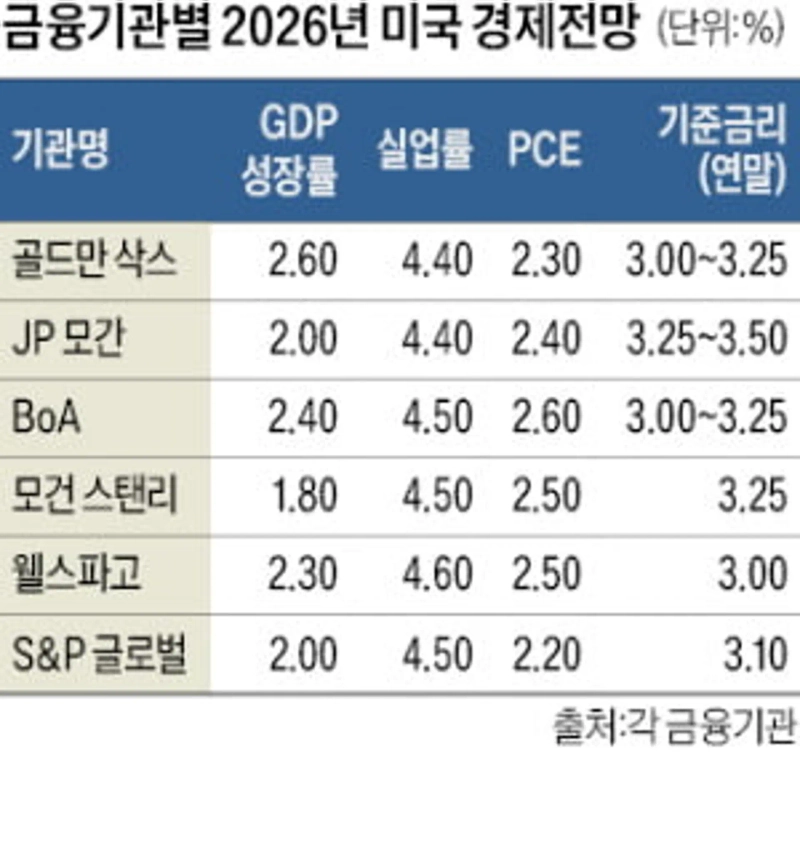
Six major investment banks, including Goldman Sachs and Morgan Stanley, expect the Fed to enact about two rate cuts in 2026, totaling around 0.50% percentage points. However, they assess that this is closer to a fine-tuning response to economic slowing rather than aggressive easing to stimulate the economy.
The problem is inflation. As companies' cost increases from tariff hikes are passed on to consumer prices, there is a possibility that inflation may 'stick' in the high-2% to 3% range. For this reason, cautious views that the scope for rate cuts may be limited also coexist.
The most important variable in the Fed's policy judgment for 2026 is the labor market. Major investment banks expect the unemployment rate to rise modestly to the 4.3~4.9% range. The interpretation is that this is closer to a gradual slowdown rather than a sharp employment collapse.
However, the nature of the labor market is likely to change significantly. With immigration restriction policies reducing labor supply, upward wage pressures remain, while companies are accelerating the adoption of 'labor-saving AI.' As a result, jobs centered on simple and repetitive tasks are expected to decline, and a 'qualitative change' is expected as employment structure is reorganized toward high-skilled, technology-based occupations.
Market views are largely that the rate-cut cycle will likely conclude during 2026. Goldman Sachs and Morgan Stanley expect the Fed to lower the policy rate to around 3.0~3.25% in Q2–Q3 of 2026 and then enter a long period of stability.
Analysts largely argue that a return to a 'zero interest rate era' like in the past is unlikely because tariff increases and expanded fiscal spending will push up prices, making it difficult for inflation to fall quickly below the 2% target. Accordingly, there are forecasts that an annual 3% range interest rate is likely to become the 'new normal.'
New York=Park Shin-young, correspondent nyusos@hankyung.com

Korea Economic Daily
hankyung@bloomingbit.ioThe Korea Economic Daily Global is a digital media where latest news on Korean companies, industries, and financial markets.