PiCK
Crypto held on overseas exchanges worth '500 million won or more' will be automatically flagged…tax shock if you can’t substantiate
Summary
- It explained that with CARF being introduced this year, holdings and transaction histories of Korean residents who hold 500 million won or more on overseas crypto-asset exchanges could come within the National Tax Service’s line of sight.
- It stated that if you hold assets of 500 million won or more on an overseas exchange even for a single day and fail to report it, the burden of administrative penalties increases, and the larger the high-value holdings, the higher the tax burden could become.
- It reported that under the CARF framework, organizing documentation to substantiate year-end holding balances, the source of assets, and transfer routes will effectively become an essential risk management factor.
Forecast Trend Report by Period


Assets held on overseas exchanges now within tax authorities’ line of sight
Assets exceeding 500 million won automatically detected…prepare to substantiate fund flows
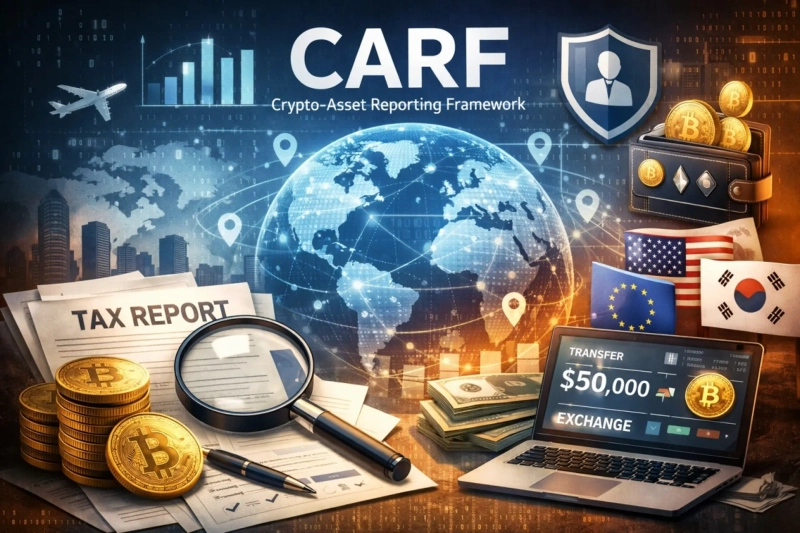
If you are an investor holding 500 million won or more on an overseas crypto-asset exchange, you should recheck your tax risk from the new year.
This is because assets held and transaction histories on overseas exchanges—areas that have been difficult for tax authorities to verify directly—are set to shift this year to a framework under which such information is gradually shared across countries.
As global tax information standards are applied to Korea’s crypto market, an increasing number of analysts say the more important variable is no longer how much tax you pay, but how far the tax authorities can look into your overseas assets and transactions.
Transaction data collection begins this year…information on high-net-worth holders with 500 million won or more will surface
According to public materials released by the Organisation for Economic Co-operation and Development (OECD) and tax authorities on the 2nd (local time), major countries including South Korea will begin full-scale collection of crypto-asset information this year to implement CARF (CARF, Crypto-Asset Reporting Framework).
Once CARF is introduced, Korean residents’ crypto holdings and transaction histories on overseas exchanges are also likely, in the long term, to come within the National Tax Service’s line of sight. In particular, if you held assets of 500 million won or more on an overseas exchange even for a single day but fail to report them, you may face substantial administrative penalties.
Lee Jae-hyuk, partner and CPA at PwC Samil, said, “After CARF takes effect, holdings data from overseas exchanges will be automatically transmitted to Korea’s National Tax Service, making the likelihood of detecting non-reporting virtually very high. Unlike simple taxes, administrative penalties rise in percentage terms as the amount increases, meaning the larger the holdings, the heavier the tax burden could become.”
While overseas exchange data had remained an area that tax authorities struggled to secure directly, the perception of “invisible assets” is expected to fade as CARF creates an automatic cross-border transmission mechanism.
CARF will be implemented in stages. From Jan. 1 this year, crypto-asset service providers in each country will begin collecting user information and transaction data, and from Jan. 1 next year, automatic information exchange between countries will be fully rolled out. In other words, 2026 is the preparation phase during which information is accumulated, and 2027 is when that information begins moving across borders.
Although information exchange itself will begin in 2027, the practical monitoring target is likely to be transaction and holdings data from 2026, because the information exchanged by tax authorities is compiled based on year-end balances.
Lee added, “Under the CARF framework, year-end holding balances are the key benchmark. Once data starts being shared from 2026 onward, we cannot rule out the possibility that past transactions and holdings could become an issue retrospectively.”
The key is “substantiating profits”…prepare documentation on sources of funds and transfer routes
The most important issue after CARF’s introduction is whether you can “explain your profits.” You must be able to clearly account for how assets were formed and the routes by which they were moved.
Investors should first organize transaction records and asset transfer routes into a single timeline. Aligning exchange-to-exchange transfers, deposits and withdrawals to and from personal wallets, and the source of funds for KRW deposit accounts in chronological order will make it easier to respond to future substantiation requests.
Lee said, “The biggest change after CARF takes effect is not taxation itself but how tax authorities access information,” adding, “As assets held on overseas exchanges and even past transaction histories can be automatically linked, it will effectively become essential to organize documentation so you can explain sources of funds and transfer routes at any time.” He emphasized, “The larger the amount of assets held and the higher the reliance on overseas exchanges, the more this advance preparation is not a choice but a must for risk management.”
Lee Young-min, Bloomingbit reporter 20min@bloomingbit.io, Lee Soo-hyun, Bloomingbit reporter shlee@bloomingbit.io

YM Lee
20min@bloomingbit.ioCrypto Chatterbox_ tlg@Bloomingbit_YMLEE