"I rolled along in the sandbox for seven years"…An innovative firm left out once the tokenized securities market opened
Summary
- The Financial Services Commission (FSC) said it will bring the distribution platform for fractional investment securities into the regulated system through preliminary approval of a fractional investment over-the-counter exchange for tokenized securities (STO).
- The industry expects consortia with existing financial infrastructure—the KDX Consortium and NXT Consortium—to be more likely to receive preliminary approval, while the startup-led Sowoo Consortium is effectively on track to be eliminated.
- Lucentblock, which has operated a real estate fractional investment platform under the regulatory sandbox, said its pilot track record was not sufficiently reflected in the licensing competition despite achievements including KRW 30 billion in cumulative distribution and 500,000 users.
Forecast Trend Report by Period


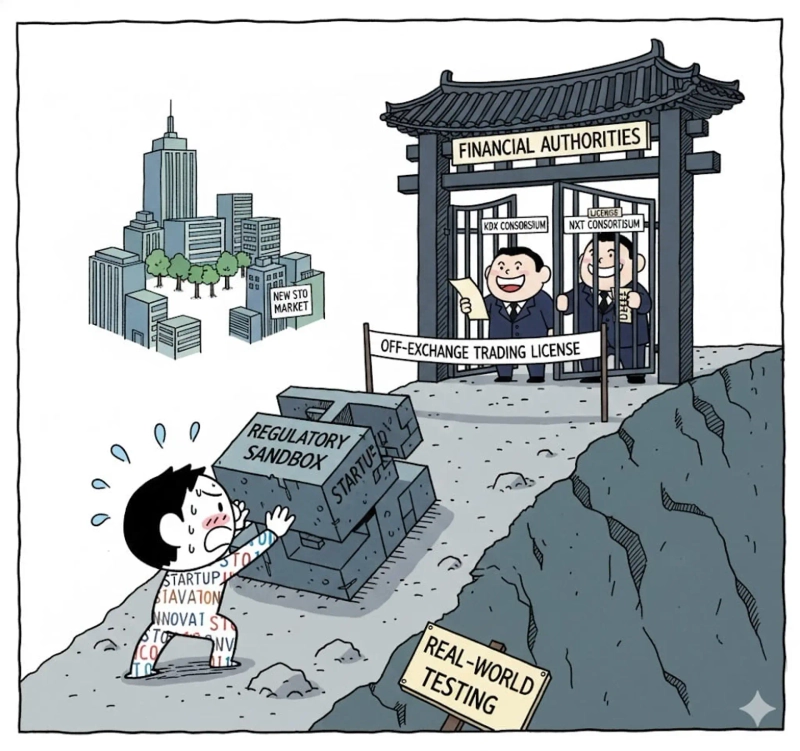
A startup that has carried out pilot testing under the regulatory sandbox ahead of preliminary approval for an over-the-counter exchange for tokenized securities (STO) now faces the risk of being derailed. As regulators are said to be reviewing approvals centered on consortia equipped with existing financial infrastructure, criticism is growing that the party that tested innovation and the beneficiaries of institutionalization are diverging.
According to the investment banking industry on the 9th, the Financial Services Commission (FSC) is set to deliberate at its regular meeting on the 14th on agenda items for preliminary approval of fractional investment OTC exchanges for the “Korea Exchange–Koscom (KDX Consortium)” and the “Nextrade–Musicow (NXT Consortium).” Through this approval, the FSC plans to bring the distribution platform for fractional investment securities into the regulated system.
STOs are a new type of financial service in which real assets such as real estate and music copyrights are divided into securities and traded. Until relevant laws and制度 were put in place, the government provided opportunities for real-world pilot testing to private startups through the “regulatory sandbox.” This preliminary approval drew high expectations in the market as it is seen as the first step in converting the pilot service into a formal制度.
The problem is that although this approval is a process to bring sandbox-tested businesses into the regulated framework, it is said to have been designed as a competitive landscape favoring consortia with existing financial infrastructure. In the industry, expectations are that—barring surprises—the KDX and NXT consortia will secure preliminary approval. The only consortium led by a private startup, the “Sowoo (led by Lucentblock)” consortium, is reportedly effectively on track to be eliminated.
Lucentblock is cited as a case that carried out pilot testing while bearing regulatory risk amid the absence of laws and制度. Headquartered in Daejeon, the company has operated a real estate fractional investment platform since being designated an FSC Innovative Financial Service in 2018. By continuously operating the service with actual investors and assets, it has secured cumulative distribution volume of KRW 30 billion and 500,000 users, and has been assessed as having validated market viability and stability through accident-free operations.
However, the criteria changed once institutionalization began. While the financial authorities described this approval as “institutionalizing the sandbox pilot service,” the actual procedure was a competitive licensing process for new operators. As institutions with existing trading and settlement infrastructure emerged as leading candidates in the process, a structure was formed in which the startup that led the pilot and public or quasi-public infrastructure institutions competed on the same terms.
Lucentblock in particular argues that its pilot results were not sufficiently reflected in the screening process. It says that formal requirements—such as whether a consortium was formed or whether existing infrastructure was held—carried more weight than operational data accumulated in the market. It is also raising concerns that fair-competition principles may have been violated by the fact that some rival applicants, after signing nondisclosure agreements (NDAs) during prior investment and collaboration reviews, later switched to become competitors in the same business area.
Some argue that Lucentblock’s business under the regulatory sandbox falls under the “primary market” area—issuance and sale of real estate fractional investment products—whereas the STO OTC exchange the authorities are seeking to license this time is a “secondary market” responsible for trading and distribution of securities, making the nature of the two different. An investment banking industry official said, “Issuance and distribution are entirely different domains in terms of risk-management systems and regulatory intensity,” adding, “It is hard to say an approval for distribution infrastructure should be granted simply because they have sandbox experience.”
Because the secondary market involves continuous trading between investors, it requires a higher level of infrastructure and control, such as market surveillance, abnormal-trading detection, and settlement stability.
Even so, controversy is expected to continue as there is no clear standard for how the role of operators that pioneered the market through the regulatory sandbox should be evaluated in the institutionalization process. Since the FSC has described this approval as “institutionalizing the sandbox pilot service,” questions are being raised over the extent to which the operational experience and data accumulated by pilot operators were reflected in the competitive licensing process.
Reporter Ahn Jeong-hoon ajh6321@hankyung.com

Korea Economic Daily
hankyung@bloomingbit.ioThe Korea Economic Daily Global is a digital media where latest news on Korean companies, industries, and financial markets.