PiCK
Exchange rules on major shareholder stakes spark legitimacy and fairness debate… “Out of step with President Lee’s policy stance”
Summary
- Financial authorities are pushing a regulation as a key clause that would cap major shareholders’ stakes in digital-asset exchanges at 15–20%.
- Legal circles said that imposing an ownership cap without reflecting the distinct market structure and risk profile of digital assets, unlike stock exchanges, lacks sufficient justification.
- The startup sector voiced concerns that the measure’s impact on reducing monopolies/oligopolies and strengthening public interest is unclear and that it conflicts with the Lee Jae-myung administration’s pro-venture and startup growth agenda.
Forecast Trend Report by Period


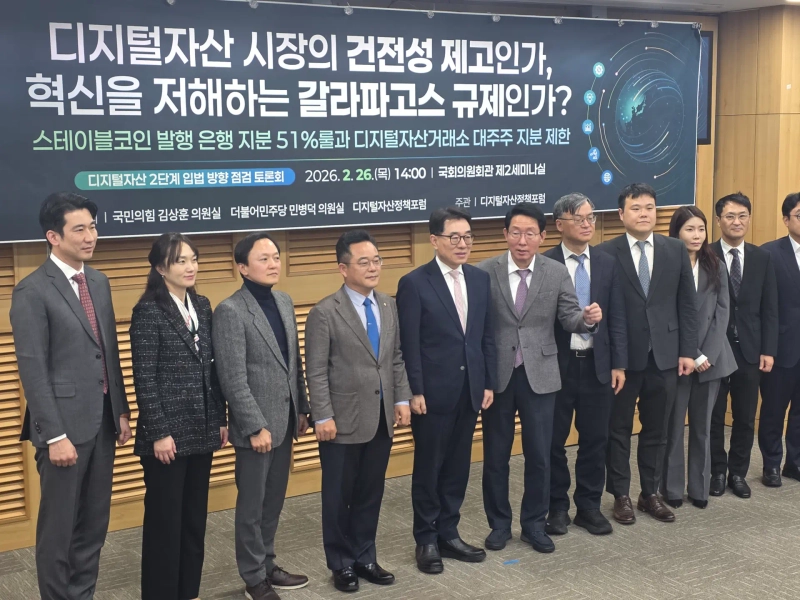
Industry and legal circles have raised questions about the rationale behind the Financial Services Commission’s proposed regulation to cap major shareholders’ stakes in digital-asset exchanges. Critics say that, contrary to the stated policy goal of curbing monopolies and oligopolies, the measure’s effectiveness is unclear—and that it could clash in particular with the Lee Jae-myung administration’s “top-four venture powerhouse” agenda.
According to the National Assembly on the 26th, discussions at a forum held that day—titled “Reviewing the direction of Phase 2 digital-asset legislation”—focused on the appropriateness and fairness of regulating major shareholders’ stakes in digital-asset exchanges. The proposal would cap controlling shareholders’ ownership at up to about 15–20%, a provision financial authorities are pushing as a key clause in the Phase 2 legislative process for digital assets.
The forum was co-hosted by Rep. Min Byung-duk of the Democratic Party of Korea, Rep. Kim Sang-hoon of the People Power Party, and the Digital Asset Policy Forum. Discussants included: ▲Ryu Kyung-eun, professor at Korea University School of Law, ▲Jung Jae-wook, attorney at Law Firm Jooeon, ▲Choi Seung-jae, professor in the Department of Law at Sejong University, ▲Hyun Ji-hye, attorney at Law Firm Changcheon, ▲Lee Jong-seop, professor at Seoul National University Business School, and ▲Cho Young-ki, secretary-general of the Korea Internet Corporations Association.
“A cap on controlling shareholders’ stakes ignores the nature of digital assets”
Legal experts attending the forum criticized the stake cap as a regulation premised on treating digital assets and securities as the same type of asset, arguing that it fails to adequately reflect the market’s specific characteristics.
Attorney Jung Jae-wook said, “Financial authorities currently seem to be trying to apply to digital-asset exchanges the same logic as the stake limits on stock exchanges under the Capital Markets Act,” but noted that “that regulation was introduced against the unique backdrop of a unified monopoly structure based on a membership system at stock exchanges.” He added, “Applying the same assumptions to digital-asset exchanges, where trading structures and market environments are completely different, is questionable in terms of validity.”
Professor Choi Seung-jae also said, “Authorities argue that the reason for regulating ownership stakes in digital-asset exchanges is to minimize systemic risk, but it is not right to assume that exchanges have the same systemic-risk structure as banks or traditional securities markets,” adding, “In a situation where market structures and risk characteristics differ, choosing a strong tool like a structural ownership cap should be approached cautiously.” He added, “Known risks can be addressed sufficiently through other means, such as conduct regulation or stronger internal controls.”
Questions were also raised about whether the measure would reduce market dominance. Authorities are known to cite “breaking up a monopoly/oligopoly system” as the main reason for the stake cap.
Choi said, “Splitting ownership does not automatically weaken a platform’s market power,” adding, “A more precise review is needed of the alignment between the policy objective and the regulatory instrument.”
Startup sector: “A regulation at odds with the government’s innovation stance”
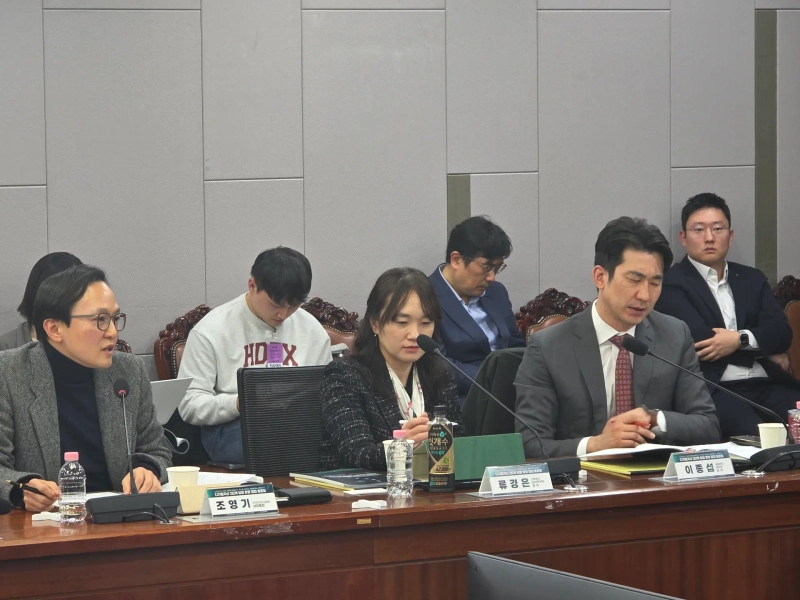
Industry players are also wary of the ripple effects the digital-asset exchange ownership regulation could trigger.
Cho Young-ki, secretary-general of the Korea Internet Corporations Association, said, “A close review is needed of whether a stake cap is an appropriate tool to achieve the goal of strengthening public interest,” adding, “The logic that stakes should be limited because something is public infrastructure is a logic that could be applied to most platforms of a certain scale today.”
Cho continued, “Many startups within the association are expressing concerns about the possibility that this proposal will be introduced,” adding, “A signal that, once they grow beyond a certain size, they could be structurally subject to ownership caps could become a major burden for the startup sector.”
He also argued that the measure does not align with the current administration’s stated goal of promoting startups. Cho said, “President Lee Jae-myung, during the campaign, emphasized fostering ventures and startups and revitalizing investment,” adding, “Compared with that stance, discussions of structural ownership caps could send a negative signal to the market.” He added, “The most important thing in the startup ecosystem is predictability,” and said, “An explanation is needed regarding consistency with overall policy direction.”

Uk Jin
wook9629@bloomingbit.ioH3LLO, World! I am Uk Jin.