Predicate: “Aleo overcomes privacy-chain constraints… bridging speed improved by 99%”
Summary
- Predicate said Aleo has overcome the limitations of privacy blockchains and has progressively resolved the structural conflict between regulatory compliance and user experience (UX).
- Aleo, in collaboration with Predicate, passed the ARC-100 risk-management standard and said the introduction of automated real-time screening cut bridge deposit waiting times by 99%—from 24 hours to about 15 minutes.
- Predicate said Circle and Paxos Labs plan to deploy private stablecoins on the Aleo network based on these results, emphasizing that Aleo can meet global-level risk-management standards.
Forecast Trend Report by Period


Predicate, an on-chain interaction solutions company, said on the 21st that it has published an analytical report on Aleo (ALEO), a privacy Layer-1 blockchain.
In the report, Predicate said it “conducts a comprehensive analysis of Aleo’s technical achievements and regulatory-compliance framework, and concludes that Aleo has overcome limitations that existing privacy blockchains have faced.”
According to the report, Aleo, through collaboration with Predicate, has progressively resolved the structural conflict between privacy protection, regulatory compliance, and user experience (UX). By combining Aleo’s core technology—zero-knowledge proofs (ZK)—with Predicate’s “programmable policy platform,” it established an architecture that maintains privacy while enabling real-time risk controls.
Aleo first focused on addressing a chronic limitation of privacy chains: while they offer strong privacy guarantees, they can be abused for illicit activities such as criminal money laundering. To that end, it enhanced risk-management standards together with Predicate, and as a result passed “ARC-100,” a risk-management standard for assets entering via bridges.
It also improved processing delays that occurred during bridge usage. Verulink, the existing Aleo bridge, had a structural limitation in which deposits could take up to 24 hours to complete due to a screening approach reliant on manual checks and updates. Aleo addressed this by implementing Predicate’s automated real-time screening system in Verulink.
Predicate’s “programmable policy platform” connects relevant on-chain data—such as the U.S. Treasury Department’s Office of Foreign Assets Control (OFAC) sanctions lists—via APIs, reflecting the latest information in real time. It automatically determines whether the wallet address requesting a transaction is subject to sanctions, and sends only transactions that pass verification to the blockchain.
With the introduction of this automated system, the Aleo network bridge’s deposit waiting time was reduced by 99%, from 24 hours to about 15 minutes.
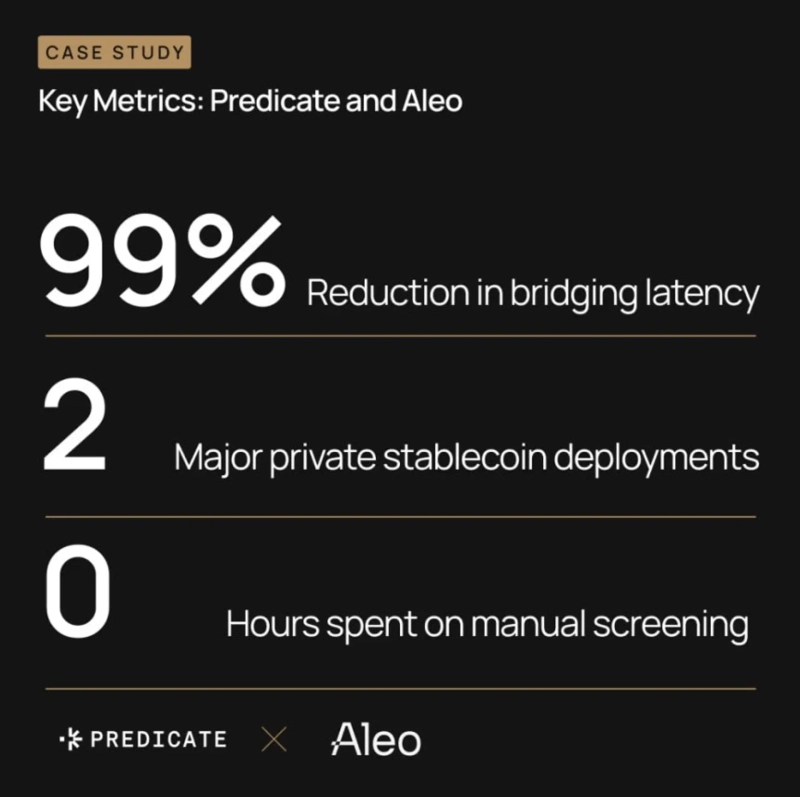
Predicate further assessed that these technical achievements helped secure the trust of global stablecoin issuers. Circle and Paxos Labs, in fact, plan to deploy private stablecoins on the Aleo network.
Leena Im, Aleo’s chief operating officer (COO), said, “Predicate is an essential partner in realizing the balance among privacy, usability, and risk management that Aleo pursues,” adding, “We will continue to raise our technical completeness so that privacy technology can spread into everyday life and across the broader financial industry.”
Predicate emphasized, “Aleo is the optimal network capable of achieving both privacy guarantees and regulatory compliance,” adding, “This research shows that Aleo can meet global-level risk-management standards without sacrificing development speed or user convenience.”

Bloomingbit Newsroom
news@bloomingbit.ioFor news reports, news@bloomingbit.io