PiCK
SEC issues guidance on tokenized securities, clarifying distinction between issuer-led issuance and third-party tokenization
Summary
- The U.S. Securities and Exchange Commission (SEC) said it has issued official guidance on tokenized securities, detailing how federal securities laws apply.
- The SEC said tokenized securities do not change the legal nature of existing securities, and that existing federal securities laws continue to apply even when distributed ledger technology (DLT) and blockchain are used.
- The SEC distinguished between issuer-led issuance and third-party tokenization, and said it expects market participants to be able to prepare procedures such as registration, filings, and approvals based on the guidance.
Forecast Trend Report by Period


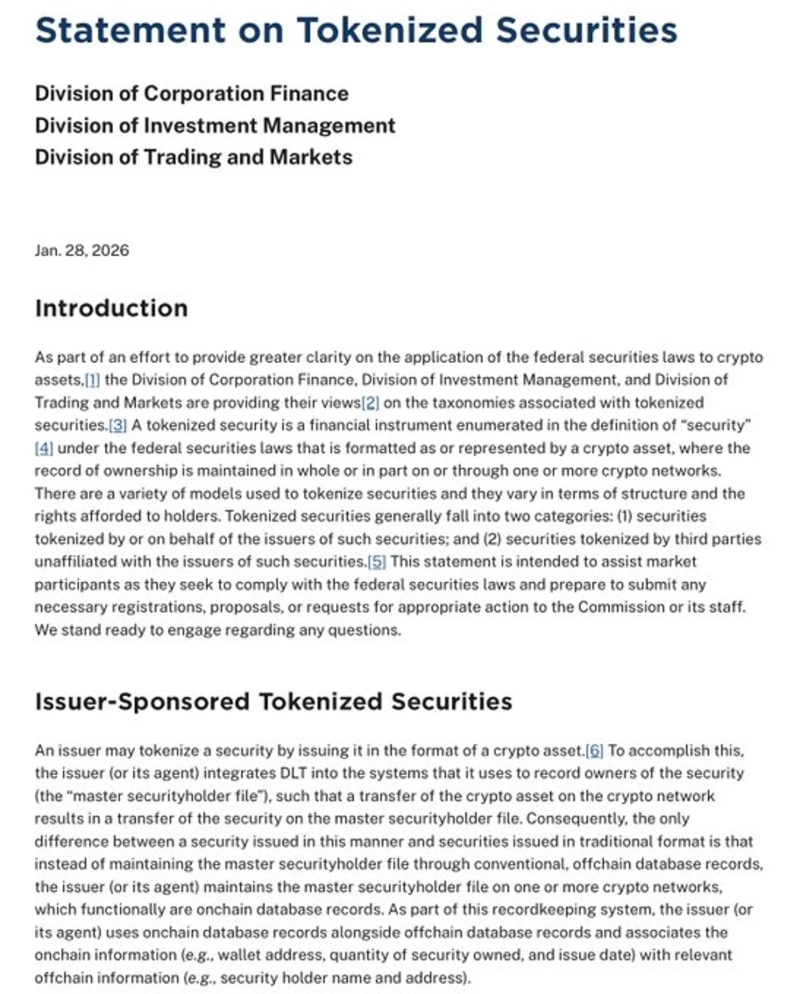
The U.S. Securities and Exchange Commission (SEC) has released official guidance on tokenized securities, detailing how federal securities laws apply.
On the 28th (local time), Eleanor Terrett, host of CryptoAmerica, wrote on X that “the SEC’s Division of Corporation Finance, Division of Investment Management, and Division of Trading and Markets issued a joint statement setting out legal interpretations and structural classification standards for tokenized securities.”
In the guidance, the SEC made clear that tokenized securities do not change the legal nature of the underlying securities. Tokenization is merely a technical means of moving the record of ownership to distributed ledger technology (DLT) or blockchain, and existing federal securities laws continue to apply to the asset.
In particular, the SEC divided tokenization structures into an issuer-led model and a third-party tokenization model. In the issuer-led model, the issuer or its agent directly issues securities in token form and records ownership on-chain. In this case, it is viewed as replacing an existing off-chain database with a blockchain, and the SEC said there is no substantive difference from a traditional securities issuance.
By contrast, where a third party unrelated to the securities issuer tokenizes existing securities, the key determinants are the structure of investor rights and how ownership is linked. The SEC stressed that such arrangements still fall within the scope of securities laws, and require a clear explanation of how the token represents the actual security as well as regulatory compliance.
The SEC said it expects market participants to be able to use the guidance to prepare necessary procedures such as registration, filings, and approvals. The guidance is likely to serve as an important reference point for financial institutions and blockchain companies pursuing tokenized equities and bonds, real-world asset (RWA) tokenization, and security token offerings (STOs).

YM Lee
20min@bloomingbit.ioCrypto Chatterbox_ tlg@Bloomingbit_YMLEE