Jensen Huang squarely rebuts claims Nvidia is holding off on investing in OpenAI
Summary
- CEO Jensen Huang denied the Wall Street Journal report, saying Nvidia will make a huge investment in OpenAI and that it will be the largest investment the company has ever made.
- OpenAI is pursuing fundraising of up to $100 billion, targeting completion in the first quarter of this year; if successful, its valuation could reach as high as $830 billion.
- An AI industry source said the two companies’ relationship could serve as a barometer for the sustainability of the AI boom, amid concerns about uncertainty over the boom’s future within Nvidia’s board and worries that an OpenAI collapse could be devastating for Nvidia.
Forecast Trend Report by Period


A yardstick for distinguishing an AI boom from a bubble?
A ‘reversal’ just one day after a WSJ report
CEO Huang rebuts via Taiwanese media
“U.S. media claims are nonsense”
Aftershocks may not subside
“Dissatisfaction rising within Nvidia’s board”
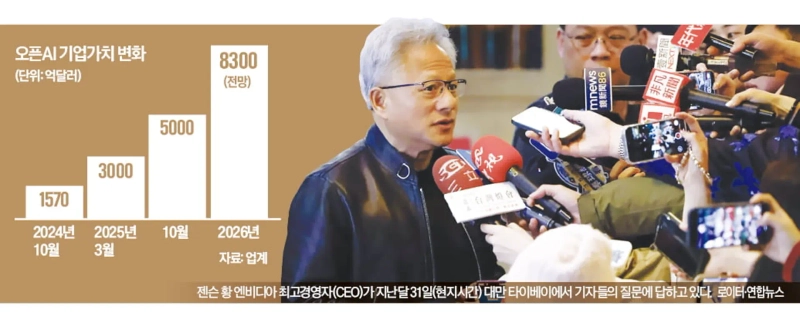
Nvidia Chief Executive Officer Jensen Huang flatly rejected a Wall Street Journal report saying the company would put its OpenAI investment on hold—just one day after it was published. Analysts say the episode is emblematic of the soul-searching in the AI industry and capital markets over whether the global AI boom can expand structurally or has already entered bubble territory.
Spotlight on OpenAI’s Q1 fundraising
Speaking to reporters in Taipei, Taiwan, on the 31st (local time), Huang dismissed as “nonsense” a report claiming he had voiced criticism and concerns about OpenAI. “OpenAI’s work is incredible, and they are one of the most influential companies of our time,” he said, adding, “I really enjoy working with Sam Altman, OpenAI’s CEO.” He also made clear that Nvidia would invest in OpenAI. “We’re going to make a huge investment in OpenAI,” he said. “It will probably be the largest investment we’ve ever made.”
His remarks were a rebuttal to the WSJ report the day before. Citing sources, the WSJ said Nvidia had decided to hold off on its OpenAI investment plan announced in September last year. At the time, Nvidia said it would invest $100 billion in OpenAI over several years, despite criticism that the move amounted to circular dealings meant to keep the AI boom going. The WSJ wrote that Huang had criticized OpenAI’s business approach as lacking discipline and had expressed concern that it was facing competition from Google and Anthropic.
OpenAI is currently running a funding round aimed at raising up to $100 billion (about KRW 145 trillion), with completion targeted for the first quarter of this year. If successful, the company’s valuation is expected to reach as high as $830 billion (about KRW 1,224 trillion). Big Tech names such as Microsoft (MS) and Amazon are expected to open their wallets for the series. Analysts say that if Nvidia—an anchor of the AI semiconductor ecosystem—were to delay investing, it could place a meaningful burden on OpenAI’s fundraising.
Generative AI pioneer squeezed by Google
The controversy is being read as an extension of the debate over whether OpenAI has become a focal point for the AI bubble thesis. Microsoft, for one, said in its fourth-quarter earnings release last year that capital expenditures (CAPEX) surged 66% year on year to $37.5 billion. With growth in its core cloud Azure business slowing, the AI bubble narrative resurfaced. Each time the issue has reignited, Huang has maintained that AI market growth will continue.
Some observers say Huang’s efforts to contain the controversy in front of Taiwanese media could instead add fuel to speculation about an AI bubble. An industry source estimated that “the WSJ report went beyond a simple rumor and reflected internal currents within Nvidia’s board that are not fully convinced about the future of the AI boom.”
OpenAI sparked the generative AI boom with the launch of ChatGPT in 2022. Recently, however, it has been seen as ceding some initiative— to Anthropic in the enterprise (B2B) AI market and to Google in the consumer (B2C) market. An OpenAI collapse would also be devastating for Nvidia. To keep shipping high-priced, cutting-edge GPUs, growth from large buyers like OpenAI is essential. An industry source noted, “Huang is in a situation where he has to find a way to scale back investment in OpenAI without stoking the AI bubble thesis.”
The relationship between Nvidia and OpenAI is expected to serve as a yardstick for gauging the sustainability of the AI boom.
Reporter Kang Ha-ryeong hr.kang@hankyung.com

Korea Economic Daily
hankyung@bloomingbit.ioThe Korea Economic Daily Global is a digital media where latest news on Korean companies, industries, and financial markets.