PiCK
Shock as 'No US government backstop' message hits… Bitcoin retreats toward $60,000 and Ethereum tumbles in tandem [Lee Soo-hyun’s Coin Radar]
Summary
- Bitcoin fell to the $60,000 level, and the US Treasury secretary’s comment that there is “no government-level safety net” has led to weakened buying sentiment and heightened volatility, the report said.
- Ethereum dropped more than 30% over the week to below $2,000, and the report noted growing downside risks amid Vitalik Buterin’s selling and continued net outflows from spot ETF funds.
- For Dogecoin, the report said it is retesting the key $0.10 support, with the risk of a sharp decline if the $0.08 support breaks, while the $0.090 and $0.0950 zones are flagged as near-term resistance.
Forecast Trend Report by Period



<Lee Soo-hyun’s Coin Radar> is a weekly column that reviews the flow of the virtual asset (cryptocurrency) market and explains the background. Going beyond a simple list of price moves, it offers a multidimensional analysis of global economic issues and investor behavior, providing insights to gauge market direction.
Major coins
1. Bitcoin (BTC)
Bitcoin extended its unrelenting slide this week, ultimately falling to the $60,000 level. It was the first time Bitcoin had printed the $60,000 handle since November 2024. As of the 6th, it was trading around $64,000 on CoinMarketCap.
The early-week decline was initially attributed to the “Warsh shock.” Expectations for rate cuts cooled quickly after Kevin Warsh—seen as strongly hawkish—was floated as a candidate for the next Fed chair, draining risk appetite across markets. Bitcoin struggled to avoid the fallout.
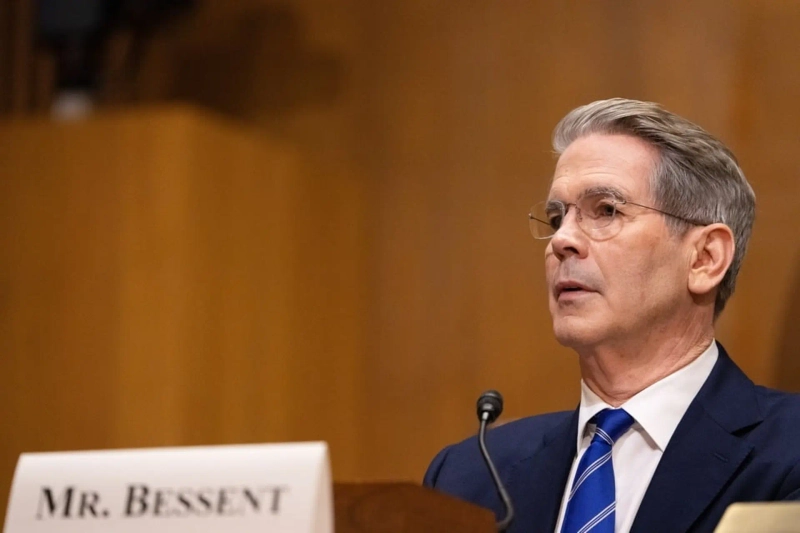
The decisive trigger was concentrated on the 4th (local time). That day, US Treasury Secretary Scott Bessent drew a line at a congressional hearing, saying in effect that “even if Bitcoin prices collapse, the government has no authority to intervene.” The market interpreted it as a message that there is “no government-level safety net,” even under President Donald Trump’s administration. Buying sentiment then shrank sharply, deepening Bitcoin’s losses.

There was also an assessment that warning remarks by Michael Burry, the protagonist of the film The Big Short, stoked fear. In a Substack post on the 2nd, Burry argued that Bitcoin’s decline could spread into a “death spiral” that harms related companies, adding that if Bitcoin falls further, funding conditions could deteriorate sharply for Strategy, a Bitcoin-treasury company. According to CNBC, volatility in Bitcoin and related exchange-traded funds (ETFs) widened after his comments. Then, on the 5th, after Bitcoin slipped below the $70,000 level, Burry further amplified market anxiety, saying Bitcoin would suffer a crash similar in magnitude to the 2022 bear market.
On the policy front, debate continues over the US virtual-asset market-structure bill, the CLARITY Act. On the 3rd, the White House met with industry and banks to discuss the bill’s key sticking point—the “stablecoin compensation” provision—but failed to reach a clear agreement. The White House has asked for a compromise by the end of this month. Procedurally, hurdles remain, including passage through the Senate Banking Committee and crafting a single bill with the Agriculture and Banking committees, followed by House–Senate coordination. Even so, some say the chances of approval within the year remain alive. CoinShares notes that the GENIUS Act, a US stablecoin bill, passed last year after overcoming difficulties, and sees the CLARITY Act as feasible as well. Still, with 2026 being a midterm-election year, there are warnings that legislative momentum could fade as the year progresses.
Views on the price outlook are split. Bernstein said Bitcoin may have formed a bottom around the $60,000 level and could enter a recovery phase in the first half, framing this pullback as a retracement within an upcycle. By contrast, on-chain analyst Ananda Banerjee warned that unless spot demand clearly recovers, investors should leave room for further downside within the $63,000–$69,000 range. In the near term, volatility is likely to persist, and the prevailing view is that it is too early to call a bottom at current levels.
2. Ethereum (ETH)
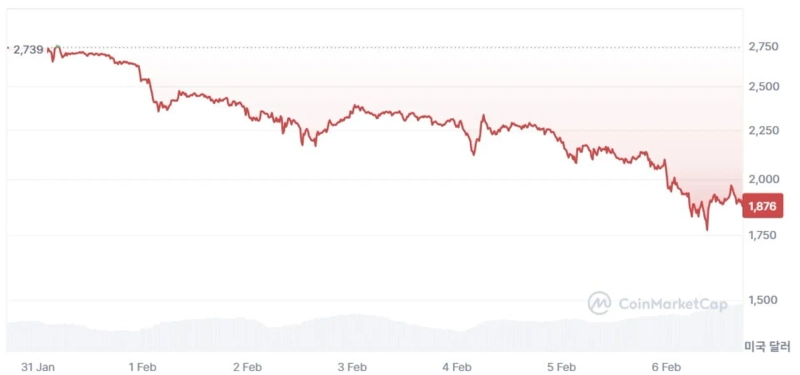
Ethereum also saw sharp swings this week. Losses widened in tandem with Bitcoin’s decline, falling more than 30% over the week on CoinMarketCap and sliding below $2,000. As of the 6th, it was hovering around $1,900.
Short-term sentiment took a hit after reports that Ethereum founder Vitalik Buterin sold part of his holdings earmarked for ecosystem support. On the 5th, Vitalik was found to have sold 27.6% of 16,384 ETH that he had set aside for supporting the Ethereum ecosystem. The amount sold so far totals about 4,521 ETH ($9,939,000), with an average sale price of $2,202. The value is close to $10 million. Because the selling is still assessed to be ongoing, additional sales could emerge at any time.
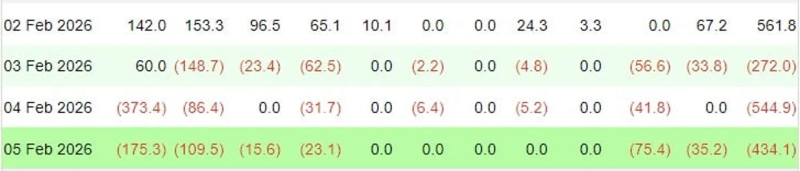
Institutional flows remain a headwind as well. On the 5th, based on TraderT data, about $80.79 million flowed out of US spot Ethereum ETFs in a single day, and on a monthly basis net outflows have continued for three consecutive months. With institutional demand failing to recover clearly, some argue volatility could increase.
In the short term, the possibility of further declines is being raised. Crypto outlet Cointelegraph says the $1,700 range should also be kept in play, while noting that to discuss a meaningful trend reversal, the $2,300–$2,400 zone needs to be reclaimed.
3. XRP (XRP)
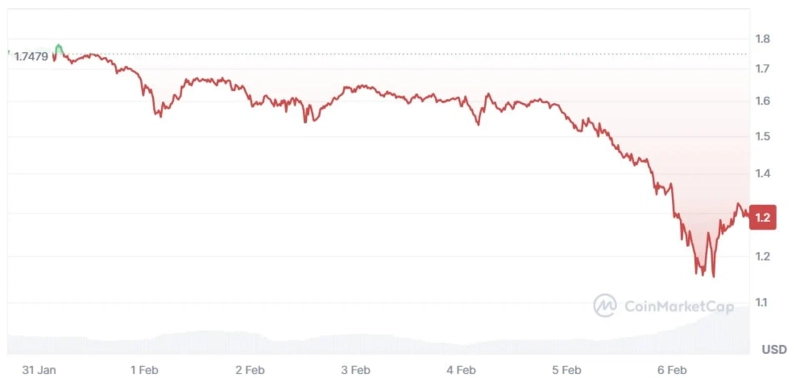
XRP slipped below the $2 level and has since lost rebound traction, now down to the low $1 range. As of the 6th, it was trading around $1.2 on CoinMarketCap.
Analysts say this decline reflects a combination of a technical breakdown and shifts in on-chain supply and demand. Technically, the breach of a key support level is seen as decisive. On the 5th, crypto outlet CoinDesk noted that “as XRP clearly broke below the $1.60 area, the perception spread that ‘the price zone that can hold has weakened.’” The market may view the stretch down to $1 as an “air pocket” with a thin supply overhang, meaning that once a decline begins, downside can open faster than expected.
On-chain indicators also point to mounting sell pressure. According to CryptoQuant, XRP balances held on exchanges rose from 2.67 billion to 2.71 billion. Typically, higher inflows to exchanges in volatile phases are read as a signal of potential supply expansion. In derivatives markets as well, position unwinding appears to be dominating over fresh inflows. XRP futures open interest fell from $2.61 billion to $2.57 billion, reinforcing assessments that rebound momentum has weakened.
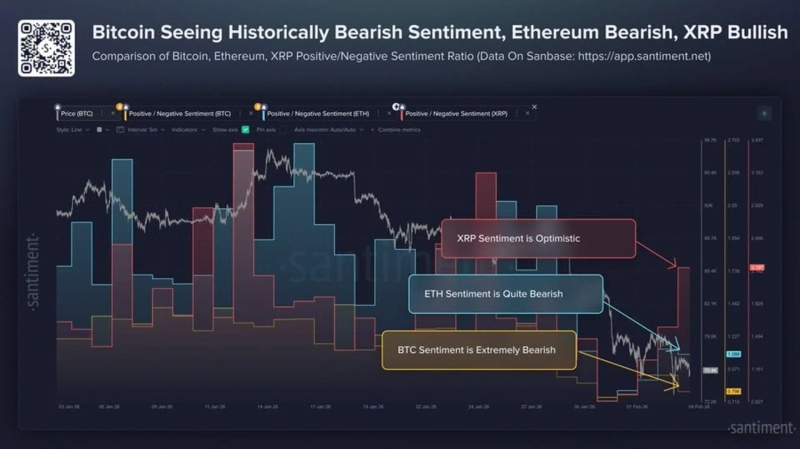
Still, some analyses note that XRP community sentiment tends to diverge from price. According to on-chain analytics platform Santiment, XRP maintains far stronger bullish sentiment on social media than Bitcoin or Ethereum. The positive-to-negative sentiment index was more than twice that of Ethereum and more than 170% higher than Bitcoin’s. While that could cushion sell pressure in the short term, it may also signal that risks are being underestimated.
Overall, the outlook remains cautious. CoinDesk said the uptrend has broken and projected that, in an extreme case, the $1 level should also be left on the table. NewsBTC analyst Aayush Jindal warned of further downside if XRP fails to reclaim resistance at $1.5320.
Issue coins
1. Dogecoin (DOGE)

Dogecoin also fell more than 20% over the week on CoinMarketCap, dropping below the $0.10 level. As of the 6th, it was still trading around $0.09.
Dogecoin drew renewed attention this week as the Elon Musk–SpaceX narrative resurfaced. On the 3rd, Musk replied on X to a post referencing his past remark that SpaceX would “literally send Dogecoin to the moon,” saying “Maybe next year.” After previously responding briefly with “Yes,” his additional comment again turned market attention toward Dogecoin.
Still, the prevailing view is that while Musk-related headlines remain as a “catalyst,” their price impact is no longer what it used to be. The SpaceX DOGE-1 lunar mission has been delayed multiple times, and in this case as well, no specific schedule or execution plan has been disclosed.
Technically, some see Dogecoin trading within a bearish channel. Crypto outlet Coingape said Dogecoin has been in a declining channel with lower highs since the peak after late 2025, and summarized the move as failing to rebound even after confirming support near $0.108 following the drop below $0.11—now retesting the key $0.10 support. It also noted that in a phase of heightened Bitcoin volatility, sentiment-sensitive assets like Dogecoin can see buying interest shrink quickly.
The key going forward is whether support at $0.08 holds. Crypto outlet NewsBTC analyzed that if Dogecoin fails to defend the $0.080 support level, a sharp drop could appear to $0.0750 and even below. Conversely, in the event of a technical rebound, around $0.090 is cited as the first resistance, with the zone where $0.0950 meets the downtrend line identified as the most important near-term resistance.
Lee Soo-hyun, Bloomingbit reporter shlee@bloomingbit.io

Suehyeon Lee
shlee@bloomingbit.ioI'm reporter Suehyeon Lee, your Web3 Moderator.