Binance Japan chief: “Stablecoins and AI will reshape the crypto market structure in 2026”
Summary
- Chino said the 2026 crypto market will hit a turning point in which regulatory clarity, stablecoins, and artificial intelligence (AI) converge, allowing crypto to take root in regulated finance and everyday payments.
- He said Japan is pushing stablecoin framework upgrades, incorporating crypto as financial products, and tax-structure changes, which could support the digital asset treasury (DAT) strategy and broaden participation by traditional financial institutions.
- He said the Japanese government is fostering stablecoins as core infrastructure through Web3, security token offerings (STOs), and integration with PayPay, enabling crypto to expand beyond an investment vehicle into real-world use and a driver of economic growth.
Forecast Trend Report by Period


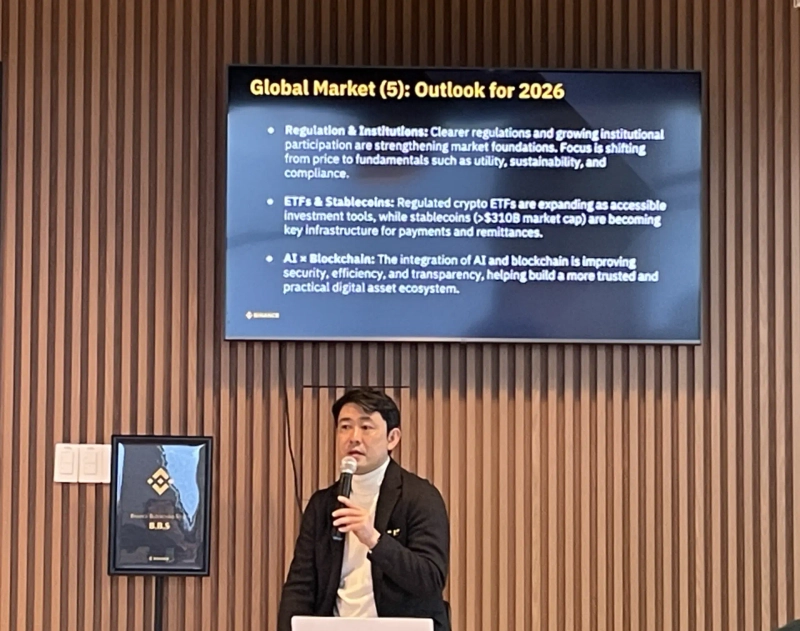
“In 2026, the crypto market will reach a turning point where stablecoins and artificial intelligence (AI) technologies converge on the back of clearer regulation, blurring the boundary between everyday payments and regulated finance. Japan, in particular, is accelerating Web3 growth by pushing regulatory reforms—diversifying eligible stablecoin issuers and incorporating crypto into the financial products framework.”
Takeshi Chino, CEO of Binance Japan (pictured), made the remarks on Feb. 11 at the “3rd Binance BBS” held in Seodaemun-gu, Seoul, introducing Japan’s regulatory overhaul cases and trends in blockchain technology. He described this year as an inflection point at which virtual assets (cryptocurrencies) move beyond being mere investment assets to become core infrastructure for the global financial system. He added that the combination of Japan’s ongoing stablecoin framework upgrades and an AI-driven environment is likely to expand both the scope of crypto use and economic growth at the same time.
“The crypto market will settle into regulated finance on the back of AI and stablecoins”
Chino said that while about 90% of the stablecoin market is currently dollar-denominated, if stablecoins backed by domestic currencies such as the yen or the euro spread into everyday use, a new ecosystem akin to existing fiat currency could emerge. He also said that the digital asset treasury (DAT) strategy—where companies stockpile virtual assets such as Bitcoin (BTC) as part of asset diversification—is likely to continue, particularly among listed companies.
He cited the convergence of AI and blockchain as a key factor reshaping market structure. “If an environment expands in which AI carries out asset allocation and trading on blockchain without intermediary cost burdens, accessibility to the crypto market will increase further,” he said. The analysis is that greater regulatory clarity, participation by traditional financial players, and technological automation could combine to expand the market.
Chino also explained that Binance Japan is expanding crypto use into payments through integration with PayPay, Japan’s largest payments platform. Binance Japan currently offers a crypto trading function using PayPay. It is also working to enable related services directly within the PayPay app. The idea is to lay the groundwork for crypto in Japan to spread beyond an investment tool into real-world use.
“Japan’s crypto regulation to shift beyond payments to ‘financial products’… tax overhaul expected”
Chino said Japan’s crypto market has built one of the world’s strictest regulatory regimes in the wake of the Mt. Gox incident. He added that around this year, Japan’s crypto framework is likely to face a turning point, shifting from a payment-services focus to a system under the Financial Instruments and Exchange Act similar to stocks and bonds. He cited changes to the tax structure and improved market credibility as key effects of the institutional overhaul.
He said that in Japan, profits from crypto trading are currently subject to a tax rate of up to 55%, but if crypto is incorporated into the financial products framework, it could become possible to apply the same flat 20% rate as stocks. “If regulatory clarity is secured, participation by traditional financial institutions will naturally expand,” he said.
He also highlighted ongoing stablecoin regulatory upgrades in Japan and the growth potential of the security token offering (STO) market. “As the system is being refined so that not only banks but also payment service operators can issue stablecoins, related products will gradually increase,” he said, adding, “The trend of embedding wallet functions into existing services to lower the barrier to entry for users will be a key driver of Web3 adoption.”
“Japan’s Web3 economy growth: stablecoins emerging as core infrastructure”
Chino cited “economic recovery through Web3” as the backdrop for the Japanese government’s push to foster stablecoins. He said the government has set nurturing the Web3 ecosystem as a national agenda, and in that process views stablecoins as core infrastructure.
He also outlined Japan’s regulatory structure, which differentiates requirements depending on the type of stablecoin issuer. In Japan, banks, payment service providers, and trust banks can issue stablecoins, but the authority granted and constraints differ. “Banks are granted the broadest autonomy, but licensing requirements are very stringent, while fund transfer operators (payment service providers) face relatively lower entry barriers but are (regulatorily) limited to a remittance cap of 1 million yen,” he said, adding that choosing the right approach depending on business objectives is important.
Asked about overseas crypto firms’ entry into the Korean market and how to respond to regulation, he pointed to substantive communication with regulators as a key factor. “There are limits to an approach that only follows the letter of the rules,” he said. “Quickly identifying what regulators are actually concerned about and the background, and responding accordingly, will determine the success or failure of a business pivot,” he advised.
Kang Min-seung, Bloomingbit reporter minriver@bloomingbit.io

Minseung Kang
minriver@bloomingbit.ioBlockchain journalist | Writer of Trade Now & Altcoin Now, must-read content for investors.