PiCK
LayerZero, which drove '₩16 trillion Tether inflows,' unveils mainnet…steps up push into Korea
Summary
- LayerZero said it has unveiled its own mainnet, 'Zero,' targeting more than a 100-fold performance improvement and a 50-fold reduction in operating costs versus existing blockchains.
- ICE (NYSE parent), DTCC, Citadel, Google Cloud, and ARK Invest joined the Zero ecosystem as launch partners and investors, and LayerZero said it signed an MOU with Nexpace, a subsidiary of Nexon.
- LayerZero said Tether’s expansion to 16 issuance chains led to $11 billion (about ₩16 trillion) in inflows and roughly ₩600 billion in annual profit growth, and that it plans to extend this to won-denominated stablecoins in Korea and strategic partnerships with Korean financial institutions.
Forecast Trend Report by Period


LayerZero launches 'Zero' mainnet
Zero-knowledge proofs adopted...costs cut to one-fiftieth
Wall Street heavyweights join, including Citadel and ARK Invest
"Even Tether sees profit growth"…courting Korea’s financial sector
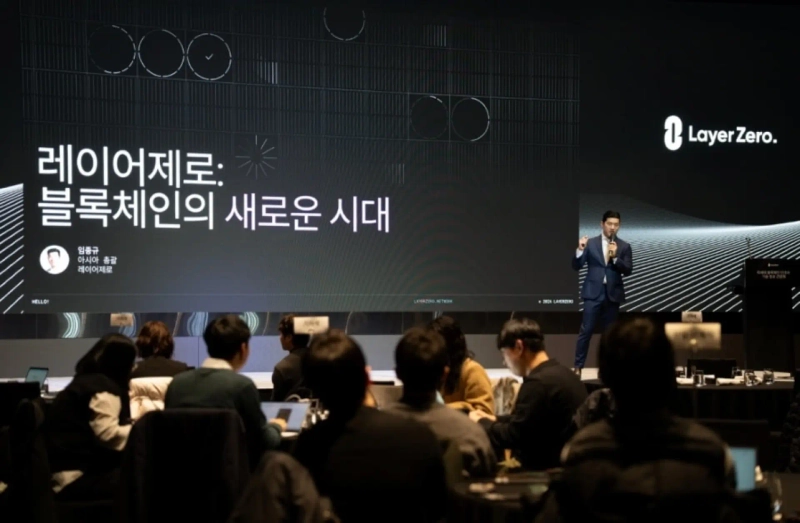
Cross-chain interoperability protocol 'LayerZero (ZRO),' which has connected more than 150 blockchains worldwide, has unveiled its own mainnet, 'Zero.' The company says it aims to build financial-industry-grade infrastructure that overcomes legacy blockchains’ speed and cost constraints and to emerge as a blockchain spanning global financial markets. It also plans to accelerate its push into Korea’s won-denominated stablecoin and real-world asset (RWA) markets on the back of the new network.
LayerZero held a press briefing on the 11th at the Glad Hotel in Yeouido, Seoul, where it presented the technical features of its next-generation blockchain architecture 'Zero,' its global expansion strategy, and plans for entering the Korean market.
"NYSE-level volume can be put on-chain…at one-fiftieth the cost"
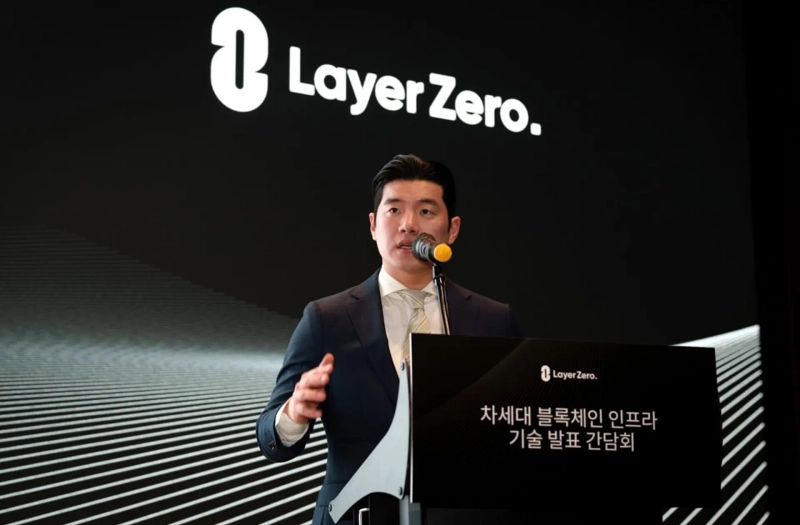
In a keynote address, Lim Jong-gyu, LayerZero’s Asia-Pacific (APAC) head, introduced the 'Zero' mainnet, saying, "We’re holding a separate briefing in Seoul after New York because we view the Korean market as strategically important."
Lim underscored the need for 'Zero' by pointing to the technical limits of existing blockchains. "The New York Stock Exchange (NYSE) processes as many as 2 million trades per second, but even high-performance chains such as Solana only handle about 4,000 per second," he said, adding, "Simple optimization can’t meet the performance standards the financial industry demands."
To address this, LayerZero adopted zero-knowledge proof (ZK) technology. By enabling verification of information without disclosing all payment details, the company says it dramatically reduced network load. It also applied an architecture that distributes processing depending on transaction characteristics, improving consistency and stability.
According to the company, Zero was designed to target more than a 100-fold performance improvement over existing blockchains through innovations across compute, storage, networking, and ZK. It said it has built a compute scheduling technology (FAFO) that supports 1 million transactions per second and a high-speed, verifiable database (QMDB) that processes 3 million state updates per second.
It also stressed that operating costs can be sharply reduced. Lim said, "With current technology, putting all NYSE trades on-chain would cost more than ₩5 trillion a year, but using Zero would make it possible to operate for under ₩100 billion," adding, "Our goal is to implement, in a blockchain environment, the transaction-processing capacity global financial markets require." He continued, "LayerZero aims to become the plumbing of the crypto-asset market," and added, "We will create an environment where any application or blockchain can be onboarded."
Wall Street 'big money' joins, including ARK Invest and Citadel…tie-up with Nexon too
LayerZero also unveiled a roster of global partners participating in the Zero ecosystem. Intercontinental Exchange (ICE), the NYSE’s parent company, the Depository Trust & Clearing Corporation (DTCC), hedge-fund market maker Citadel, Google Cloud, and ARK Invest were named as launch partners and investors.
Cathie Wood, chief executive officer (CEO) of ARK Invest, and Michael Blaugrund, vice president of strategy initiatives at ICE, among others, have joined LayerZero’s advisory board to support the expansion of the Zero ecosystem.
Cooperation with Korean companies was also specified. LayerZero said it signed a memorandum of understanding (MOU) for a partnership with Nexpace, Nexon’s blockchain subsidiary. It plans to connect Nexpace’s gaming ecosystem to Zero to explore new business models.
A LayerZero official said, "We are in talks with Nexpace on multiple fronts. Details of a more concrete partnership will be announced soon."
"Tether profit up ₩600 billion in nine months"…courting Korea’s financial sector
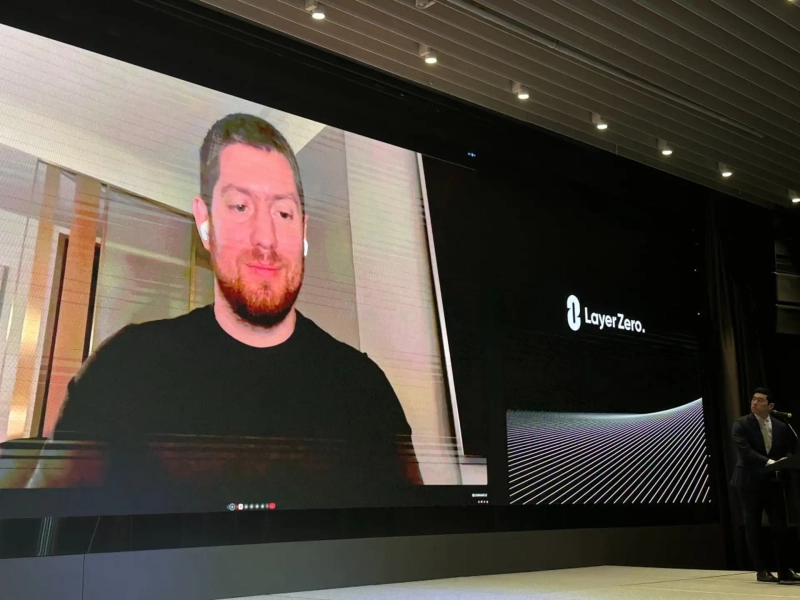
Brian Pellegrino, a LayerZero co-founder, delivered a message to Korea’s financial sector via video link.
He said, "After adopting LayerZero’s solution, Tether expanded its issuance chains from just three—Ethereum, Tron and Ton—to 16 in nine months," adding, "As a result, an additional $11 billion (about ₩16 trillion) in assets flowed in, translating into a direct profit increase of about ₩600 billion a year." He emphasized that expanding technical infrastructure directly translated into revenue growth.
LayerZero’s strategy is to apply this success story to the Korean market. Pellegrino said, "Korea has strong fintech capabilities and a fast pace of crypto-asset adoption, to the point it’s called Asia’s financial hub," adding, "We can solve the liquidity expansion and cost-efficiency challenges faced by won stablecoin issuers."
He added, "As we did in working with Tether, we want to continue in-depth discussions with Korean financial institutions that are considering strategic partnerships beyond a simple technology rollout," making clear the company’s intent to step up its push into Korea.

Doohyun Hwang
cow5361@bloomingbit.ioKEEP CALM AND HODL🍀