U.S. fleshes out 'MASGA' blueprint…to have allies build initial tranche [Lee Sang-eun’s Washington Now]
Summary
- The U.S. government said it will pursue a bridge strategy under the U.S. Maritime Action Plan (MAP), encouraging allies’ shipyards to build the initial tranche and then shifting to investment and construction in the United States.
- It said it will impose a cargo-tonnage-linked universal fee on all foreign-built vessels, effectively using it as a “second tariff,” and deposit the proceeds into the Maritime Security Trust Fund (MSTF).
- It said it will introduce a “U.S. Maritime Priority Requirement (USMPR)” mandating that a set share of U.S.-bound container cargo be carried on U.S.-built ships, protecting U.S. shipbuilding through what would amount to a “second Jones Act.”
Forecast Trend Report by Period


Fees to be levied on all foreign-built vessels in proportion to cargo tonnage, adding another burden on top of tariffs
New rule to mandate a set share of U.S.-bound containers be carried on 'U.S.-built ships'—a 'second Jones Act'

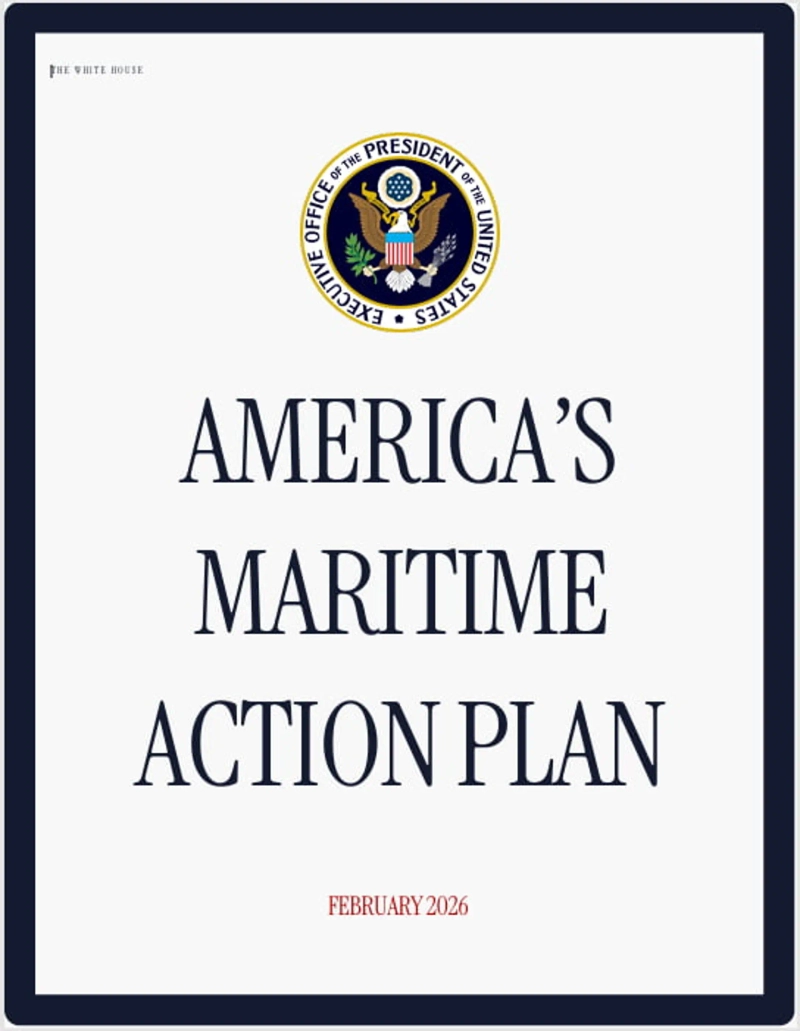
The Donald Trump administration has unveiled the “U.S. Maritime Action Plan (MAP)” aimed at reviving the domestic shipbuilding industry. The plan envisions having allied shipyards build the initial tranche under contract, then shifting construction to the United States through subsequent investment in America.
On the 13th (local time), the White House released the MAP document in the names of Secretary of State Marco Rubio—who also serves as White House National Security Adviser—and Office of Management and Budget (OMB) Director Russell Vought. The document lays out an implementation plan for “Restoring Maritime Dominance,” which President Trump signed on April 9 last year. According to the document, the U.S. government will designate “Maritime Prosperity Zones (MPZs)” to provide tax incentives and attract allies’ shipyard investment into the United States.
The 38-page document states it will “continue historic cooperation with South Korea and Japan to revitalize U.S. shipbuilding.” It also says it will “encourage allied shipbuilders to invest in the U.S. shipbuilding industry” and will “focus on proactive investment partnerships with allies and trusted partners.”
◆ ‘Bridge strategy’ raises possibility of Korea building initial tranche
The document explicitly sets out a “bridge strategy.” It says that when purchasing multiple vessels, “initial vessels should be built at the foreign shipbuilder’s home-yard,” while “direct investment proceeds simultaneously at U.S. shipyards.” In other words, if a Korean shipbuilder wins an order for multiple ships, the initial tranche could be built in Korea and later vessels in the United States as a contractual condition. To build in the U.S., investment would naturally follow, and know-how would be transferred in the process—an interpretation of the plan.
In a joint fact sheet released in November last year, the two countries said they would “increase as quickly as possible the number of U.S. commercial ships and U.S. Navy combat-capable warships, including potential construction of U.S. ships in South Korea.” The new document advances this by calling for placing orders for multiple vessels while splitting early and later production locations.
However, for such an approach to be realized, existing statutory restrictions—such as the Jones Act (commercial vessels) and the Byrnes–Tollefson Amendment (warships), which specify “built in the United States”—would need to be loosened. In this regard, Trump is reported to have told the Korean negotiating team last year that he would apply certain exceptions via executive orders and similar measures.
There is a growing consensus in the U.S. government and in Congress that rebuilding U.S. shipbuilding is only feasible by leveraging allied shipyards. But opposition from lawmakers representing districts with shipyards scuttled revisions to the relevant laws last year. Even if bypassed via executive order, the measure would likely be permitted only as a temporary interim step, while the long-term goal of U.S.-based construction remains intact.
The document also includes language about “using existing mature or modular commercial and government (domestic and international) vessel designs” and “leveraging commercial standards and designs.” This implies the possibility that the U.S. side could draw on Korean designs for destroyers, auxiliaries, and merchant ships.
◆ 100 dedicated zones (MPZs) to be designated
The document states that “President Trump secured at least $150 billion in dedicated investment for the U.S. shipbuilding industry.” This is interpreted as referring to the “MASGA dedicated investment” pledged by South Korea. It explains that “by establishing a clear pathway for foreign direct investment (FDI) in U.S. shipyards, suppliers, and maritime infrastructure, the United States can strengthen external relationships while expanding domestic capacity.”
As the pathway for such investment, the document proposes “Maritime Prosperity Zones (MPZs).” It notes that while existing incentive mechanisms across the federal, state, and local governments—including tax credits, loan guarantees, and workforce training programs—can be useful tools, they are fragmented and often insufficient to attract major shipbuilders; MPZ designation would coordinate them. Areas where Korean companies invest are also likely to be designated as MPZs.
The Secretary of Commerce will be responsible for selecting MPZs, with authority to designate a total of 100 zones for a 10-year term. The report says consultations should be held with the Secretary of the Treasury, Secretary of Transportation, Secretary of Homeland Security, the OMB Director, and the Secretary of War. It adds that MPZs will be “ensured to be geographically diverse,” covering not only the U.S. East and West coasts and the Gulf of America but also river basins, the Great Lakes, Alaska, Hawaii, and U.S. territories—areas beyond traditional coastal hubs for shipbuilding and ship repair.
The document says it will reflect the “enhanced Opportunity Zones (OZ 2.0)” provisions included in last year’s “One Big Beautiful Bill Act (OBBBA).” These provisions extend tax benefits for longer periods in exchange for mandatory investment reporting.
It stresses that expanding shipbuilding capacity through these policies is aimed not merely at increasing the number of ships built domestically, but at rebuilding “an independent production capability, rapid mobilization in crises, and a resilient maritime industrial base (MIB) with international competitiveness.”
A ‘second tariff’ plan sends a warning signal
The plan to “create a universal fee on foreign-built vessels of all nations entering U.S. ports” is a disadvantageous point for Korean companies. The document says the fee would be set at 1–25 cents per kg based on the weight of imported cargo loaded on the vessel. It calculates that a 1-cent fee could generate $66 billion over 10 years (about KRW 9.5 trillion), while a 25-cent fee could generate $1.5 trillion (about KRW 2,160 trillion).
This is intended as a pressure tactic to force U.S.-based construction. Given that current U.S. shipbuilding capacity is extremely limited, the fee would in practice apply to most vessels and function as a “second tariff.” Shipping lines, as cargo owners, would be the primary payers, but ultimately importers and consumers are expected to bear the burden.
The plan is to deposit the revenue into the Maritime Security Trust Fund (MSTF). The document states that “to the extent foreign-built vessels benefit from access to the U.S. market, this policy ensures they contribute to the long-term reactivation of U.S. maritime capacity.”
The document also presents various funding measures. It says it will “establish a new grant program to fund projects that increase the capacity and efficiency of U.S. shipyards of all sizes.” It aims to expand federal financing and tax incentives (Title XI, the Capital Construction Fund (CCF), the Construction Reserve Fund (CRF), accelerated depreciation, tax credits, etc.) to reduce the capital costs of building shipyards and constructing vessels. It also adds that it will create dedicated credit or loan programs for major shipyard capital projects. Whether Korean companies would benefit from such support will likely depend on the release of more detailed program information.
A ‘second Jones Act’ also on the table…competitiveness remains distant
The document also addresses skilled labor and workforce shortages in the shipbuilding industry, including plans to create various workforce training programs and strengthen related support. However, it remains uncertain whether these plans will deliver the targeted increase in output.
The key question is: once production capacity is expanded, “who will buy” the ships. For warships, some demand can be absorbed even if prices are higher due to the nature of the defense industry, but merchant ships must compete in the market with Korean—and Chinese—vessels.
The solution proposed is the creation of requirements such as a new “U.S. Maritime Priority Requirement (USMPR)” to fill a portion of U.S.-bound container cargo with “U.S.-built ships.” The document says it will “require that a set percentage of U.S.-bound container cargo be carried by qualifying U.S. vessels.” It notes that while 41.5% of current U.S. international trade (worth about $2.1 trillion) moves by sea, most of the ships involved were built abroad. It argues that “foreign dominance of the global container shipping market has accelerated the decline of U.S. domestic shipbuilding capacity and the shortage of U.S. mariners,” which it says is “a significant vulnerability to U.S. economic and national security.”
Such requirements could be a double-edged sword for Korean shipyards that push ahead with investment in the United States. In the early stages, they are expected to provide a temporary boost by securing demand. Since unit production costs are likely to be several times higher than in Korea or China, securing initial demand is essential.
Over the longer term, however, this is likely to become another version of the Jones Act (which requires that merchant ships operating between U.S. coastal points be built in the United States). If the government-protected U.S.-only ship market is separated from the global ship market, the odds are high that industrial competitiveness will erode over time. Moreover, because the purpose of such regulation is to protect U.S. workers’ jobs, efforts to improve management efficiency at less competitive shipyards could be hindered.
Washington=Correspondent Lee Sang-eun selee@hankyung.com

Korea Economic Daily
hankyung@bloomingbit.ioThe Korea Economic Daily Global is a digital media where latest news on Korean companies, industries, and financial markets.