Summary
- US President Donald Trump is reportedly weighing an early-stage “limited military strike” to force Iran into a nuclear deal.
- It said the United States plans to escalate its response to broader strikes on regime infrastructure aimed at regime collapse if Iran continues to reject demands to halt uranium enrichment.
- It said the prospect of an actual strike is rising as the United States significantly reinforces forces near Iran, including F-35s, F-22 fighter jets, and a carrier strike group.
Forecast Trend Report by Period


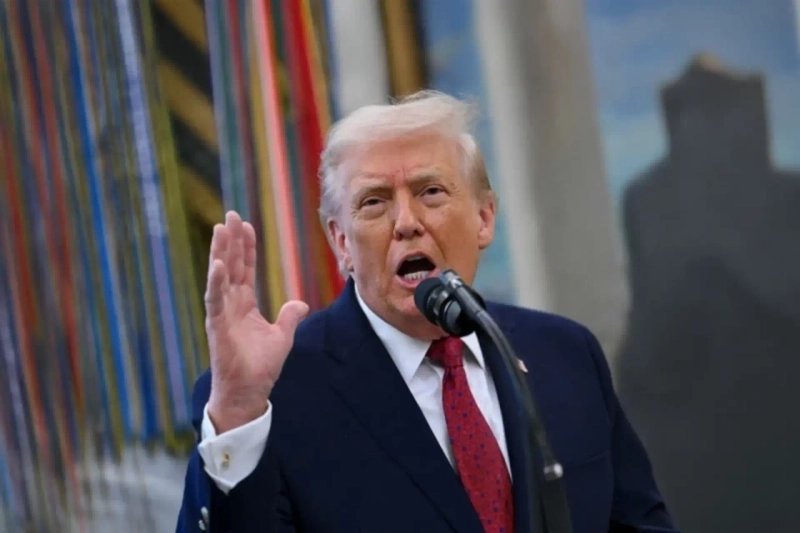
US President Donald Trump is reportedly considering an early-stage “limited military strike” to compel Iran to accept a nuclear deal.
On the 19th (local time), The Wall Street Journal, citing sources, said that “if a strike is approved, it could be carried out within days, and a small number of military and government facilities would be targeted.” If Iran continues to refuse demands to halt uranium enrichment, the United States plans to raise the level of its response by launching broader strikes on regime infrastructure that could aim at the collapse of the Iranian government.
President Trump said last Thursday that he would decide his next steps on Iran within the next 10 days. He later told reporters it would be “no more than about two weeks,” stressing that he would “reach a deal one way or another.”
In this regard, White House spokesperson Anna Kelly declined to comment on specific next steps by the United States, saying, “Only President Trump knows what he’s going to do.” Officials said Trump has not yet made a final decision on the scale of an attack, but is weighing a range of options—from a weeklong barrage aimed at regime change to small strikes targeting government and military facilities.
This consideration of a small initial strike is similar to the so-called “bloody nose” strategy that Trump discussed regarding North Korea during his first term. In 2018, the US administration gave serious consideration to a limited preemptive strike to pressure North Korea to halt its nuclear program.
Iran is already on high alert over moves by the Trump administration. That is because, last year, the White House announced it would give Iran two weeks to reach a nuclear agreement, but just days later set a precedent by suddenly striking three Iranian nuclear facilities using B-2 bombers.
Senior US and Iranian officials held diplomatic talks this week but remained deadlocked. The United States strongly demanded a complete halt to Iran’s uranium enrichment, limits on its ballistic missile program, and an end to its support for armed proxy forces. Iran, however, rejected a comprehensive agreement, offering only lukewarm concessions, and repeated its long-standing position that it has never sought nuclear weapons.
As the stalemate drags on, the likelihood of an actual strike is rising further as US forces are being significantly reinforced near Iran. Over the past few days, the United States has forward-deployed its latest F-35 and F-22 fighter jets to the Middle East. A second carrier strike group carrying attack aircraft and electronic warfare assets is en route, and command-and-control aircraft for large-scale air operations and key air-defense networks have also been deployed to the region in recent weeks.
Iran’s Supreme Leader Ali Khamenei, on the 17th, warned of a maximum-level military response, saying, “We can sink US aircraft carriers and strike so powerfully that US forces cannot recover.”

Doohyun Hwang
cow5361@bloomingbit.ioKEEP CALM AND HODL🍀