Blue House: "Friendly talks with the U.S. to ensure tariff deal and exports to the U.S. are not harmed"
Summary
- It said uncertainty in the global trade environment has increased due to the U.S. Supreme Court’s ruling that reciprocal tariffs are unlawful and invalid.
- The government said it will continue friendly consultations to ensure the balance of benefits secured through the Korea-U.S. tariff agreement and conditions for exports to the U.S. are not harmed.
- It said it will closely cooperate with business groups while reviewing the issue of refunds for reciprocal tariffs already paid and the status of legislation for the Special Act on Investment in the U.S.
Forecast Trend Report by Period


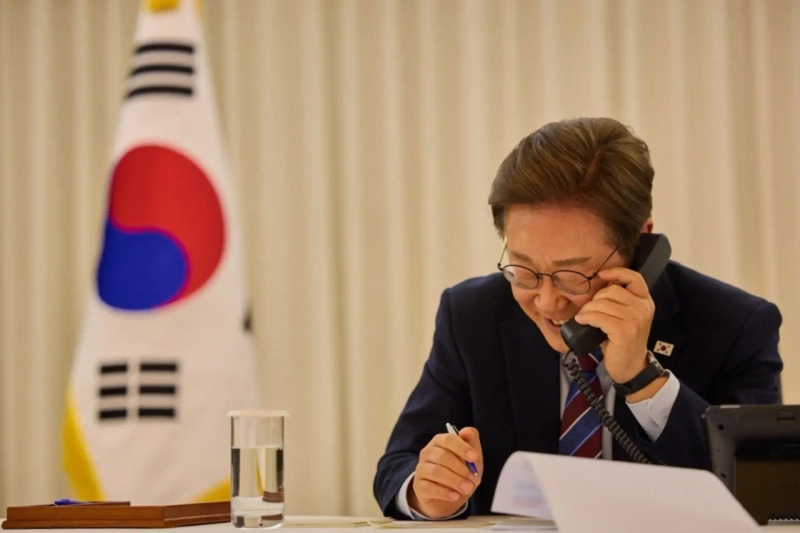
The Blue House said on the 21st, regarding the U.S. Supreme Court ruling that the reciprocal tariffs are unlawful, that "while it is true that uncertainty in the global trade environment has increased due to the U.S. judiciary’s ruling, the government plans to continue friendly consultations based on the special alliance between South Korea and the United States so that neither the balance of benefits secured through the Korea-U.S. tariff agreement nor the conditions for exports to the U.S. are undermined."
The Blue House said it shared this stance at an interagency meeting on pending trade issues with the U.S., chaired that afternoon by National Security Office Director Wi Sung-lac and Policy Office Director Kim Yong-bum.
Kang Yu-jung, spokesperson for the Blue House, explained in a written briefing that participants reviewed the key points and impact of the U.S. Supreme Court’s ruling that invalidated the reciprocal tariffs imposed under the International Emergency Economic Powers Act (IEEPA).
The meeting was attended by senior and vice ministers from relevant ministries, including Deputy Prime Minister and Minister of Economy and Finance Koo Yun-cheol, Foreign Minister Cho Hyun, Minister of Trade, Industry and Energy Kim Jeong-gwan, and Trade Minister Yeo Han-gu, as well as key aides such as Ha Jun-kyung, the Blue House’s Senior Secretary for Economic Growth, and Oh Hyun-joo, third deputy director of the National Security Office.
Under the ruling, the 15% reciprocal tariff currently being levied by the U.S. becomes invalid. However, as the U.S. administration subsequently announced the imposition of a 10% global tariff under Section 122 of the Trade Act, the government decided to closely monitor additional U.S. measures and developments in major countries.
As for refunds of reciprocal tariffs already paid—an issue not explicitly addressed in the ruling—the government decided to work closely with business groups and associations to ensure accurate information is delivered to Korean companies in a timely manner. It also agreed to review the status of legislation for the Special Act on Investment in the U.S. and to proceed without disruption with legislative procedures such as public hearings.
Earlier, on the 20th (local time), the U.S. Supreme Court finalized a decision finding the IEEPA—used by President Trump as the basis for imposing reciprocal tariffs—unlawful for exceeding the scope of its authority. The Court held that the authority to levy taxes, including tariffs, rests with Congress, and that the IEEPA’s ambiguous provisions do not delegate to the president unlimited authority to impose tariffs.
Lee Seul-ki, Hankyung.com reporter seulkee@hankyung.com

Korea Economic Daily
hankyung@bloomingbit.ioThe Korea Economic Daily Global is a digital media where latest news on Korean companies, industries, and financial markets.