South Korea exports 174 trillion won worth—but an unexpected reason it’s getting nervous about the AI boom [Global Money X-File]
Summary
- It said that a surge in global data center power demand and computeflation are intensifying power-infrastructure bottlenecks and inflationary pressures.
- It reported that the Global South’s manufacturing base—including Vietnam, Mexico and Malaysia—is seeing electricity and water resources crowded out by AI data centers, heightening fears of premature deindustrialization.
- It said that if local grid constraints lower assembly-plant utilization, South Korea could face declining intermediate-goods exports and a worsening trade balance, while there is also an opportunity in a transformer and power T&D equipment supercycle.
Forecast Trend Report by Period


Power-hungry Big Tech data centers…hit emerging-market manufacturing

As Big Tech ramps up investment in artificial intelligence (AI) infrastructure, “computeflation”—inflationary pressure across global supply chains—has emerged as a new flashpoint for the world economy. Big Tech is routing around bottlenecks in advanced economies’ power grids by shifting to emerging markets, effectively crowding out energy available to local manufacturing.
Data center electricity consumption surges
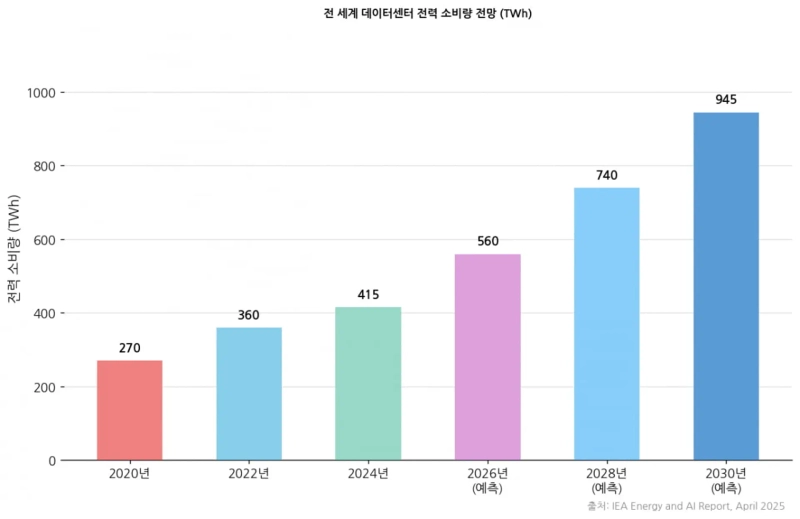
According to the International Energy Agency (IEA) on the 26th, global data center electricity consumption is projected to rise from 415 TWh in 2024 to as much as 1,000 TWh by 2030. IEA Executive Director Fatih Birol warned in a report last year that “AI is one of the biggest topics in today’s energy world, and proactive investment is urgently needed to prevent power bottlenecks.”
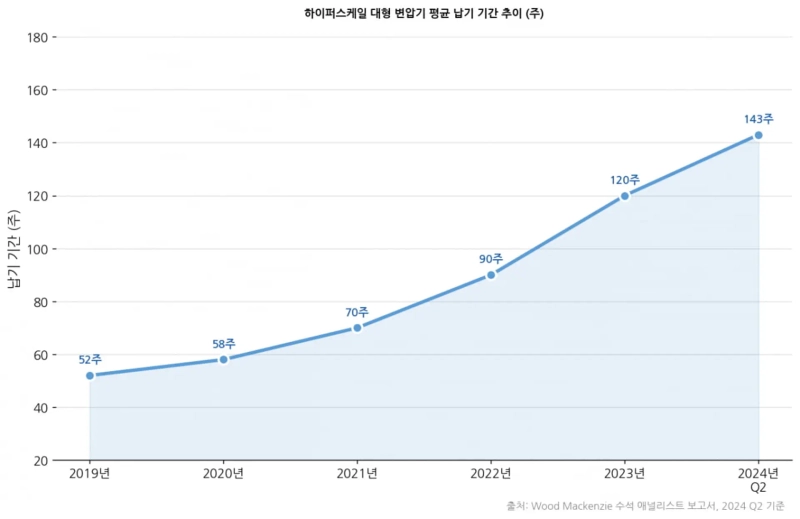
The industry points to the biggest issue as delays in “Time-to-Power”—the physical lag involved in expanding relevant infrastructure. According to global research firm Wood Mackenzie, the average delivery lead time in the United States for large step-up transformers—essential for hyperscale grid connections—rose to 143 weeks as of the second quarter of last year.
Ben Boucher, a senior analyst at Wood Mackenzie, said, “With power demand exploding, as of 2025 the U.S. is facing a 30% shortfall in the supply of power transformers.” The limits of advanced economies are clear: even with money, they cannot secure the necessary infrastructure equipment. According to the UK regulator Ofgem, as of this month the amount of data center capacity waiting to connect in the UK totals 50 GW, exceeding the country’s overall peak demand (about 45 GW).
Recently, U.S. Big Tech firms and others have been detouring to “Global South” countries in Southeast Asia and Latin America, where it is easier to secure sites and regulations are looser, to avoid infrastructure bottlenecks at home. The problem is that traditional manufacturing hubs that had benefited from supply-chain diversification are experiencing a “crowding-out effect,” with essential public goods being absorbed by AI capital.
Emerging markets’ infrastructure is being crowded out
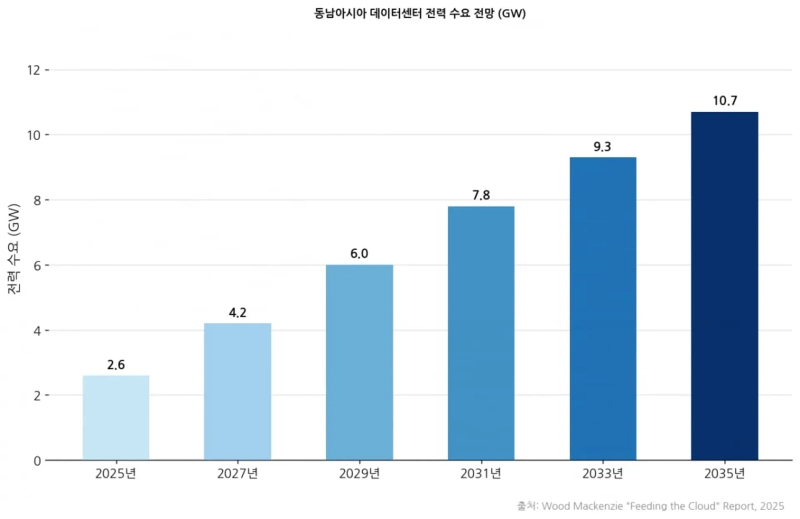
A prime example is Johor state in Malaysia, a hub for Southeast Asia. Wood Mackenzie projects that data center power demand in Southeast Asia will surge from 2.6 GW in 2025 to 10.7 GW in 2035. As a result, due to pressure on water resources and the power grid, as of the end of 2024 up to 30% of new approval applications were rejected in local reviews. Malaysian Prime Minister Anwar Ibrahim recently said, “To contain pressure on the power grid and water resources, we will strictly limit entry of new data centers unrelated to AI for two years.”
Mexico’s Querétaro state has also seen data centers drive up electricity procurement costs for nearby industrial parks. Reuters reported that large-scale capital is flowing in, including CloudHQ’s $4.8 billion investment in a massive data center campus in the region. But the area’s power transmission and distribution infrastructure has already reached its limits. Oscar Ocampo, energy coordinator at the Mexican Institute for Competitiveness (IMCO), noted in a November interview with El País last year that “Mexico has seen virtually no investment in the power sector over the past six years.”
Vietnam, too, has been put on alert by a rapid rise in electricity demand, as investment to expand digital infrastructure has been concentrated in the northern region. Worried that power shortages could undermine foreign direct investment and national industrial competitiveness, the Vietnamese government has elevated power procurement to a top priority. Prime Minister Phạm Minh Chính stressed last month in a directive on ensuring power supply that “adequate power supply is mandatory, and there can be no exceptions.”
Opinions are divided in these countries over attracting Big Tech. Supporters say the companies’ massive capital and long-term power purchase agreements have dramatically accelerated developing countries’ decarbonization transition and the buildout of renewable-energy infrastructure. Critics, however, argue that data centers—which have a very low job-creation multiplier—are soaking up base-load electricity that supports traditional manufacturing responsible for employing tens of thousands.
The most serious economic risk is the prospect of “premature deindustrialization” in emerging markets. Typically, developing countries attract traditional manufacturing on the back of cheap labor and stable basic infrastructure, fostering a middle class and growing the national economy. But concerns are rising that they could end up draining their own core resources to run AI computation largely used by consumers in advanced economies—potentially undermining existing, healthy trade ecosystems.
The value added and technological dividends generated by AI accrue to U.S. tech companies that own large language model (LMM) software and algorithm patents. Meanwhile, the ecological and physical costs—massive carbon emissions to sustain huge data facilities, as well as depletion of electricity and water resources—could be left to Global South countries, entrenching an asymmetric structure.
Spillovers to the global macroeconomy
There are macroeconomic spillovers as well. For now, data centers still account for a small share of global electricity consumption. But in some regions, the knock-on effects are expected to be significant. According to power statistics released last year by Ireland’s Central Statistics Office, the share of data centers in Ireland’s total metered electricity consumption rose from 5% in 2015 to 22% in 2024.
The impact of computeflation does not stop at higher local electricity bills. Countless global manufacturing plants located in Global South industrial parks—such as in Querétaro, northern Vietnam, and Johor—must absorb soaring industrial power tariffs in full. Rising risks of voltage drops and rolling blackouts could also add maintenance costs to prevent production-line shutdowns. Traditional manufacturers facing severe pressure on operating margins may have little choice but to raise export prices for key intermediate goods and final consumer products to defend profitability.
South Korea’s economy will be affected as well. Korea’s economic model depends on a value chain in which high value-added intermediate goods are mass-produced domestically, exported to Vietnam, Mexico and elsewhere, and assembled into finished products at local factories. According to the Ministry of Trade, Industry and Energy, South Korea’s exports to ASEAN totaled about $122.5 billion last year. Of that, exports to Vietnam alone—its key assembly base—reached $62.8 billion. More than 80% of exports to Vietnam and Mexico are intermediate goods such as parts and equipment.
If grid constraints reduce utilization rates at local assembly plants, they may be unable to process components in a timely manner, leading to fewer new export orders for Korean intermediate goods and a deterioration in the trade balance. On the other hand, the global shortage of transformers and power transmission and distribution equipment presents a geopolitical opportunity—a “supercycle”—for South Korea’s related industries.
Reporter Kim Joo-wan kjwan@hankyung.com

Korea Economic Daily
hankyung@bloomingbit.ioThe Korea Economic Daily Global is a digital media where latest news on Korean companies, industries, and financial markets.