Ruling and opposition parties: "Digital-asset regulation must prioritize innovation…Oppose bank-led stablecoins and curbs on exchange controlling shareholders"
Summary
- Rep. Kim Sang-hoon said the 15–20% cap on controlling shareholders’ stakes in exchanges could undermine confidence in Korea’s digital-asset market.
- Rep. Min Byeong-deok said the Digital Asset Framework Act must be a stepping stone, emphasizing that designing Korea’s digital-asset market structure is key.
- Rep. Min Byeong-deok warned that a closed structure would hinder domestic business growth, while proposing stability safeguards such as bank-led stablecoins, Wonsco, and holding reserve assets of at least 100%.
Forecast Trend Report by Period


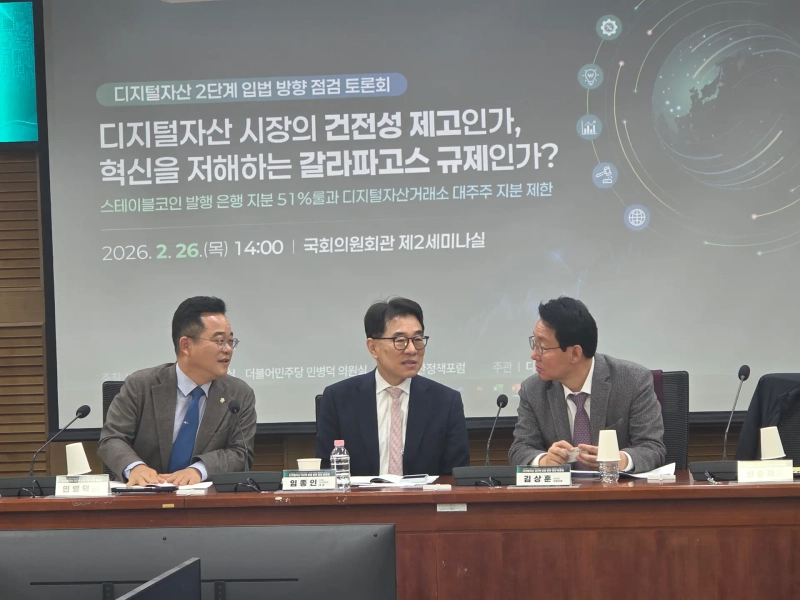
"Regulation of controlling shareholders’ stakes in exchanges is a constraint that tightens the screws on the digital-asset market—something without precedent in global markets. If mishandled, it could undermine confidence in Korea’s digital-asset market."
On the 26th, Rep. Kim Sang-hoon of the People Power Party made the remarks while attending the 'Discussion Forum Reviewing the Direction of Phase 2 Digital-Asset Legislation' at Seminar Room No. 2 of the National Assembly building in Yeouido, Seoul. Rep. Kim serves as chair of the party’s 'Stock and Digital Asset Value-Up Special Committee.'
The controlling-shareholder stake cap is included in the government proposal released by the Financial Services Commission (FSC) and refers to limiting the ownership stake of controlling shareholders in digital-asset exchanges to 15–20%.
Rep. Kim said, "So far, the government has been consistently one-sided in regulating digital assets," adding, "At the time, some risks made certain regulations unavoidable, but the situation is changing rapidly after Donald Trump was elected U.S. president."
He continued, "We need to secure leadership in the global market, and this is not the right time to impose limits on controlling shareholders’ stakes in exchanges," adding that "legislation is needed that can put wind under the sails of the digital-asset market."
Rep. Min Byeong-deok of the Democratic Party of Korea, a member of the Digital Asset Task Force (TF) that co-hosted the forum, also voiced opposition to the financial authorities’ regulatory approach.
Rep. Min said, "If the Phase 1 User Protection Act aimed to establish a minimum level of order, Phase 2 will determine how to design Korea’s digital-asset market structure," adding, "I have repeatedly stressed that the Digital Asset Framework Act must serve as a stepping stone, not a stumbling block."
In particular, Rep. Min expressed concern that the bank-centered stablecoin (a digital asset pegged to the value of fiat currency) issuance structure advocated by the authorities could undermine the scalability of a won-denominated stablecoin. The government proposal released by the FSC specifies that stablecoin issuers should be limited to a consortium with 'bank equity stake 50%+1.'
Rep. Min said, "A stablecoin is not just a digital asset—it is infrastructure for the digital era," adding, "We need to make Wonsco (a won-based stablecoin) a go-to coin and attract many customers around the world."
He added, "But if we build an overly closed structure in the institutional design process or introduce regulations that are not aligned with international standards, domestic businesses cannot grow."
Rep. Min also questioned the claim that a bank-centered ownership structure guarantees stablecoin stability. He explained, "The claim that bank equity stake 50%+1 can enhance stability may sound plausible, but stablecoin stability does not come from a bank-centered ownership structure."
He then presented measures that could enhance stablecoin stability: ▲holding reserve assets of at least 100%, ▲a clear guarantee of redemption rights, ▲transparent disclosures, ▲external oversight, and ▲conduct regulation for internal controls and supervisory systems.

Uk Jin
wook9629@bloomingbit.ioH3LLO, World! I am Uk Jin.