The KOSPI is at ‘6,000’—so why is my stock the only one not rising?… “There are opportunities in OOO” [Analysis+]
Summary
- Brokerages said that, as the KOSPI’s rise has been driven by large caps, investors need to selectively pick relatively underperforming names expected to benefit from policy tailwinds.
- Experts cited index volatility stemming from short-term overheating and recommended a staggered buying strategy, adding that mid- and small-cap stocks should be approached from the perspective of policy expectations and supply-demand dynamics.
- Brokerages said that if investors selectively pick names where governance-related issues remain—such as the Commercial Act revision, treasury-share cancellations, holding companies, and asset plays—there may be additional opportunities and substantial upward pressure on valuations.
Forecast Trend Report by Period


Large- and mid-cap indices up 14% while micro-caps ‘barely’ gain 1%
“Commercial Act revision creates additional opportunities in governance-related themes and asset plays”
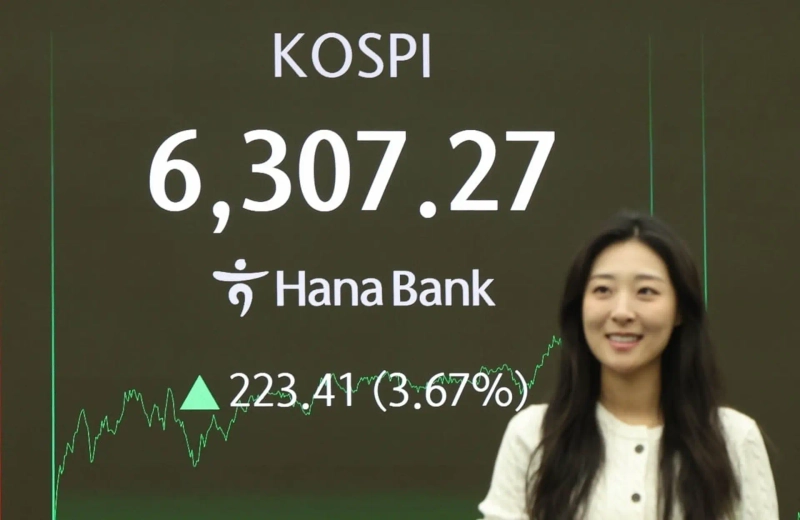
As the KOSPI climbed from the 5,000 level to 6,300 in just one month after breaking above 5,000, a growing sense of being left out is spreading among investors who jumped into the market late.
The brokerage industry says that, since achieving “6,000 KOSPI” has largely been driven by semiconductor-heavy large caps, investors going forward should selectively pick stocks that have lagged but are expected to benefit from policy support.
According to the Korea Exchange on the 27th, 240 stocks rose and 662 fell on the KOSPI market the previous day. Even so, the KOSPI jumped 3.67% from the prior session. That the index rose despite more decliners than advancers indicates gains were concentrated in large caps with hefty market capitalizations.
The KOSDAQ market also saw 437 advancers versus 1,257 decliners, yet the index gained 1.97%. Here, too, rally leadership came from top market-cap names such as pharmaceuticals/biotech and semiconductor equipment companies.
So far this year, the concentration into large caps in Korea’s stock market has been severe.
Over the past month, while the KRX Large & Mid-Cap TMI (Total Market Index) rose 14.62%, the KRX Mid-Cap TMI gained 4.09%, the KRX Small-Cap TMI 2.87%, and the KRX Micro-Cap TMI only 1.21%.
TMI is a market index compiled by the Korea Exchange that reflects both the KOSPI and KOSDAQ markets, calculated based on shares actually in circulation after excluding holdings by controlling shareholders and related parties.
Large & mid-cap covers stocks accounting for more than 94% of cumulative market cap; mid-cap refers to those within large & mid-cap excluding KRX300 constituents; small-cap covers the 94–99% cumulative market-cap bracket; and micro-cap refers to stocks below the 99% cumulative market-cap threshold.
Han Ji-young, a researcher at Kiwoom Securities, said, “With the KOSPI recently staging a strong bull run, conditions are such that investors can easily be swept up by chase-buying and FOMO (fear of missing out),” adding, “Given the risk of short-term overheating pushing up index volatility, a strategy of scaling in—rather than buying all at once—is desirable.”
She added, “For mid- and small-cap stocks, it is necessary to approach them from the perspective of policy expectations and supply-demand dynamics.”
Brokerages also advise that, beyond semiconductors backed by earnings, investors should pay attention to stocks expected to benefit from policy tailwinds following the National Assembly’s passage of the third revision to the Commercial Act.
In particular, they say that even amid concerns of price-in effects in the recent rally, investors should focus at this week’s shareholder meetings on companies with issues such as holding-company discounts, succession-related overhangs, and the potential for treasury-share cancellations.
Park Se-yeon, a researcher at Hanwha Investment & Securities, said, “This Commercial Act revision requires companies to decide whether to cancel and how much of newly acquired treasury shares within one year of purchase, and for existing treasury shares within 18 months from the effective date—so if you select stocks where issues still remain, there are additional opportunities.”
She added, “Holding companies, asset plays and manufacturers that have accumulated large treasury-share holdings while lingering for long periods in the 0.3–0.6x price-to-book (PBR) range may face increasing pressure over time either to move toward a blanket cancellation or to persuade shareholders at annual meetings regarding how they will use treasury shares,” noting, “Over the medium to long term, they are likely to face upward valuation pressure premised on improved corporate governance.”
Noh Jeong-dong, Hankyung.com reporter dong2@hankyung.com

Korea Economic Daily
hankyung@bloomingbit.ioThe Korea Economic Daily Global is a digital media where latest news on Korean companies, industries, and financial markets.