President Lee: “Ultra-high-end homes should bear burdens on par with advanced economies” … hints at higher holding taxes
Summary
- The government said raising the effective holding-tax rate from the current 0.1% range to around 1%—in line with major global cities—would increase the tax burden on ultra-high-end homes and expensive apartments in Seoul.
- President Lee Jae-myung said the government will make selling more advantageous than holding not only for multi-homeowners but also for single-homeowners holding for investment or speculation, and that regulations and burdens will be designed around owner-occupied primary homes.
- As a holding-tax hike is pursued with reference to overseas cases, the report noted analyses citing examples such as New Jersey—where the property-tax burden is high but the home price index still rose nearly 70%—to argue that strengthening holding taxes alone has limits in stabilizing home prices.
Forecast Trend Report by Period


Signals tougher tax burden on ‘one premium home’ after heavier taxation on multi-homeowners
New York’s effective rate at around 1–2%
Tokyo levies fixed-asset tax on construction cost
Korea: around 0.1% based on officially assessed land prices
New Jersey has the heaviest property-tax burden
Home prices surged nearly 70% over five years
“Tax burden alone has limits in stabilizing prices”
Counterargument: “Simple comparisons are difficult”
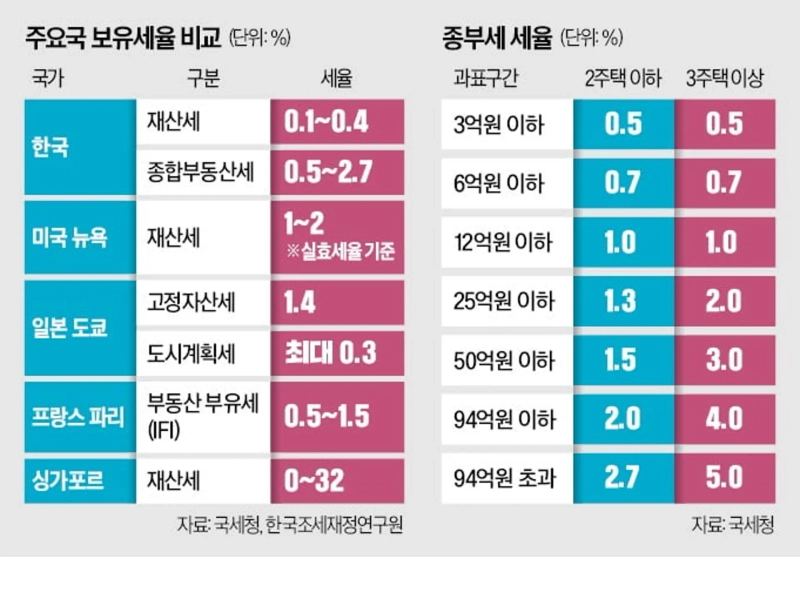
With the end of the grace period for heavy capital-gains taxation on multi-homeowners set for May 9, expectations are growing that the government will raise holding taxes. The view gained traction after President Lee Jae-myung wrote on X (formerly Twitter) on the 27th that “ultra-high-end homes will face burdens and regulations commensurate with the level of advanced-economy capitals.” The government is reviewing a property-tax overhaul that lowers transaction taxes and raises holding taxes. Analysts say that if the effective holding-tax rate—currently in the 0.1% range—is lifted to around 1% to match major global cities, the tax burden on owners of expensive apartments in Seoul could swell rapidly.
◇ Lee: “Regulation will be based on owner-occupied primary homes”
The president wrote that day, “We will mobilize all policy tools to make it advantageous to sell rather than hold—not only for multi-homeowners but also for single-homeowners who own not for residence but for investment and speculation.” As expectations rise that the preference for “one premium home” will grow after May 9, the remarks are interpreted as signaling that even single-homeowners could face a heavier holding-tax burden on high-priced homes.
He added, “Various regulations and burdens will be based on owner-occupied primary homes, but we will apply finely tuned weightings depending on whether the home is used for residence, the number of homes, price level, details of regulations, and regional characteristics,” and said, “We will actively protect ordinary housing while designing measures to thoroughly block investment and speculation using housing.”
◇ New York: effective holding-tax rate of 1–2%
According to the industry, Korea’s effective rate for real-estate holding taxes is in the 0.1% range. The private nonprofit research group Land+Liberty Institute estimated Korea’s effective holding-tax rate at 0.15% as of 2023.
Effective holding-tax rates in major global cities tend to be higher than Korea’s. According to the report “Economic Effects of the Comprehensive Real Estate Holding Tax and Future Policy Directions,” published in December 2024 by the Korea Institute of Public Finance, unlike Korea, the United States collects property tax as a type of “residual tax” to fill local budget gaps. Property-tax rates vary depending on local budget size, other local tax revenue, and assessed real-estate values, but New York City’s effective real-estate holding-tax rate is estimated at 1–2% of market value.
The United States also imposes a “mansion tax,” conceptually similar to Korea’s acquisition tax. The mansion tax is a progressive tax levied on transactions of homes priced at $1 million or more. Depending on the purchase price, rates range from 1% to 3.9%. It was designed to curb short-term trades aimed at capital gains.
In Tokyo, for housing, a “fixed asset tax” of 1.4% and a “city planning tax” of up to 0.3% are levied on a tax base equal to 50–70% of construction cost. However, if the assessed value of a house is less than ¥200,000, neither tax is imposed.
In Paris, if a household’s net real-estate assets exceed €1.3 million, France operates a real-estate wealth tax (IFI) with a progressive rate of up to 1.5% per year. Another feature is the imposition of a “vacant home tax” on idle homes in major cities, restricting multi-homeowners from leaving homes empty or holding them for speculative purposes. In Asia, Singapore has a relatively high property-tax system. Even for owner-occupied homes, it applies a progressive rate of up to 32% based on the property’s annual value (AV)—the estimated gross annual rent if the property were leased.
◇ Counterargument: “Hard to compare holding taxes directly”
Some note that it is difficult to conclude that Korea’s holding-tax burden is low based on a simple comparison with overseas cases. Korea calculates the tax base based on officially assessed land prices, including land value, whereas many Organisation for Economic Co-operation and Development (OECD) members exclude land and use only building value as the basis. Because the effective property-tax rate is calculated by dividing tax revenue by total property value, excluding land value shrinks the denominator, making the effective rate appear higher.
Others also argue that even if holding-tax rates are low, Korea’s inheritance-tax rate—among the highest in the world—should be taken into account.
It is also unclear whether a holding-tax hike can curb the so-called preference for “one premium home.” In the United States, New Jersey has the highest property-tax burden, with an effective rate reaching 2.3%, yet its home price index has risen nearly 70% over the past five years. This is cited as background for analyses suggesting that strengthening holding-tax burdens alone cannot guarantee housing-price stability.
By Lee Kwang-sik / Kim Ik-hwan, bumeran@hankyung.com

Korea Economic Daily
hankyung@bloomingbit.ioThe Korea Economic Daily Global is a digital media where latest news on Korean companies, industries, and financial markets.