PiCK
Bitcoin rebounds on Nvidia tailwinds…Ethereum selling pressure eases; XRP supply-demand improves [Lee Su-hyun’s Coin Radar]
Summary
- Bitcoin is said to be extending its rebound around the $67,000 level, supported by Nvidia’s earnings surprise, USDC growth, and net inflows into spot ETFs.
- Ethereum is said to be seeing eased selling pressure as exchange inflows plunge and leverage declines, with whether it breaks above $2,100 cited as the key inflection point after recovering the $2,000 level.
- XRP and Polkadot rebounded on expectations of improving supply-demand dynamics and a supply halving event, respectively; XRP’s key levels were cited as $1.40 support and $1.49–$1.52 resistance, while Polkadot’s post-event potential for increased volatility was highlighted as a point to watch.
Forecast Trend Report by Period


<Lee Su-hyun’s Coin Radar> is a weekly column that tracks trends in the digital-asset (cryptocurrency) market and explains what’s behind them. Going beyond a simple listing of prices, it provides a multifaceted analysis of global economic issues and investor positioning, offering insights to help gauge market direction.
Major coins
1. Bitcoin (BTC)

Bitcoin put on a roller-coaster performance this week. After slipping at one point to the $62,000 level, it managed to rebound on the 25th (local time). As of the 27th, it is trading around $67,000 on CoinMarketCap.
The spark for the rebound came from improving risk-asset sentiment broadly. Nvidia’s earnings surprise in particular had an impact. Nvidia reported fourth-quarter revenue of $68.13 billion, beating market expectations ($66.2 billion), while adjusted earnings per share (EPS) came in at $1.62 versus the consensus $1.52. That sent Nvidia shares up more than 4% at one point in after-hours trading, lifting the tone across tech stocks and giving Bitcoin additional momentum.
Results from Circle, the issuer of the stablecoin USDC, also supported what was seen as a “restoration of market confidence.” Circle’s fourth-quarter revenue rose 77% year on year to $770 million, and EPS came in at $0.43, far above the market estimate ($0.16). In particular, USDC in circulation in the fourth quarter increased 72% year on year to $75.3 billion. That helped reassure markets that the stablecoin sector’s fundamentals remain intact.
On top of that, inflows into spot Bitcoin ETFs turned net positive again, providing a support factor for prices. On the 25th, spot Bitcoin ETFs saw inflows of more than $500 million, with an additional $750 million coming in over the past two days combined. Bloomberg analyst Eric Balchunas described it as “a sizable inflow lately.”
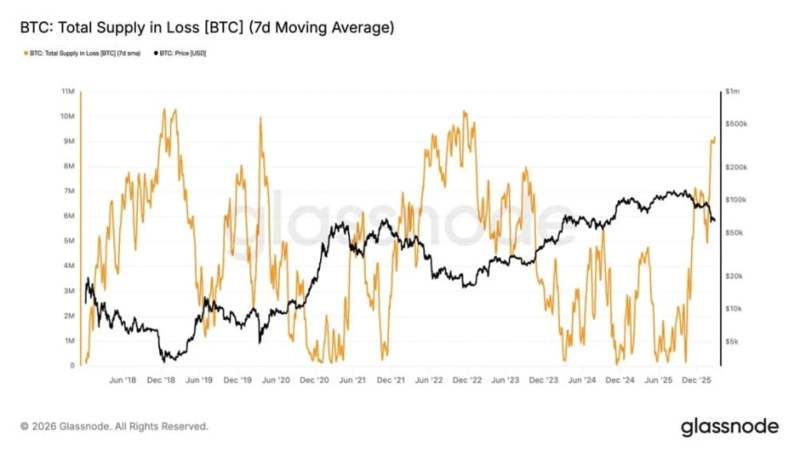
That said, one on-chain metric drawing attention is the excessively large “supply in loss.” The seven-day average of “total supply in loss”—Bitcoin held at a cost basis above the current price—rose to about 9.2 million coins, indicating that nearly half of circulating supply is at a loss. Glassnode noted that this is “a feature often observed late in bear markets historically,” adding that it is “closer to a bottoming zone than the initial capitulation phase.”
Glassnode’s Accumulation Trend Score has also remained below 0.5 since the 5th of last month, suggesting that aggressive buying led by large investors has yet to be confirmed. The upshot, according to the analysis, is that ETF inflows alone are not enough; renewed spot absorption, sustained whale accumulation, and a clear turn in institutional flows would also need to be in place to transition to a “true bull” phase.
In the near term, the area around $68,000 is highlighted as a key level to watch. Crypto-focused outlet Cointelegraph laid out a scenario in which “after Bitcoin establishes the $68,000 support line, a break above the 20-day exponential moving average (EMA) at $69,220 could open the way to $74,508.”
By contrast, crypto analyst Rekt Capital flagged potential resistance near $68,480, adding that the key to calling it a trend reversal would be whether the weekly close can move above the 200-week EMA at $68,338 and establish it as new support.
2. Ethereum (ETH)
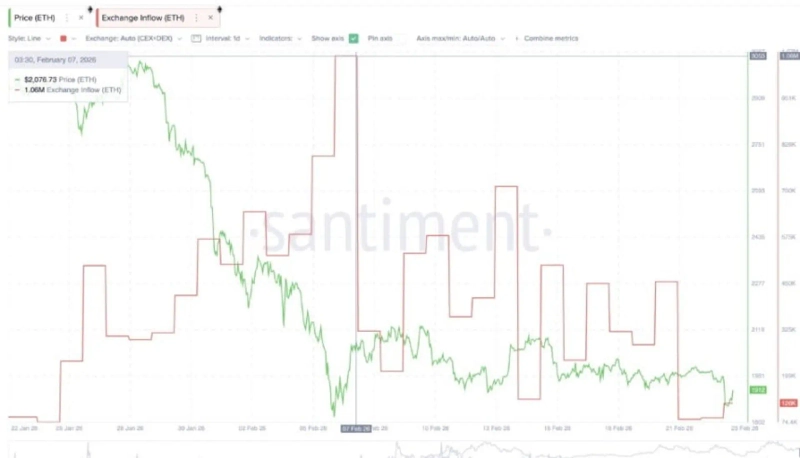
Ethereum also sank to around $1,800 early this week, but has since rebounded and currently has recovered $2,000 on CoinMarketCap.
Analysts say this rebound was bolstered by signs of easing “selling pressure.” The most notable shift has been a sharp drop in exchange inflows. According to Santiment, exchange inflows over the past seven days hit a peak of 1.06 million ETH, but have recently fallen to about 126,000 ETH—down roughly 90%. Because exchange inflows are generally interpreted as positioning to sell, this is read as a signal that near-term selling pressure has eased.
In derivatives markets, deleveraging has also played out. CryptoQuant data show that stablecoin-margined Ethereum open interest (OI) has dropped sharply since the peak on the 17th of last month. At Binance, the figure fell from above $4.0 billion at the time to $1.93 billion as of the 24th—more than halved. Bybit was also cited as declining from $1.26 billion to $866 million. With an episode of excessive leverage effectively reset, some conditions necessary for base-building are seen as having been met.
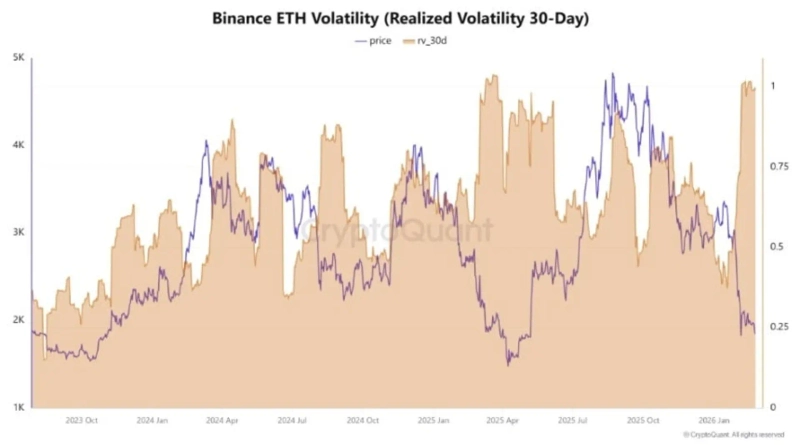
Still, expanding volatility is viewed as a risk factor. Binance’s 30-day realized volatility for Ethereum approached 0.97, marking the highest level since March 2025. This suggests the market has entered a period of strong price repricing. If volatility remains elevated without a clear breakout, the possibility of an extended range-bound phase cannot be ruled out.
Looking ahead, the $2,000–$2,100 battleground is cited as pivotal. Analyst Ayush Jindal said, “If buying interest holds above $2,000, another attempt higher is possible,” and pointed to $2,080 as the first near-term resistance. A move above $2,080 could open the way to $2,120, then $2,150, and potentially up to $2,320. Cointelegraph also identified a break above $2,100 as a key inflection point, saying that “if that level is cleared, improving profitability for whale investors could reinforce the uptrend.”
3. XRP (XRP)
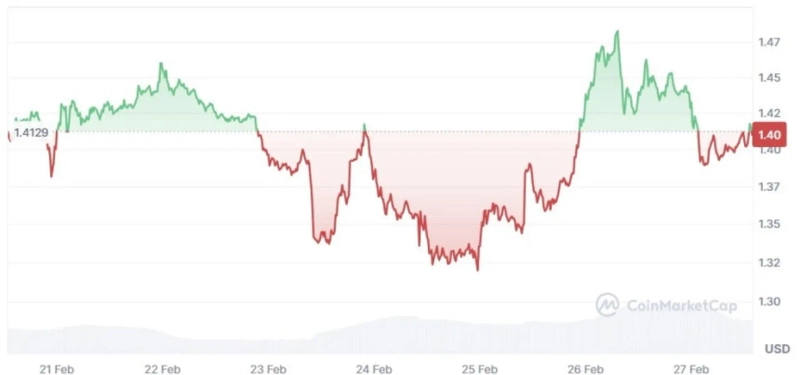
XRP also slid at one point to the low-$1.3 range, but rebounded by close to 6% at one stage and rose toward $1.5. It is currently trading around $1.4 on CoinMarketCap.
XRP’s rebound is broadly interpreted as being driven by improved “supply-demand dynamics.” First, it is noted that short-term buying intensity has been confirmed in the spot market. Indeed, according to crypto exchange Bitrue, XRP spot trading volume surged between the 23rd and 24th. Retail buying jumped 212%, exceeding sell orders by more than twofold. That implies a short-term shift in which buyers have been driving the market.
Institutional flows are also assessed as positive. Since its mid-November launch, the spot XRP exchange-traded fund (ETF) has attracted roughly $1.1 billion in net assets and has recorded steady weekly net inflows, according to compiled figures. With net outflows occurring on only five days, medium- to long-term flows are seen as stable.
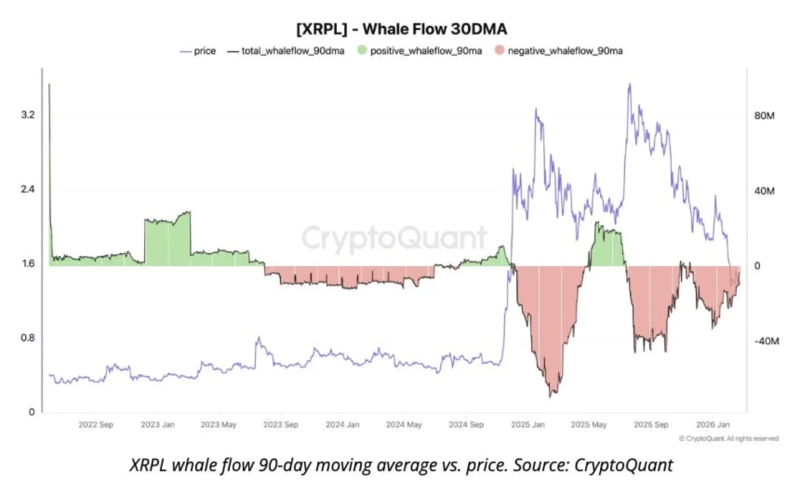
Whale flows also first showed “slowing sales.” Based on Glassnode data, the 90-day moving average of XRP whale net outflows shrank sharply from -33.5 million XRP in December last year to about -3.3 million XRP recently. Given that prices fell a further roughly 25% over the same period while outflows contracted markedly, the interpretation is that the phase of aggressive selling by large holders has passed.
Data also indicate that wallets holding at least 1,000 XRP have resumed accumulation. This suggests large holders may be positioning around a short-term low. It is also noted that in April 2025, after a similar slowdown in whale selling, XRP surged more than 50% over the following months. While history cannot be assumed to repeat exactly, from a supply-demand perspective there is room to view it as “a weakening of the force that had been pressing the downside.”
Looking ahead, the focus is on whether support can be established around the $1.40 area. Crypto-focused outlet CoinDesk said, “We need to watch whether the $1.40–$1.42 zone can serve as a new support line,” adding that “if $1.45 is broken, there could be room to rise to $1.50 and further to $1.57.” It also warned that if the price slips again below $1.37, the prior consolidation range could reopen.
Crypto analyst Sypress Demaninko pointed to the $1.49–$1.52 zone as upside resistance, saying that a breakout could open a scenario toward $2 or higher after clearing a sell wall at $1.68. Conversely, if buying interest fails to hold, a retest of $1.40 is possible, and if that breaks, the downside could open to $1.35—making that area a key level to watch heading into the weekend.
Issue coins
1. Polkadot (DOT)
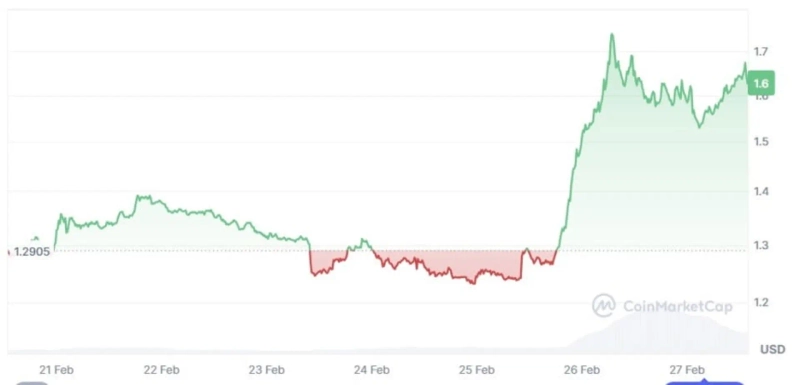
Among altcoins this week, Polkadot (DOT) stood out as the strongest performer. Its weekly gain reached 28% on CoinMarketCap, and as of the 27th it is still trading around $1.6.
The key driver of the rally is seen as a “supply halving” event now two weeks away. Polkadot’s network has announced plans to halve its annual token issuance starting March 14 and cap total supply at about 2.1 billion DOT. The aim is to reduce the inflation burden by cutting issuance and increase scarcity over time, and the fact that it is a clearly scheduled “confirmed event” is interpreted as having stimulated pre-positioning demand.
Expectations were further boosted by rumors spreading that major asset managers such as Grayscale and 21Shares have applied to launch a spot Polkadot ETF. While there has been no official confirmation or approval stage, the view that an ETF could act as an on-ramp for institutional capital fueled short-term momentum, with hopes that “if approved, the landscape could change.”
Still, the broader crypto market remains in a highly volatile phase, which is a headwind. In particular, Bitcoin’s trajectory is cited as the biggest variable in the near term. If Bitcoin fails to break through the psychological resistance around $70,000 and profit-taking intensifies, the broader altcoin market could come under pressure as well, and Polkadot could also take a hit.
In sum, Polkadot has a strong catalyst in the form of supply-cut expectations, but because the overall market is not yet in a comfort zone, it is necessary to keep in mind the potential for increased volatility after the event.

Suehyeon Lee
shlee@bloomingbit.ioI'm reporter Suehyeon Lee, your Web3 Moderator.