'$64 oil' assumption shaken… Iran strikes cloud growth and inflation trajectory
Summary
- The Bank of Korea said uncertainty has increased after U.S. and Israeli strikes on Iran, undermining its outlook based on $64-a-barrel international oil, 2.0% economic growth, and 2.2% inflation this year.
- Global investment banks such as JPMorgan said that if the Strait of Hormuz is blocked and military clashes spread, international oil prices could surge to $120–$130 a barrel.
- It said that a spike in oil prices could materialize downside risks to the 2% growth outlook, amplifying negative impacts on exports, investment and employment, and consumer inflation, potentially destabilizing the growth forecast.
Forecast Trend Report by Period


The Bank of Korea last month put this year’s economic growth forecast at 2.0% and its consumer inflation forecast at 2.2%. Those projections were based on an assumption that international oil prices would average $64 a barrel. But with Middle East risks resurfacing after U.S. and Israeli airstrikes on Iran, analysts say uncertainty surrounding the outlook has intensified.
According to the Bank of Korea’s Economic Outlook Report (February 2026) released on the 1st, the central bank projected international oil prices at $64 a barrel this year. In the report, it said that “in the short term, geopolitical risks such as stalled U.S.–Iran negotiations will act as a major source of uncertainty,” while also assessing that “downward pressure is likely to be strong as an oversupply persists throughout the year amid a production-increase stance by major oil producers.”
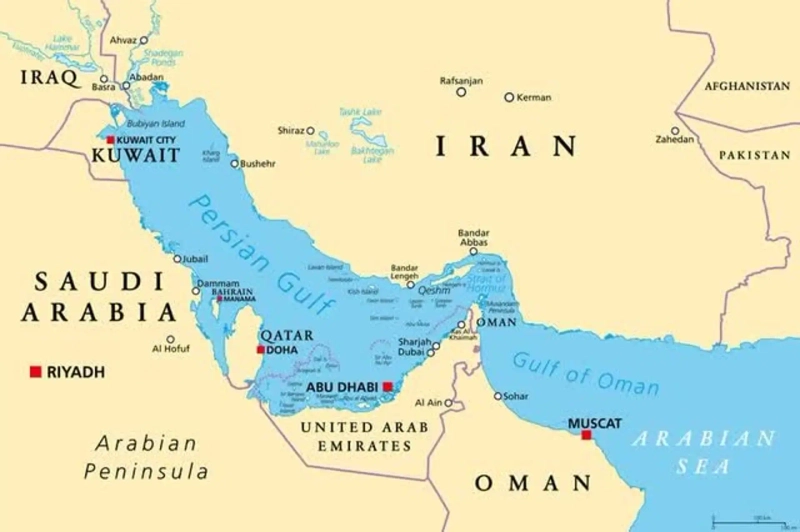
The Bank of Korea’s $64-a-barrel oil assumption did not reflect the U.S.–Israel strikes on Iran the previous day. As tensions in the Middle East escalated after the strikes, expectations are growing that international oil prices could exceed the central bank’s forecast. According to TASS, IRGC Brig. Gen. Ebrahim Jabari said in an Al Mayadeen TV interview that “the Revolutionary Guard has implemented a closure of the Strait of Hormuz following the invasion of Iran.”
Global investment banks (IBs), including JPMorgan, say that if the Strait of Hormuz is fully blocked and military clashes spread, international oil prices could surge to $120–$130 a barrel—nearly double the Bank of Korea’s forecast.
If oil prices spike, the downside risks to this year’s 2% growth outlook could also materialize. South Korea’s economy, which is heavily dependent on crude imports, could be hit hard by rising production costs and a deterioration in the terms of trade. Higher oil prices directly push up consumer inflation while also increasing corporate cost burdens, which is likely to weigh on investment and employment.
Exports would also come under pressure. The Korea International Trade Association estimates that a 10% rise in international oil prices lifts export unit prices by 2.09%, but reduces export volumes by 2.48%, resulting in a 0.39% decline in total export value. Reflecting higher semiconductor prices and expectations of an export rebound, the Bank of Korea raised its forecast for goods export growth this year by 0.7% points to 2.1%. Citing improving semiconductor exports, it also lifted its growth forecast to 2.0% from 1.8%. However, if tensions in the Middle East become protracted or escalate further, it cannot be ruled out that the growth outlook could be thrown off.
Reporter Kim Ik-hwan lovepen@hankyung.com

Korea Economic Daily
hankyung@bloomingbit.ioThe Korea Economic Daily Global is a digital media where latest news on Korean companies, industries, and financial markets.