Bargain hunting surges on reports of quiet U.S.-Iran contact… “Markets could swing with the battlefield outlook”
Summary
- As the possibility of negotiations between the United States and Iran was raised, strong bargain buying flowed into the Korean stock market, the report said.
- Korean equities rallied sharply—led by semiconductors, brokerage shares, and secondary-battery, biotech and robotics stocks—prompting talk of a possible W-shaped rebound.
- Experts said the KOSPI’s downside was confirmed at the 5,000 level and recommended a staggered buying strategy in a high-volatility environment driven by the war.
Forecast Trend Report by Period


Stocks notch a historic rebound… the ‘two top chipmakers’ jump more than 10%
Brokerage shares surge as trading value spikes
Hopes for government measures to support KOSDAQ
Secondary batteries, biotech and robotics stocks also rally
Brokerage circles: “A W-shaped rebound is possible
Recommend staggered buying if a correction phase returns”
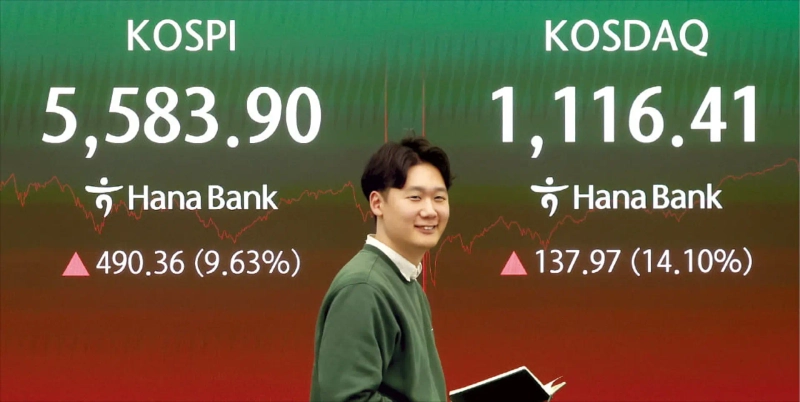
Korean stocks, which had plunged on the fallout from the war between the United States and Iran, swung sharply higher in just a day. As talk of possible negotiations between the two countries emerged, bargain buying flooded in. Volatility is likely to remain elevated for the time being depending on the course of the war, but market experts say a staggered buying strategy can be effective during corrective phases.
Chip ‘top two’ leap in tandem by double digits
According to the Korea Exchange on the 5th, Samsung Electronics surged 11.27% to close at 191,600 won. It briefly spiked to 199,700 won, attempting to regain the “200,000-won Samsung” milestone. SK hynix ended up 10.84% at 941,000 won.
As stock indices swung wildly on the Iran war and trading value swelled, brokerage shares also posted sharp gains. Kiwoom Securities rose 18.39% to finish at 441,000 won. Hanwha Investment & Securities (17.81%), SK Securities (17.37%), SangSangIn Securities (15.54%) and Mirae Asset Securities (15.40%) also climbed broadly in large strides. Total trading value in the Korean market on the 3rd, 4th and 5th was tallied at 6,969.9 billion won, 7,947.2 billion won and 6,072.6 billion won, respectively—well above this year’s daily average (4,572.5 billion won).
Automakers such as Hyundai Motor (9.38%) and Kia (6.19%) also managed a rebound.
Expectations for government measures to support the KOSDAQ market added fuel, sending secondary-battery, biotech and robotics stocks sharply higher across the board. EcoPro rose 20.18% to close at 160,800 won. News that could offset concerns the Iran war may become prolonged spurred strong inflows of bargain buying.
One such report said Iranian intelligence authorities, via a third country, proposed to the U.S. Central Intelligence Agency (CIA) to discuss conditions for ending the conflict. With the view spreading that the U.S. administration, heading into the November midterm elections, would find it difficult to enter a protracted war, expectations for negotiations grew further. Lee Kyung-min, head of FICC Research at Daishin Securities, said, “Yesterday’s selloff confirmed the downside in the KOSPI at the 5,000 level,” adding, “As sentiment spread that the worst-case scenario had already been priced in, a powerful rebound was produced.”
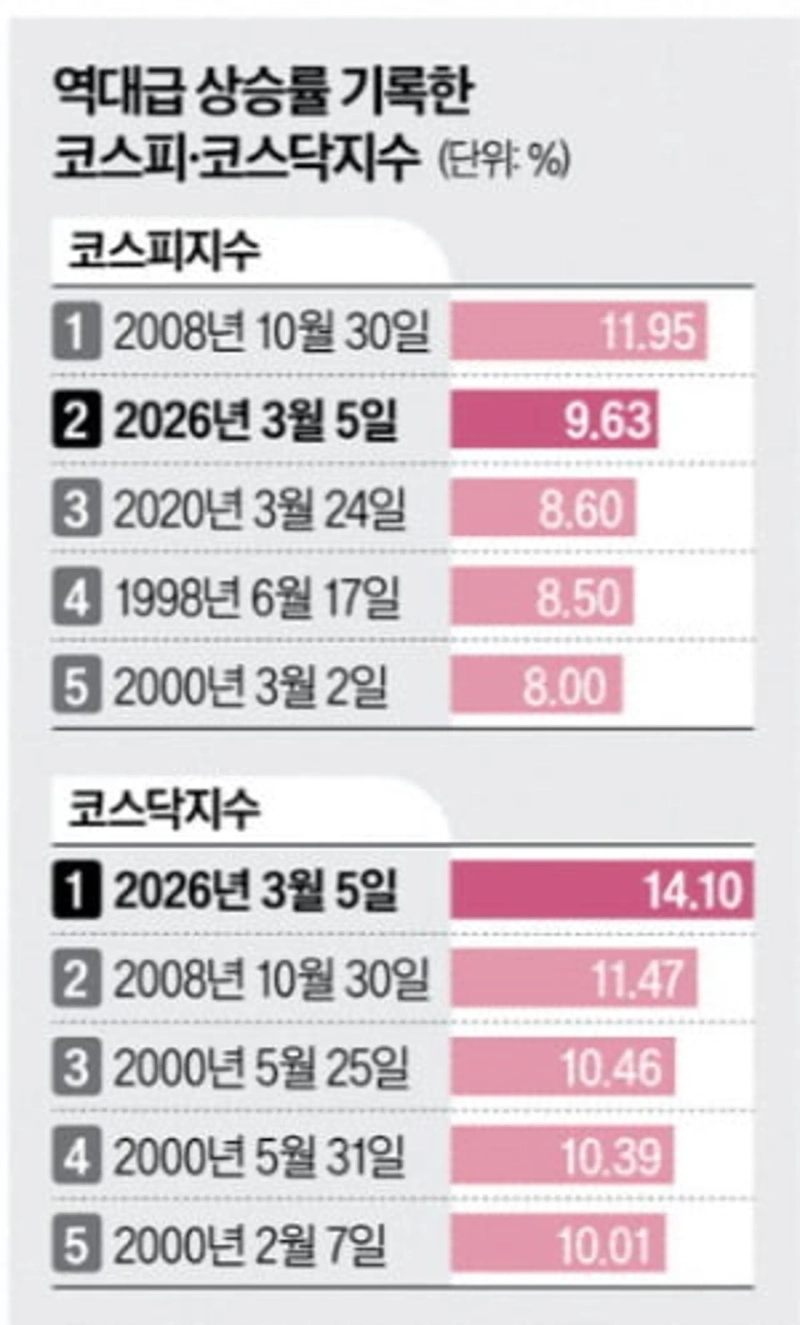
Experts: “A W-shaped rebound is possible”
The KOSPI’s market capitalization, after it quickly reclaimed the 5,580 level that day, came to 4,604.3577 trillion won—up about 409 trillion won from the previous day (4,194.9468 trillion won). Korea’s fear gauge, the “KOSPI 200 Volatility Index” (VKOSPI), which had surged to an all-time high of 80.37, fell 8.29% to 73.71.
Despite the day’s spike, experts project that market volatility could intensify at any time depending on war developments. In particular, if the nature of the conflict changes—such as the outbreak of a ground war inside Iran—there is no way to rule out another shock to stocks.
That is why some analysis suggests Korean equities are likely to trace a “W-shaped rebound.” Lee Eun-taek, an analyst at KB Securities, said, “After ‘panic selling,’ a W-shaped rebound has occurred more often than a V-shaped one.” Cho Byung-hyun, an analyst at Daol Investment & Securities, also noted, “Looking at cases where the market fell more than 10% for two consecutive days, even if it initially manages a rebound, it often tries to rise again only after digesting another round of ‘aftershocks’ from the plunge.”
Even so, the view is that any renewed decline would not break below the prior low. Lee said, “During phases when the business cycle is expanding, the KOSPI’s maximum drawdown has been around 20%.” Given that the KOSPI fell 18.4% over the 3rd–4th, it is unlikely the index will be pushed back below the 5,000 line.
If the U.S.-Iran war ends, some expect another attempt to recover the previous peak. Kim Ji-young, head of the Research Center at Kyobo Securities, said, “Given upward revisions to earnings estimates for listed Korean companies, a liquidity-driven market will continue,” adding, “In a phase like now when volatility is rising, we recommend a strategy of buying in stages.”
Sim Sung-mi / Ryu Eun-hyuk, reporters smshim@hankyung.com

Korea Economic Daily
hankyung@bloomingbit.ioThe Korea Economic Daily Global is a digital media where latest news on Korean companies, industries, and financial markets.