PiCK
Indicators look strong… Why Ethereum remains stuck in a ‘$2,000 range’
Summary
- CryptoQuant said Ethereum’s on-chain indicators are at record highs while the price remains stuck in a $2,000 trading range, deepening the ‘Adoption Paradox.’
- It analyzed that network usage rose on the back of DeFi and stablecoin growth, but since the Fusaka upgrade, declines in gas fees and TVL have weakened the narrative for price gains.
- Polymarket and CryptoQuant said fears are growing that if macro conditions worsen due to the Middle East conflict and other factors, Ethereum’s price could fall below $1,500 within the year—and potentially to the mid-$1,000s.
Forecast Trend Report by Period


On-chain metrics at all-time highs
Yet ‘Ethereum’ stays in the $2,000s
Widening gap between price and network
Fears emerge it could ‘drop into the $1,000s’

“Ethereum (ETH) is facing the ‘Adoption Paradox.’”
That is CryptoQuant’s recent assessment of Ethereum. The on-chain analytics firm says the decoupling between Ethereum’s price and the network’s fundamentals—previously highly correlated—is becoming more pronounced.
In fact, the Ethereum network has continued to grow this year, with various on-chain indicators nearing record highs. By contrast, Ethereum’s price has been stuck in a $2,000 trading range since mid-last month. With risk appetite damped by the fallout from conflicts in the Middle East, bearish sentiment toward Ethereum is also spreading across the market.
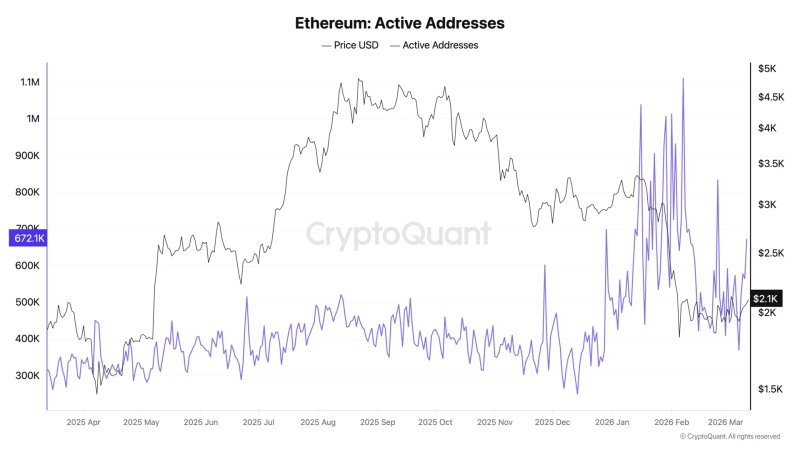
According to CryptoQuant on the 13th, the number of active Ethereum addresses surpassed 1.1 million last month, setting a new all-time high. Active addresses are a key metric for measuring network usage. The figure has declined so far this month to around 670,000 as of the previous day (the 12th), but that is still nearly 70,000 higher than last year’s peak (about 600,000). It also exceeds the prior high recorded during the 2021 bull market (about 644,000).
Other on-chain indicators are also strong. CryptoQuant noted that “major metrics such as Ethereum’s token transfer volume and the number of smart contract calls have all risen to record levels,” adding that this “shows adoption and participation in the Ethereum ecosystem continue to expand.”
The steady rise in on-chain activity is largely driven by growth in DeFi and the stablecoin market. Most DeFi infrastructure is built on Ethereum. In addition, about 55% of total stablecoin supply is issued on Ethereum. In other words, as the stablecoin market expands, Ethereum network usage naturally increases.
Ethereum, the perpetual ‘promising contender’
Even so, Ethereum’s price has struggled to gain traction. According to CoinMarketCap, a cryptocurrency market data site, Ethereum has hovered around $2,000 for about a month from mid-last month through today. It has held up relatively well despite a broader risk-asset downturn tied to the Middle East conflict, but given the network’s growth, the performance is effectively weak.
Ethereum dominance (market share) has also been steadily declining. Ethereum dominance stood at 10.5% as of today, down nearly 2% points so far this year. Kim Min-seung, head of Korbit’s Research Center, said, “Ethereum’s recent sideways price action is one of the mysteries of the crypto market,” adding, “Ethereum is a perpetual ‘promising contender’ while also being hit by a combination of factors, including a failed Layer 2 ecosystem strategy and broad weakness across the altcoin market.”
The market points to “scalability” as the main factor behind the widening gap between Ethereum’s price and its network metrics. In particular, the ‘Fusaka’ upgrade applied to the Ethereum mainnet in the second half of last year proved a direct blow. Vitalik Buterin, Ethereum’s co-founder, went so far as to call the Fusaka upgrade “the key to Layer 2 scalability,” underscoring that the upgrade focused on boosting network scalability.
“Scalability ‘side effects’ are to blame”
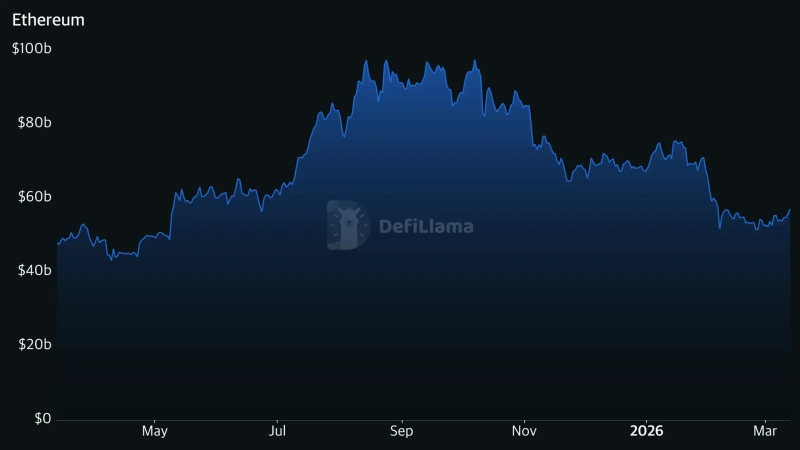
The problem is that as scalability improved, gas fees (transaction fees) also fell sharply. Typically, lower gas fees hurt not only the Ethereum network but also staking profitability. That means the downtrend in gas fees increases the likelihood of capital outflows from the Ethereum ecosystem. In fact, according to DefiLlama, Ethereum’s total value locked (TVL) stood at about $57 billion as of today, plunging more than 41% over the past six months.
Kim said, “Ethereum has taken various steps in recent years to reduce gas fees paid by network users,” adding, “As a result, the narrative that rising network usage translates into gas-fee revenue and price appreciation has weakened substantially compared with the past.”
U.S. crypto outlet 99Bitcoins reported, “Ethereum’s scalability upgrades aimed to provide users with a cheaper transaction environment, but they have had the side effect of reducing the network’s fee revenue,” adding that “this structural tension is the fundamental cause of the ‘Adoption Paradox.’”
Concerns are also growing that Ethereum’s price could sink to the mid-$1,000s. That is because the macroeconomic backdrop—now effectively the key driver of Ethereum’s price—could deteriorate amid spillovers from the Middle East conflict.
On Polymarket, the world’s largest betting site, the probability that Ethereum falls below $1,500 by year-end stood at 69% as of today. CryptoQuant also projected that if the crypto bear market persists, Ethereum could drop to $1,500 as early as the third quarter of this year.

JOON HYOUNG LEE
gilson@bloomingbit.ioCrypto Journalist based in Seoul