PiCK
KRW 90 trillion flowed overseas…Liquidity in Korea’s crypto market ‘plunges’
Summary
- The Financial Services Commission said the virtual asset outflows and liquidity transferred to overseas virtual-asset exchanges and personal wallets in the second half of last year totaled about $60 billion (about KRW 90 trillion), up about 14% from the first half.
- Allium Labs said stablecoin balances at Korea’s five largest exchanges fell by more than 50%, from about $575 million to about $188 million, and the average daily trading value also plunged by more than 30% month on month to around KRW 3 trillion.
- Analyst Jung Min-gyo and CoinDesk said that if the outflow of domestic virtual asset funds persists, it could affect Korea’s altcoin market and global liquidity as well.
Forecast Trend Report by Period


Liquidity in South Korea’s virtual asset (cryptocurrency) market appears to be shrinking rapidly. The decline is attributed to funds flowing out of domestic crypto exchanges to overseas platforms, or moving into the local stock market.
On the 25th, the Financial Services Commission (FSC) said in a report that the amount of virtual assets transferred to overseas virtual-asset exchanges and personal wallets in the second half of last year reached about $60 billion (about KRW 90 trillion). This represents an increase of about 14% from the first half of the same year ($52.2 billion).
In particular, while Travel Rule–compliant transactions fell, the scale of overseas transfers expanded. The volume of overseas remittances of KRW 1 million or more via registered operators declined by about 23%, from KRW 20.2 trillion in the first half to KRW 15.6 trillion in the second half.
Industry participants interpret the trend as stemming from regulations such as crypto taxation slated for next year and limited investment options. Kim Byung-joon, a researcher at DeSpread, said, “It is difficult to conclude that this is simply regulatory arbitrage, but blind spots in the scope of regulation appear to have structurally affected the channels through which funds move.”
Jung Min-gyo, an analyst at Presto Research, said, “Discussions around virtual-asset taxation may have contributed to some psychological dampening,” adding, “In Korea, derivatives trading is limited and listing standards are stringent, whereas overseas exchanges offer far broader choices such as leveraged trading, a wider range of coins, and DeFi (DeFi). This gap in investment opportunities is structurally leading funds to flow overseas naturally.”
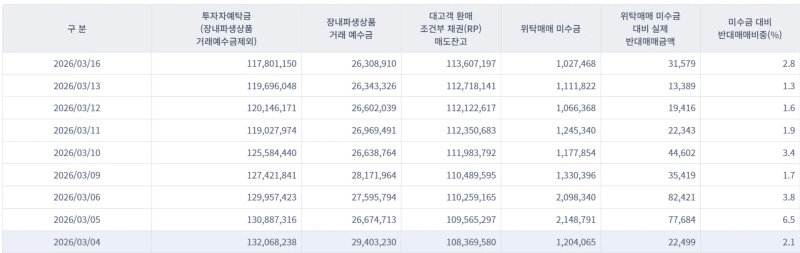
A substantial portion of these funds is also seen as likely having moved into the domestic stock market. According to the Korea Financial Investment Association, investor deposits fell from about KRW 132 trillion in early March to around KRW 112 trillion after mid-month. A decline in deposits is generally used as an indicator suggesting that some standby funds may have shifted elsewhere. During the period, the KOSPI index surged about 5% from the 5,200 level to the 5,500 level, with buying concentrated among retail investors.
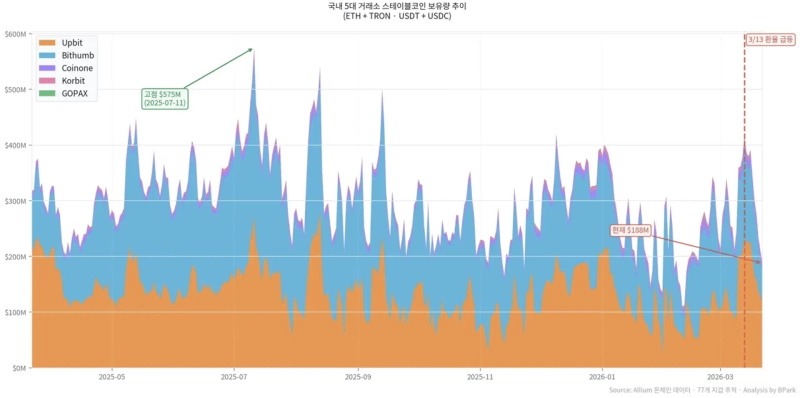
As a result, liquidity remaining on domestic exchanges appears to be shrinking sharply. According to on-chain data from Allium Labs, stablecoin balances linked to Korea’s five largest exchanges (Upbit, Bithumb, Coinone, Korbit, and Gopax) fell by more than 50%, from about $575 million in July last year to about $188 million recently. This month, the five exchanges’ average daily trading value has been around KRW 3 trillion, down more than 30% from KRW 4.4 trillion last month.
Analysts say that if these outflows from Korea’s virtual-asset market become prolonged, they could also affect the global market. Jung said, “If the outflow trend persists, it could lead to weakening trading activity in the domestic market, with the impact potentially felt more acutely in the altcoin market,” adding, “Given the weight of Korean investors, these changes could also have some impact on global liquidity.” Crypto media outlet CoinDesk likewise reported that “if the outflow of funds by Korean investors continues, it could also affect overall market liquidity.”

Suehyeon Lee
shlee@bloomingbit.ioI'm reporter Suehyeon Lee, your Web3 Moderator.