Domestic gasoline and diesel prices top 1,900 won…Seoul gasoline in the 1,950-won range
Summary
- It reported that average retail prices for gasoline and diesel at domestic gas stations have both surpassed 1,900 won per liter.
- It said that amid mixed moves in international oil prices, the pass-through of already higher prices with a time lag could keep upward pressure on domestic fuel prices in place for some time.
- It reported that since the second round of the maximum petroleum price cap was implemented, gasoline and diesel prices have surged, heightening concerns that the national average gasoline price could top 2,000 won per liter.
Forecast Trend Report by Period


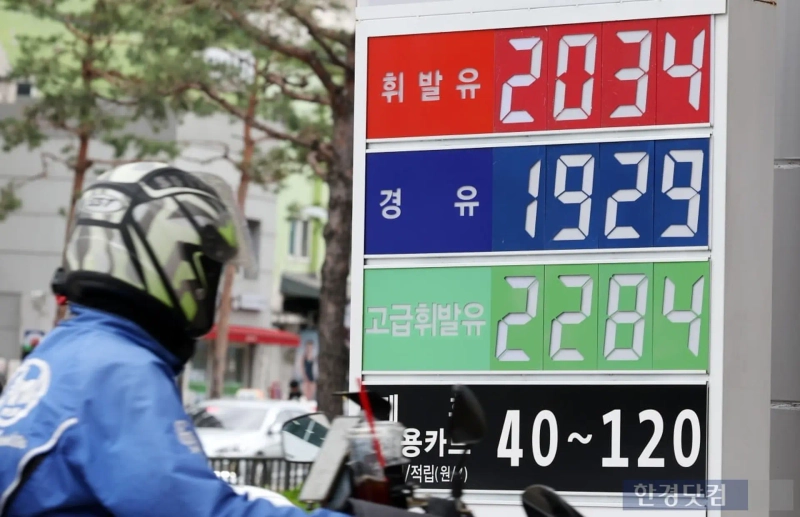
Average retail prices for gasoline and diesel at gas stations across South Korea have both climbed past 1,900 won per liter. Gasoline prices in Seoul have moved into the 1,950-won range, and the possibility of the national average gasoline price breaking above 2,000 won is also being discussed.
According to the Opinet oil price information system on the 1st, as of 4 p.m., the nationwide average gasoline price at gas stations was tallied at 1,909.7 won per liter, up 14.8 won from the previous day. Diesel also rose 15.4 won to 1,901.6 won.
Seoul continued to post the highest prices nationwide. The city’s average gasoline price rose 9.4 won in a single day to 1,954.7 won per liter, while diesel climbed 9.0 won to 1,930.8 won. Outside Seoul, average gasoline prices in several regions have already exceeded 1,900 won per liter, including Gyeonggi (1,919.5 won), North Chungcheong (1,930.1 won), South Chungcheong (1,918.4 won) and Sejong (1,912.9 won).
International oil prices were mixed as markets reflected expectations for a possible end to the war in the Middle East. On March 31 (local time), West Texas Intermediate (WTI) futures for May delivery settled at $101.38, down 1.46% from the previous session. By contrast, May Brent crude, regarded as the global benchmark, rose 4.94% to $118.35 a barrel—the highest level since June 16, 2022.
Industry officials say that even if hopes for an end to the war persist, upward pressure on domestic fuel prices is likely to continue for the time being if the already-elevated international oil prices feed through with a time lag. Some also expect oil prices to remain elevated, as the war has caused damage to production facilities in some oil-producing countries.
In South Korea in particular, concerns are growing that the nationwide average gasoline price could soon exceed 2,000 won per liter, as price gains have accelerated since the second round of the cap on maximum petroleum prices took effect on March 27.
The consumer group Energy and Petroleum Market Monitoring Unit said that over the five days after the second maximum-price notice, gasoline and diesel prices rose by 75.7 won per liter and 70.4 won per liter, respectively. The government has proposed a 5 trillion-won supplementary budget that includes the maximum petroleum price system and measures to ease fuel costs, but prices on the ground are still trending higher.
Oh Se-seong, Hankyung.com reporter sesung@hankyung.com

Korea Economic Daily
hankyung@bloomingbit.ioThe Korea Economic Daily Global is a digital media where latest news on Korean companies, industries, and financial markets.