"TurboQuant will further increase memory demand"
Summary
- CEO Baek Joon-ho said TurboQuant is an early-stage move to improve the efficiency of memory semiconductors, and that demand could expand as well.
- FuriosaAI said it plans to pursue an IPO at an appropriate time, and a potential direct US listing has been mentioned.
- He said that by 2030, 100-gigawatt AI data centers will be built around global Big Tech companies, with about 70% allocated to inference infrastructure.
Forecast Trend Report by Period


Interview with FuriosaAI CEO
"If efforts to improve memory efficiency continue
the market will grow further on technological innovation"
"We will pursue an IPO at an appropriate time"
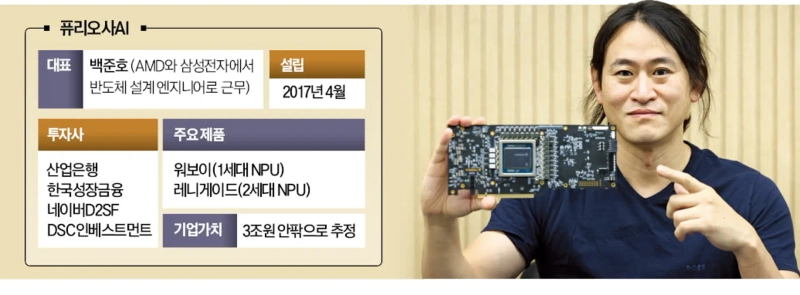
Baek Joon-ho, CEO of FuriosaAI, recently assessed Google’s ‘TurboQuant’ technology—which has been shaking up the memory semiconductor industry—as “an early-stage move toward improving the efficiency of memory semiconductors.” He also said, “If the economics of technologies like TurboQuant are secured, demand (for semiconductors) could actually expand.” On the timing and structure of the company’s initial public offering (IPO), he remained guarded, saying, “We will disclose it at an appropriate time.”
Memory innovation as agentic AI spreads
In an interview with The Korea Economic Daily on the 31st of last month, Baek said, “This year will be an important inflection point for the AI (artificial intelligence) industry.” TurboQuant is Google’s algorithm that dramatically reduces the amount of memory required to run AI. After Google unveiled the technology on the 25th of last month, shares of memory chipmakers such as Samsung Electronics and SK hynix plunged.
Baek said he expects a wave of innovation aimed at reducing system overload as ‘agentic AI’—which autonomously plans and executes tasks—moves into full swing. “More important than whether memory semiconductor demand rises or falls is the direction of technology going forward,” he said, emphasizing that “as agentic AI spreads, computer memory is being overloaded, and efforts to improve efficiency in addressing these issues will continue.” Asked about the impact of TurboQuant on chip design houses like FuriosaAI, he said it is “not necessarily negative.” His reasoning: if technological advances make memory semiconductors cheaper, more companies will adopt AI technologies.
On the possibility of a Nasdaq listing, Baek said, “We plan to pursue an IPO at an appropriate time.” The investment banking (IB) industry expects FuriosaAI could opt for a direct listing in the US, citing collaboration with American ‘Big Tech’ companies such as Google, Amazon and Tesla. Baek also avoided giving specific answers about the company’s third-generation chip, ‘Stork,’ slated for release next year.
Personal AI to spread in earnest this year as well
Baek offered a positive assessment of AI policies under the Lee Jae-myung administration and the Democratic Party of Korea, saying, “Looking at initiatives such as fostering sovereign AI, they appear to be proactive in revitalizing the ecosystem.” However, regarding the adoption of AI semiconductors in the defense sector, he said, “It is not appropriate for the government to lead a technology standard platform,” adding, “Standards are necessary, but it is desirable for the private sector to take the lead.” This differs from the view in Korea’s defense industry that “a software platform is needed that can commonly utilize neural processing units (NPUs).” Baek said there are no cases in advanced countries where governments set platform standards.
The interview took place shortly after Baek delivered a lecture at the World-OKTA World Representatives Convention hosted by the Korean Traders Association (World-OKTA) at COEX Magok in Seoul. In his talk, Baek said, “Early forms of agentic AI that perform human work nearly 24 hours a day are emerging,” and forecast that “a shift in which AI replaces not only corporate work but also tasks at the individual level will gather pace.” On AI data centers, he analyzed that they “will be rapidly reshaped from the past model-training focus to an inference-centric structure that supports real services,” adding, “Since late last year, AI model performance appears to have surpassed a critical threshold.” He said, “Around Big Tech companies globally, new data centers totaling 100 gigawatts will be built by 2030,” and added, “About 70% of this will be allocated to inference infrastructure.”
Reporter Lee Kwang-sik bumeran@hankyung.com

Korea Economic Daily
hankyung@bloomingbit.ioThe Korea Economic Daily Global is a digital media where latest news on Korean companies, industries, and financial markets.