PiCK
Trump vows to "strike Iran with extreme force"…Bitcoin tests the $65,000 support level [Kang Min-seung’s Trade Now]
Summary
- After President Donald Trump’s remarks on the Iran war, Bitcoin has turned weaker, and the report said it is necessary to confirm the $66,000 support level.
- It reported that a redistribution phase is underway as about $296.3 million in net outflows occurred from spot Bitcoin ETFs and realized losses among long-term holders increased.
- Experts were quoted as saying that if the $66,000–$65,500 zone and the $60,000 support level break, the door opens to further declines toward $65,000 and $64,200.
Forecast Trend Report by Period


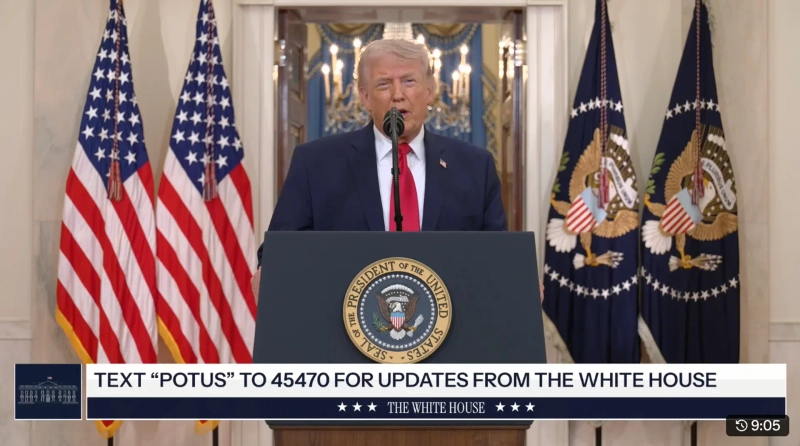
After U.S. President Donald Trump’s national address regarding the Iran war, Bitcoin (BTC) is showing a weaker trend as downside pressure intensifies. With Middle East-driven geopolitical tensions and supply-demand uncertainty persisting, investors should stay alert to the possibility of further downside pressure and confirm key support levels such as the $66,000 area.
As of 18:07 on the 2nd, Bitcoin was trading at $66,494, down about 3.2% from the previous day on Binance’s USDT market (₩101.2 million on Upbit). The kimchi premium, which indicates the price gap between overseas and domestic exchanges, stood at 0.39%.
Trump signals a hardline move within 2–3 weeks…volatility rises on oil and rates
Global equities and the cryptoasset (cryptocurrency) market are seeing heightened volatility as Middle East-driven geopolitical tensions persist and uncertainties over oil prices and interest rates intersect.
On the 1st (local time), President Donald Trump said in a national address on day 33 of the Iran war, "Over the next 2 to 3 weeks, we will deliver an extremely powerful strike against Iran." He also noted that "discussions with Iran are continuing," suggesting the possibility of parallel negotiations, but signaled that if no agreement is reached within that period, key power plants and other facilities could be struck simultaneously.
Markets, however, appear to be placing more weight on sustained military tensions than on the likelihood of negotiation progress. As President Trump called on energy-importing countries reliant on the Strait of Hormuz to take self-help measures, the United Arab Emirates (UAE) is reviewing participation in a military coalition, pointing to a spread of tensions across the region. Iran’s military also signaled a hardline stance, saying it would "continue the war until there is eternal regret and surrender."
The fallout from the Iran war is also being reflected across financial markets. Foreign central banks have recently been net sellers of U.S. Treasuries, pushing foreign official holdings down by about $8.2 billion to the lowest level since 2012, while the 10-year U.S. Treasury yield rose to its highest level since 2024. This is seen as the result of a combination of factors, including increased dollar demand driven by a surge in oil prices and asset sales by oil-producing countries.
On monetary policy, caution remains. Earlier, Federal Reserve Chair Jerome Powell said at a Harvard University event on the 30th of last month, "It is too early to assess the economic impact of the U.S.–Iran war," indicating he would watch developments for the time being. Markets say uncertainty over the future policy path is growing as U.S. consumer sentiment weakens while inflation expectations rise.
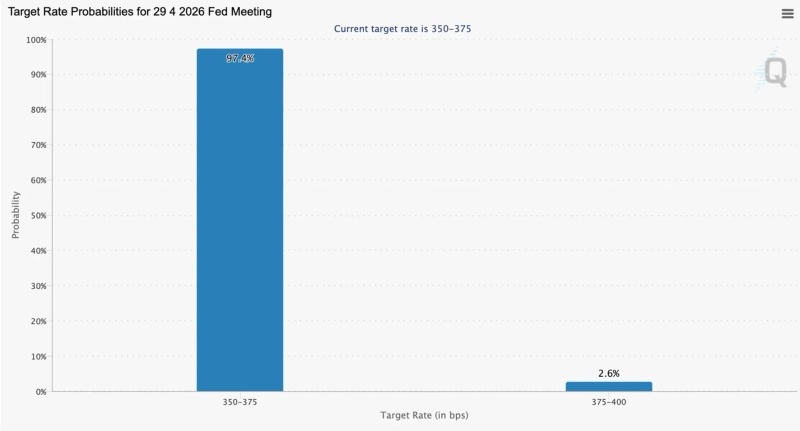
Meanwhile, as of 18:00, CME FedWatch shows the interest-rate futures market pricing in probabilities of the federal funds rate being left unchanged at 97.4%, 95.5% and 95.5% for the April, June and July Federal Open Market Committee (FOMC) meetings, respectively.
Redistribution phase amid ETF outflows…derivatives markets in "defensive mode"
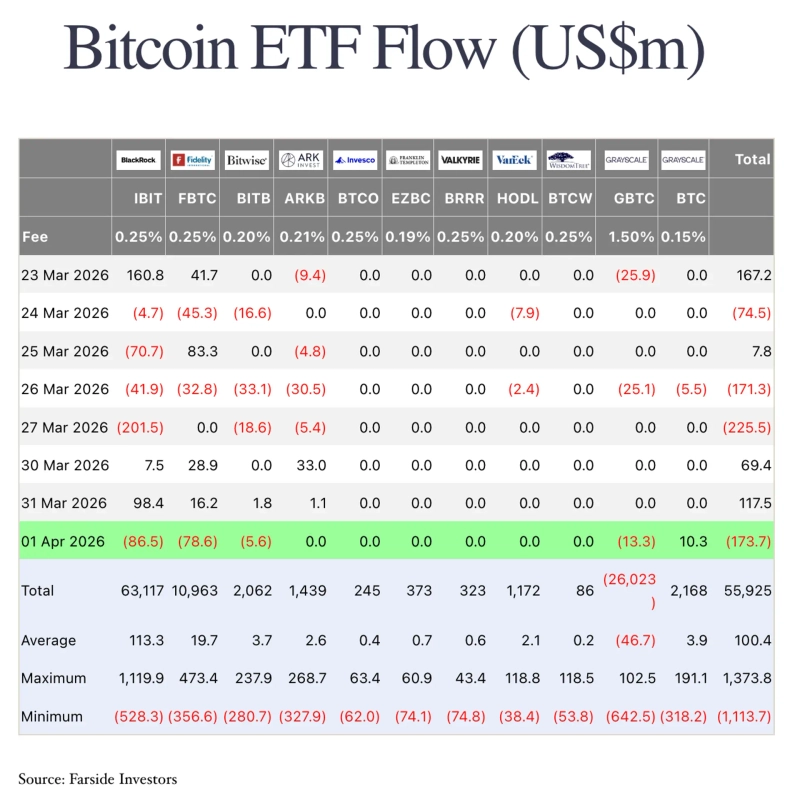
With geopolitical uncertainty lingering, fund flows are also showing a mixed pattern without a clear directional bias. Spot Bitcoin exchange-traded funds (ETFs) saw net outflows of about $296.3 million last week (about ₩450 billion), reflecting weaker investor sentiment. Still, some expectations for longer-term demand growth are forming after the U.S. Department of Labor proposed a rule that would make it easier to include cryptoassets in 401(k) retirement plans.
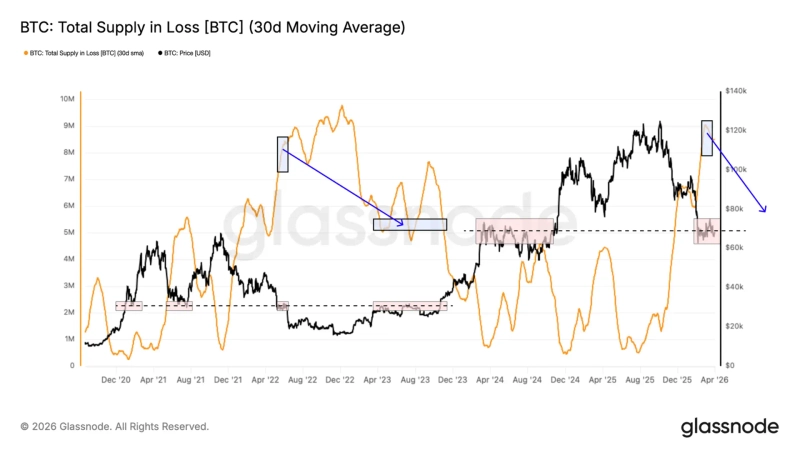
On-chain data suggests the market remains in a redistribution phase in which selling supply is being absorbed. On-chain analytics firm Glassnode said in its weekly research report on the 1st that "the market is in the process of absorbing selling supply," adding that "realized losses by long-term holders (LTHs) have increased to about $200 million per day, with signs of gradual capitulation (mass selling)." It also noted that "corporate buying remains in place, but support has weakened compared with the past," adding that "sideways trading is likely to persist until spot demand expands and excess supply is absorbed."
Traders in the crypto derivatives market appear to be leaning toward waiting or defensive positioning rather than aggressive buying. Global crypto exchange Bitfinex said in a weekly report that "market participants are hesitant to enter aggressive long (buy) positions, and conviction among leveraged investors remains limited." It added that "with implied volatility staying elevated, price swings can widen significantly even on relatively modest selling pressure."
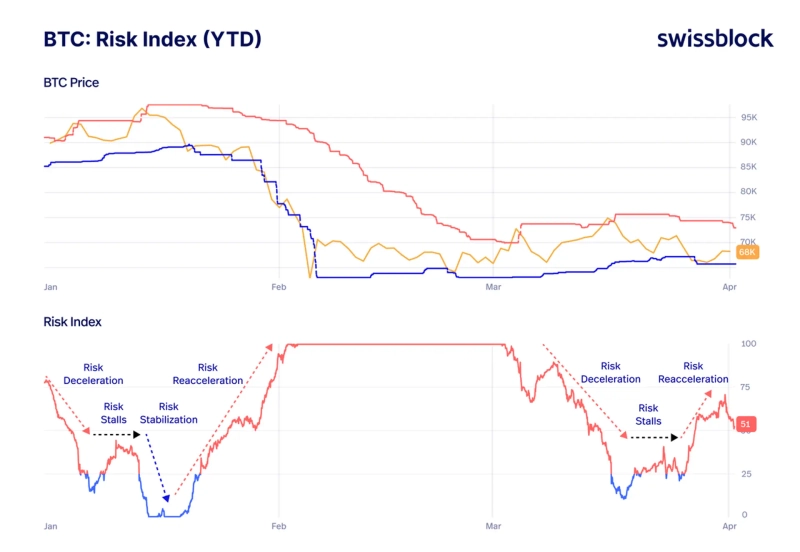
Analysts say Bitcoin’s rebound could hinge on macro changes such as an easing of geopolitical tensions. Binance Research said, "While gold fell more than 12% last month amid dollar liquidity pressure and forced asset sales, Bitcoin remained relatively stable and closed the month higher," but added that "whether Bitcoin’s rebound is sustained depends on whether a tangible easing of geopolitical tensions materializes."
"Bitcoin tests $66,000 support…directional decision near"
Bitcoin remains in a zone where downside risk is open, after running into overhead resistance. Experts see the current range less as a point for confirming direction and more as a phase where additional downside pressure will be determined by whether key support holds.
Alex Kuptsikevich, chief analyst at FxPro, said, "The crypto market fell about 3% after President Trump’s address on the Iran war, pushing total market capitalization down to around $2.29 trillion, but the lower bound support of the recently formed range is still holding." He added, "Bitcoin is converging between the $66,000 support level and the $69,000 resistance level, and the point at which an uptrend or downtrend is decided is approaching."
In the near term, whether the $66,000 support holds is cited as the key variable. Ayush Jindal, a NewsBTC researcher, said, "After failing to break above resistance near $68,800, Bitcoin has given back a significant portion of recent gains," adding that "if it moves below $68,000, additional downside pressure could continue." He added, "$66,000–$65,500 could act as a key support zone, but if that breaks, the door opens to $65,000 and even $64,200."
In the medium term, whether the $60,000 level holds is also highlighted as important. Christopher Lewis, an analyst at DailyForex, said, "Bitcoin is securing a degree of support despite geopolitical tensions and interest-rate variables," but added, "if the $60,000 support level breaks, downside pressure could expand sharply." Rakesh Upadhyay, a Cointelegraph researcher, also said, "If the price falls below $65,000, downside pressure could intensify toward $62,500 and the $60,000 zone."
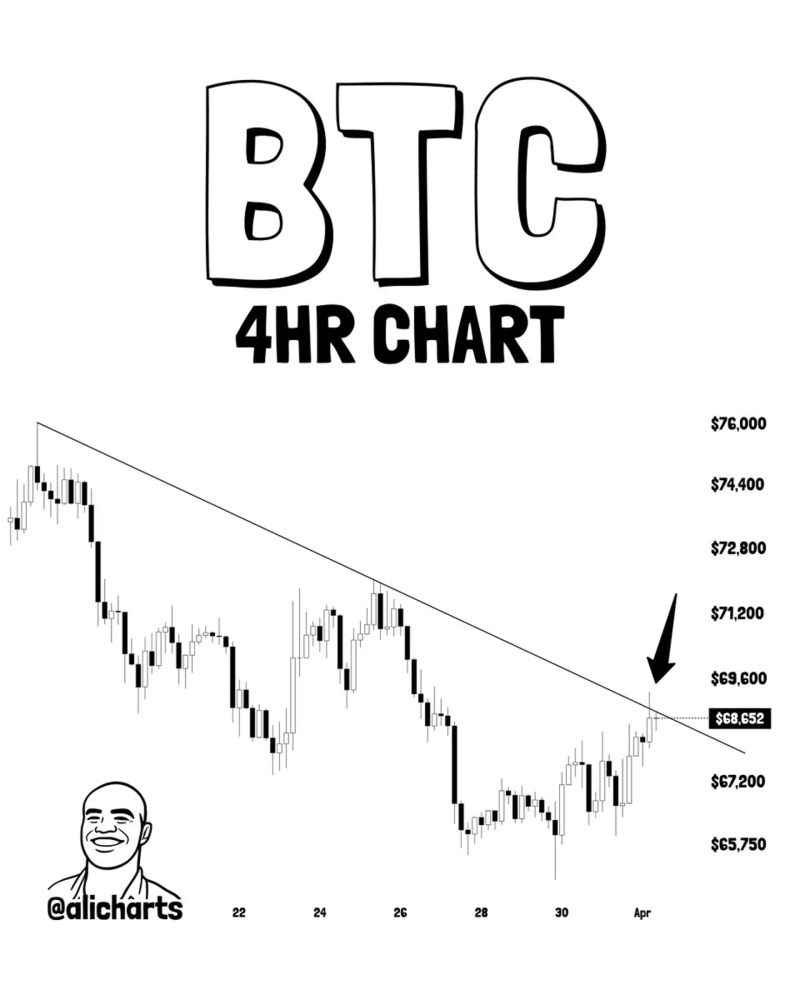
Meanwhile, the Alternative crypto Fear & Greed Index rebounded to 12 on the day but remains in the extreme fear zone. Market sentiment has not recovered sufficiently, and volatility is being seen as continuing to expand depending on short-term variables.
Kang Min-seung, Bloomingbit reporter minriver@bloomingbit.io

Minseung Kang
minriver@bloomingbit.ioBlockchain journalist | Writer of Trade Now & Altcoin Now, must-read content for investors.