PiCK
Mounting stagflation fears put ‘digital gold’ Bitcoin to the test
Summary
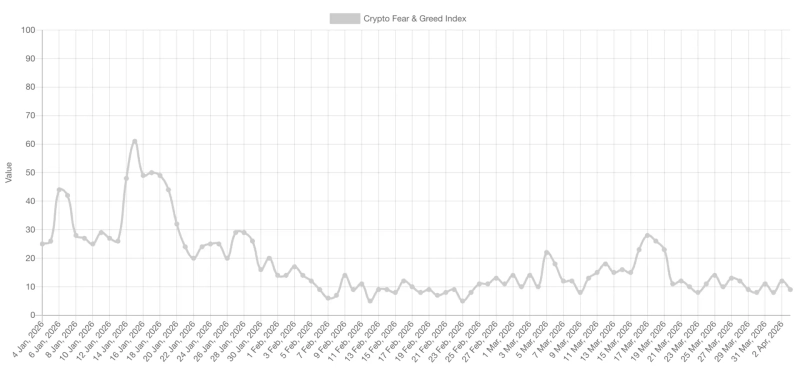
- It said that amid Middle East tensions and rising global oil prices, fears of stagflation have kept the crypto Fear & Greed Index in the ‘Extreme Fear’ zone.
- It noted the near-term outlook is not bright as Bitcoin’s first-quarter return of -22.2%, ETF outflows, risk-off sentiment, and rising odds of a delay in U.S. rate cuts overlap.
- It analyzed that in a potential stagflation environment ahead, Bitcoin’s 'digital gold' narrative could be put to the test, with the regulatory backdrop—including the Clarity Act—an additional variable.
Forecast Trend Report by Period



Shockwaves from the Middle East conflict are weighing on investor sentiment toward cryptocurrencies such as Bitcoin (BTC). Some observers warn that if a surge in global oil prices turns stagflation—an economic downturn amid high inflation—into reality across major economies, Bitcoin’s “digital gold” narrative could face a critical test.
According to Alternative, a cryptocurrency analytics firm, the Crypto Fear & Greed Index stood at 9 as of the day, down 3 points from the previous day’s 12. The lower the reading, the more risk appetite has contracted. The index has remained in the “Extreme Fear” zone for about two consecutive weeks, from the 19th of last month through the day.
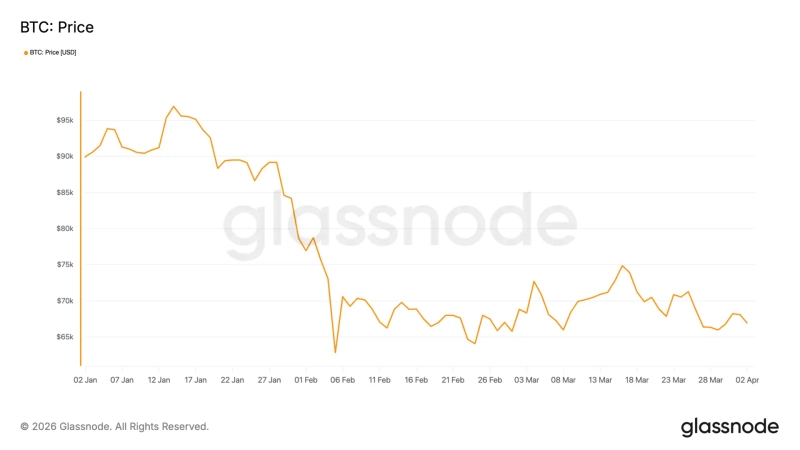
The pullback in sentiment reflects the crypto market’s inability to regain momentum in the wake of the Iran-related conflict. CoinMarketCap data show Bitcoin has traded sideways in a range in the mid-to-high $60,000s from mid-last month through the day. In the won market, it repeatedly hovered around KRW 100 million—seen as a “psychological resistance level.”
The first-quarter scorecard also fell short of investor expectations. CoinGlass data show Bitcoin’s first-quarter return was -22.2%, the lowest in eight years since 2018 (-49.7%). On a monthly basis, it posted double-digit declines in January (-10.17%) and February (-14.94%), followed by only a modest rebound last month (1.81%).
Andri Fauzan Adziima, head of research at cryptocurrency exchange Bitrue, said, “The first-quarter downturn (in Bitcoin) was primarily triggered by exchange-traded fund (ETF) outflows,” adding that “persistent inflation and broader market ‘risk-off’ sentiment also compounded the move.”
The near-term outlook is not bright either. On Polymarket, the world’s largest prediction-market platform, the probability that Bitcoin falls below $65,000 this month jumped 25 percentage points in just one day to 86% as of the day. Much of the move reflects a worsening macro backdrop, with the Iran-driven Middle East conflict entering a prolonged phase and global oil prices topping $110 a barrel.
Kim Min-seung, head of Korbit’s Research Center, noted that “U.S. spot Bitcoin ETFs returned to net inflows last month for the first time in five months, but it’s still difficult to see this as a broad-based shift in investor sentiment.”
Rising odds U.S. rate cuts are delayed
The U.S. interest-rate outlook is another headwind. In a report published the previous day (the 2nd), the International Monetary Fund (IMF) projected that “there is little room for the U.S. Federal Reserve to lower its policy rate over the next year.” The IMF assessed that energy-price gains stemming from the Iran war could delay progress toward the Fed’s inflation target (2%). The longer Fed rate cuts are pushed back, the more limited Bitcoin’s upside momentum is likely to be.
Some argue the second quarter will be a key test for Bitcoin’s “digital gold” narrative. If major economies such as the U.S. enter a stagflationary phase, Bitcoin’s identity—having oscillated between a risk asset and a safe haven—could become more clearly defined.
If inflation-hedging demand flows into the crypto market, Bitcoin’s safe-haven characteristics could strengthen. Cryptocurrency asset manager Grayscale said, “Despite the recent (geopolitical) turmoil, Bitcoin has held up relatively well compared with some traditional markets such as U.S. equities,” adding that “prices have remained comparatively stable amid volatility, suggesting a firmer base may have formed.”
Another variable is the U.S. crypto market structure bill (the Clarity Act), often cited as a positive catalyst for the crypto market. Discussions on the Clarity Act have been delayed as disagreements persist between U.S. banks and the crypto industry over paying interest on stablecoins. Kim said, “The Clarity Act would accelerate institutional participation in the crypto market and the use of stablecoins, creating synergy with the ‘innovation exemption’ the U.S. Securities and Exchange Commission (SEC) is pushing,” adding, “even if the Clarity Act passes Congress, the time lag to actual implementation needs to be taken into account.”

JOON HYOUNG LEE
gilson@bloomingbit.ioCrypto Journalist based in Seoul