PiCK
Terence Kwok: “Humanity, the internet’s ‘trust layer’…essential infrastructure in the AI era”
Summary
- Humanity said it aims to become the internet’s trust layer by building a decentralized identity verification and zero-knowledge proof (ZK)-based Proof of Trust model.
- Humanity said it will actively pursue partnerships with Korean institutions at CIS 2026 related to KYC, compliance infrastructure, and financial credential screening.
- Humanity said its model is provided to various platforms for a fee as anti-fraud infrastructure amid the spread of AI-driven fraud, and that the Korean market is its largest and most active market.
Forecast Trend Report by Period


Interview with Terence Kwok, founder of Humanity
Decentralized identity verification project
Attending ‘CIS 2026’…“expanding partnerships”
‘Proof of Trust’ model...in the spotlight as AI fraud surges
Signals intent to target Korea…“a large, active market”
“Humanity (Humanity·H) is the internet’s ‘Trust Layer.’ The ‘verifiable trust’ model we are building will become an essential element of the internet—like the Hypertext Transfer Protocol (HTTP)—within the next five years.”
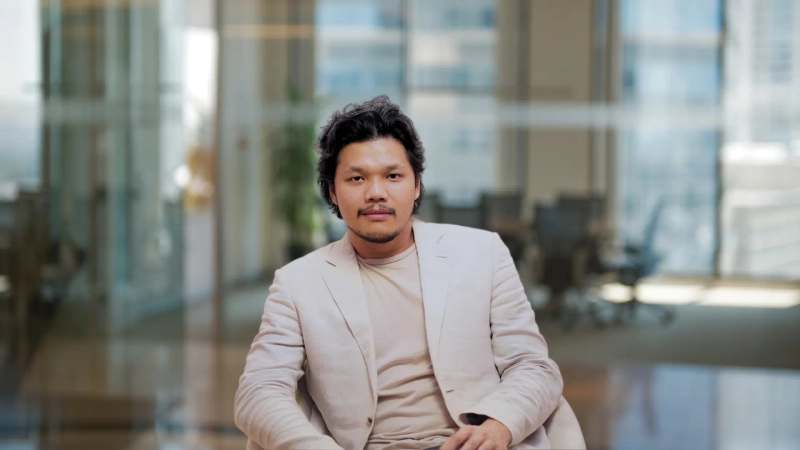
Terence Kwok, founder of Humanity (photo), said in an interview with Bloomingbit on the 7th that “the trust crisis triggered by artificial intelligence (AI) has already become reality.” He added, “The internet has a structural flaw in that it was not designed from the outset to verify who—or what—is real,” and said, “With the advent of AI, this problem has expanded to an existential level.”
Kwok sat down with Bloomingbit ahead of his participation in ‘Crypto Investment Show (CIS) 2026,’ to be held in Seoul from the 17th to 19th of this month. CIS 2026 is an investor-focused Web3 conference hosted by domestic digital-asset data platform Xangle, with Hanwha Investment & Securities participating as the title sponsor. This year’s event is expected to draw around 200 institutional investors and about 5,000 retail investors.
‘Proof of Trust’ model...actively seeking partnerships in Korea
Kwok described CIS 2026 as “an important event where institutional and retail capital in Korea’s digital-asset market converges.” He said, “(At CIS 2026) we will also actively explore possibilities for new partnerships with Korean institutions around know-your-customer (KYC), compliance infrastructure, and financial credential screening,” adding that “these areas are in high demand, and Humanity’s approach is particularly well suited to them.”
Humanity is a decentralized identity verification project founded in 2023. Using zero-knowledge proof (ZK) technology, it aims to build a ‘Proof of Trust’ model that enables users to prove their identity without disclosing personal information.
Kwok said, “Humanity’s identity verification technology has portability that can be used across blockchains and applications (apps) as well as the physical world at large,” adding, “Humanity is not a solution only for cryptocurrencies; it is infrastructure that connects Web3 with real-world regulatory and compliance demand.”

Humanity has recently drawn attention as so-called ‘scam’ crimes have surged with advances in AI technology. Kwok explained, “AI has dramatically reduced the cost and time required to create fake identities,” while “existing systems were designed on the premise of an era when generating fake identities required significant cost and time.”
He added, “AI-driven fraud is causing platforms and users losses of billions of dollars every year,” and said, “This is not a simple problem—it is a structural breakdown in which the assumptions underlying existing systems are collapsing.”
This context also underpinned Humanity’s social experiment conducted late last year on the global dating app Tinder. At the time, Humanity designed the experiment to demonstrate how vulnerable existing KYC systems are to AI. The core of the experiment was that after AI generated four fake profiles, it even carried out chats and set up dates with about 40 real Tinder users.
Kwok said, “Synthetic identities now even pass KYC verification at regulated financial institutions,” adding, “The Tinder experiment was a case that powerfully demonstrated a widespread problem that also imposes social costs.” A synthetic identity is a forged identity that cleverly blends information from a real person with fabricated information.
“It will become essential infrastructure in the AI era”
The revenue model is clear. According to Humanity, the Proof of Trust model functions as a kind of “anti-fraud infrastructure” that various platforms can use for a fee. Kwok said, “No platform wants to be perceived as ‘a place where fraud happens,’ and the cost of not adopting an anti-fraud solution is far greater than the cost of adoption,” adding, “(Proof of Trust) will become indispensable infrastructure for the internet to function in an era when AI grows more powerful and penetrates deeply into everyday life.”
On the Korean market, he said it is “already Humanity’s largest and most active market.” Kwok added, “Korean users are among the earliest adopters who accepted Humanity the fastest and most proactively,” and said, “Asia fundamentally has high crypto adoption, and regulations are becoming more sophisticated, making it a core region in Humanity’s roadmap.”
He continued, “Korea has a dense concentration of institutional capital, top-tier exchanges, and financial services companies that are proactive in adopting digital-asset infrastructure,” adding, “Korea is one of the countries with the best environment to prove the need for Humanity’s Proof of Trust model worldwide.”

JOON HYOUNG LEE
gilson@bloomingbit.ioCrypto Journalist based in Seoul