Korea Stocks Whipsawed by Iran War, but Strong Earnings Seen Supporting Further Gains
Summary
- Analysts said the Iran war has increased volatility in the Kospi, but the market has not yet entered a phase of earnings damage.
- They said operating profit and sales at major South Korean companies are set to rise sharply, supporting the case for continuing to invest with a medium- to long-term view.
- Analysts said strategies such as staggered buying, holding cash and selectively buying beaten-down large-cap stocks remain valid, though investors should be cautious about aggressively increasing exposure to the broader market.
Forecast Trend Report by Period


South Korea’s stock market has been gripped by extreme volatility since war broke out involving the US, Israel and Iran in late February. The Kospi has plunged as much as 12% in a single day and then rebounded 9% the following month, underscoring how difficult it has become to call the market’s direction. Foreign investors have been heavy sellers, while retail traders have been wrestling with how to respond.
Foreign Investors Spooked by War Dump 35.9 Trillion Won of Stocks
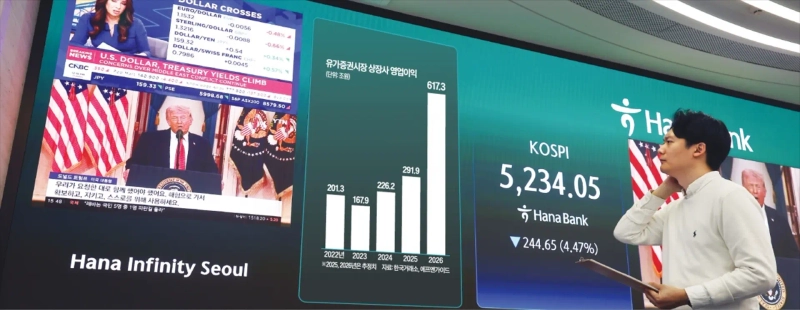
The Kospi closed at 5,234.05 on April 2, down sharply from 6,244.13 on Feb. 27, before the war began.
The decline, however, was not one-way. Sharp selloffs and rebounds repeatedly hit the benchmark, and each new comment by President Donald Trump on the war sent the index swinging.
The Kospi’s average daily move in March was 3.64%. On March 4, it dropped more than 12%, the largest one-day swing on record. March volatility was the highest since October 2008, when the average daily move reached 4.18% during the global financial crisis.
The Kospi’s volatility also stood out against major global indexes. In the month after the war began, the Nasdaq posted an average daily move of 0.96%. Asian markets sensitive to higher oil prices also fluctuated, but the Nikkei averaged 2.10% and the Hang Seng China Enterprises Index 1.15%, both less than half the Kospi’s level. Korea’s volatility index has also remained above 50, a level associated with extreme fear.
One clear trend in the turmoil has been aggressive foreign selling. Overseas investors were net sellers of 35.8807 trillion won on the Kospi in March, focused mainly on large-cap names such as Samsung Electronics and SK Hynix that had rallied sharply earlier. That followed net sales of 19 trillion won of listed shares in February. Retail investors, by contrast, absorbed nearly all of the selling. Individuals were net buyers of 33.569 trillion won on the Kospi over the same period.
Strong Earnings Outlook Supports Staggered Buying, Analysts Say
Market strategists say the recent volatility has not yet reached the point of damaging corporate earnings. Forecasts still call for a sharp increase in operating profit this year at major South Korean companies, supporting a medium- to long-term investment approach.
FnGuide, a South Korean financial data provider, estimates combined 2025 operating profit on a consolidated basis at 617.3872 trillion won for 205 Kospi-listed companies covered by brokerages. That is up 111.5% from 291.0004 trillion won a year earlier. Sales are forecast at 3,281.7493 trillion won, which would also be a record.
Samsung Electronics is forecast to post 514.7217 trillion won in sales and 191.3931 trillion won in operating profit this year. SK Hynix is expected to generate 228.5410 trillion won in sales and 159.4304 trillion won in operating profit.
The improvement is not limited to chipmakers. For the 203 listed companies excluding Samsung Electronics and SK Hynix, consensus calls for operating profit of 266.5637 trillion won, up 32.55% from 201.0930 trillion won last year. The biggest gains are expected in shipbuilding, defense and energy, as well as in financial sectors such as brokerages and banks.
Kang Dae-seung, an analyst at SK Securities, said volatility has intensified since the outbreak of the Iran war, but damage to the broader market trend remains limited. He added that it is too early to conclude the market has entered a structural downturn.
Despite the uncertainty caused by the war, earnings estimates for Kospi companies are still being revised upward. Rather than trying to make a short-term call on market direction, investors can use the current bout of volatility to build positions in stages, Kang said.
Still, some strategists caution against overly aggressive buying and say risk management remains essential. Lee Sang-yeon, an analyst at Shin Young Securities, recommended holding part of a portfolio in cash and taking a selective approach to large-cap stocks that have fallen too far relative to fundamentals. He added that investors should be careful about aggressively increasing overall exposure to the market.
Kang Jin-gyu, Hankyung reporter, josep@hankyung.com

Korea Economic Daily
hankyung@bloomingbit.ioThe Korea Economic Daily Global is a digital media where latest news on Korean companies, industries, and financial markets.