Blockchain Industry Sees On-Chain Trading Accelerating Into Financial Infrastructure
Summary
- Blockchain industry experts said on-chain trading is moving beyond an alternative and could become part of the financial infrastructure.
- Mark Lee said Perp DEXs must provide speed and liquidity on par with centralized exchanges, while offering asset diversity through a non-custodial structure, RWAs, and meme coins.
- Megan Park and MJ of Gravity said a pragmatic approach that prioritizes execution and cost efficiency is important in areas such as liquidity, decentralization, and hybrid structures.
Forecast Trend Report by Period


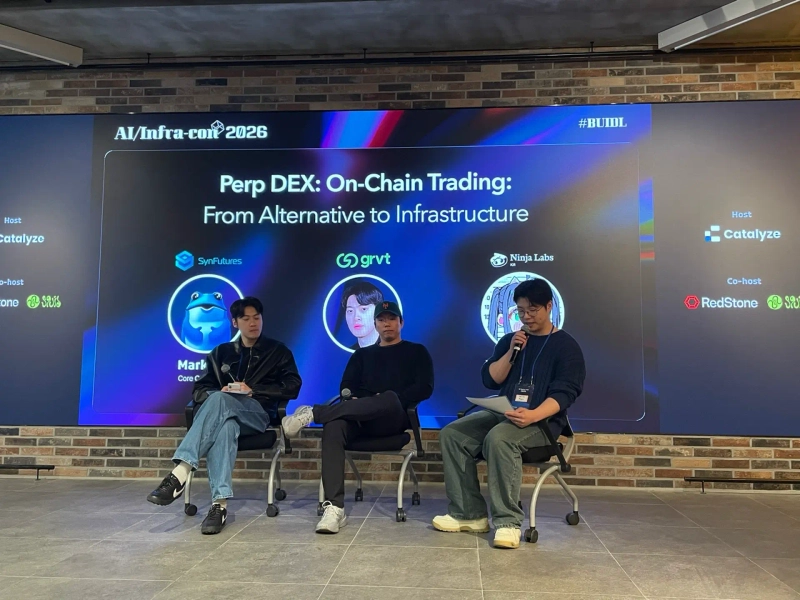
Blockchain industry participants said on-chain trading is moving beyond its role as an alternative venue and increasingly positioning itself as part of core financial infrastructure. The discussion took place at AI/InfraCon, held on April 15 at Dreamplus in Seoul's Gangnam district, and focused on perpetual decentralized exchanges, real-world assets, or RWAs, and stablecoins.
Mark Lee, a core contributor at SynFutures, said market expectations for perpetual DEXs have changed. On-chain execution alone is no longer enough to stand out, he said, adding that platforms now need to provide speed and liquidity comparable to centralized exchanges. He also cited non-custodial asset control and the ability to permissionlessly list a broader range of assets, including RWAs and meme coins, as key strengths.
Megan Park, DevRel at Ninja Labs, said market lead and user habit formation matter more than technical performance. Once a platform wins early users and becomes integrated across an ecosystem, liquidity accumulates naturally, she said, and that structure is becoming a long-term competitive advantage.
The panel offered conditional optimism on whether on-chain trading could overtake centralized exchanges in trading volume. Lee said it can compete if speed and throughput issues are resolved. He added that high-performance infrastructure built on dedicated chains will be needed to support institutional-grade trading.
The discussion also covered liquidity structure. Some on-chain liquidity currently depends in part on participants from centralized markets, but Park said the more important task is to make the on-chain environment attractive enough to draw users in voluntarily.
The panel also emphasized a pragmatic approach to decentralization. Park said users place greater weight on execution and cost efficiency than on ideological decentralization, and that hybrid structures can be a realistic alternative. MJ, a business planning executive at Gravity, added that decentralization is better understood as a spectrum than a binary choice. Systems that secure asset control and transaction transparency can still offer practical value, he said.

Minseung Kang
minriver@bloomingbit.ioBlockchain journalist | Writer of Trade Now & Altcoin Now, must-read content for investors.