PiCK
Kaia Says Korean-Won Stablecoin Debate Must Shift to Execution From Issuers
Summary
- Seo Sang-min said debate over a won-based stablecoin should move beyond who will issue it and into an execution phase focused on how it will be designed, operated and adopted.
- Kaia said issuance, redemption, reserve-asset management and suspicious-transaction responses should be managed systematically through a four-layer architecture based on the K-STAR report and a role-based separation of authority and multisignature system.
- Kaia disclosed results from a South Korea-Vietnam remittance proof of concept with a domestic financial institution, showing an 87% cut in remittance costs and processing in under three minutes, while also outlining an Asian payments network expansion strategy through Ratio and Unify.
Forecast Trend Report by Period


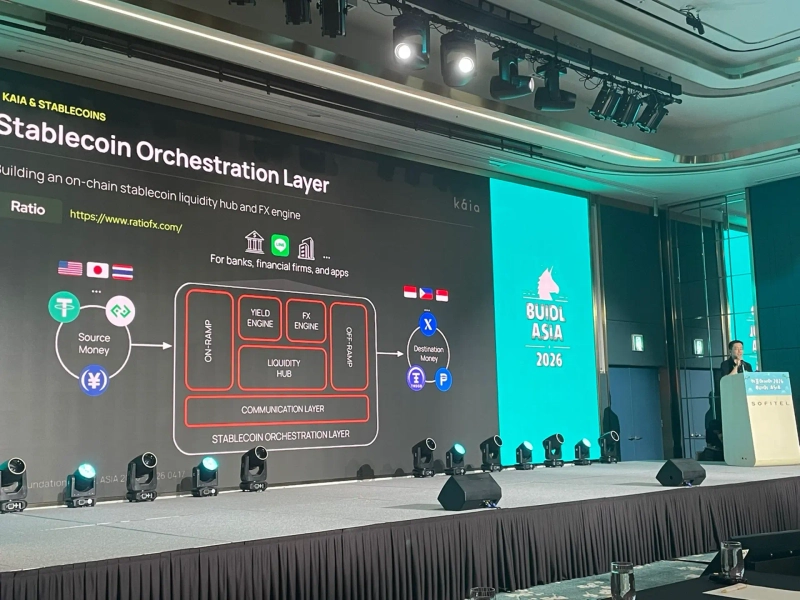
"Discussion of a Korean-won stablecoin has so far focused on who will do what. It now needs to move to execution: how it will be built and operated."
Seo Sang-min, chairman of the Kaia DLT Foundation, made the remarks at BUIDL Asia 2026 at Sofitel Ambassador Seoul on April 17, where he laid out a detailed design and implementation strategy for the practical adoption of a won-based stablecoin.
Seo identified the spread of dollar-backed stablecoins as a key risk, citing what he called "digital dollarization." USDT and USDC are rapidly encroaching on global payments infrastructure, he said. If that trend extends to South Korea, won-based financial infrastructure could contract.
He also pointed to structural limits in the existing financial system. Payment networks centered on SWIFT pass through multiple intermediaries, raising costs and slowing transactions. Stablecoins offer an alternative that can shift the system to lower-cost, faster settlement, he said.
Seo argued that debate over a won stablecoin has remained too focused on the issuing entity. Most of the discussion has centered on who should issue it, while the more important task is how it should be designed, operated and adopted. He added that an execution model should be built around common requirements, drawing on global regulatory precedents.
Kaia proposed a four-layer architecture based on the K-STAR report. The framework consists of network infrastructure, tokens and smart contracts, issuance and settlement, and a compliance data layer. It is designed to reflect both technical elements and regulatory requirements. The report sets out an architecture covering issuance, settlement and distribution of a won-based stablecoin. It was jointly prepared by the K-STAR Alliance with participation from Lambda256, AhnLab Blockchain Company and Open Asset.
Seo said the core task is designing a control structure based on role-based separation of authority and a multisignature system, rather than concentrating all authority in a single entity. The framework must systematically manage the full process, including issuance, redemption, reserve-asset management and responses to suspicious transactions.
Kaia identified payments and settlement, platform-based services and cross-border transactions as the main use cases. It said overseas remittances and business-to-business settlement would deliver the biggest gains in cost and speed.
Kaia also disclosed proof-of-concept results. In a South Korea-Vietnam remittance test conducted with a domestic financial institution, the cost of sending 100,000 won was cut 87% from conventional methods, while processing time was reduced to less than three minutes.
The company also outlined a strategy to expand an Asian payments network through stablecoin orchestration infrastructure Ratio and super app Unify. Kaia is building integrated infrastructure that allows different currencies to be exchanged on-chain and linked directly to payments, Seo said. It is also expanding user touchpoints through partnerships with platforms including Line.
Seo said the introduction of a won-based stablecoin has moved beyond the conceptual stage and now requires execution. If South Korea prepares its design and operating model in parallel, the country can play a leading role in the global stablecoin industry, he said.

Minseung Kang
minriver@bloomingbit.ioBlockchain journalist | Writer of Trade Now & Altcoin Now, must-read content for investors.