RWA Tokenization Enters Early Stage of Capital-Markets Shift, With Stablecoins Seen as Catalyst
Summary
- Experts said real-world asset (RWA) tokenization has entered the early stages of reshaping capital-market structure.
- Ko Yeon-su said the introduction of stablecoins has made practical payment and settlement possible in the token securities and RWA markets.
- Hong Sung-wook said the key challenges are the reliability of asset valuation, securing liquidity, and the structure linking on-chain records with legal ownership.
Forecast Trend Report by Period


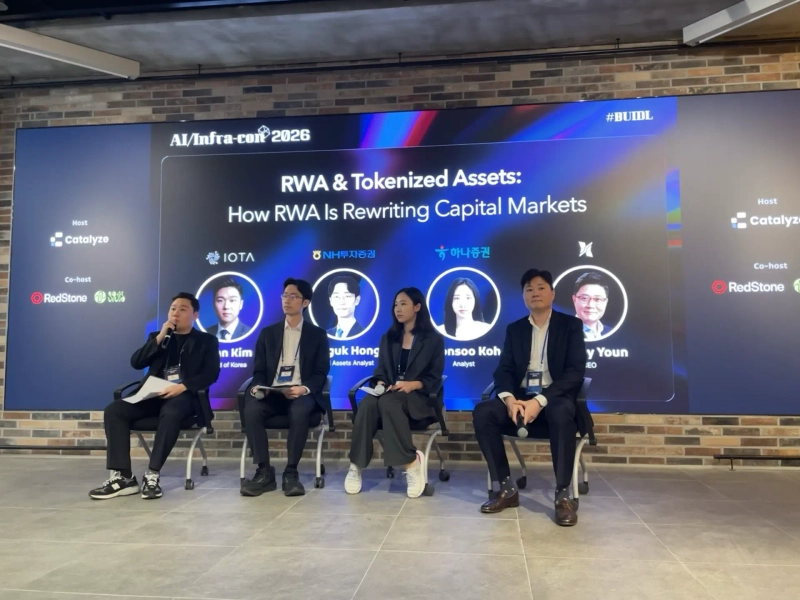
Blockchain and finance industry experts said tokenization of real-world assets, or RWAs, has moved beyond a passing trend and entered the early stages of reshaping capital-market structure. A fireside chat on “RWAs and Tokenized Assets” was held at AI/InfraCon in Seoul’s Gangnam district on May 15.
Johnny Yoon, chief executive officer of RiskX, called the expansion of RWAs the start of a structural shift. The current trend goes beyond simply digitizing assets, he said, and is reshaping distribution, payments and data architecture more broadly.
Ko Yeon-su, an analyst at Hana Securities, identified stablecoins as the key variable. Earlier tokenization efforts failed to gain traction because they lacked a payment mechanism, he said. The introduction of stablecoins has made practical payment and settlement possible in token securities and RWA markets.
Regulation and risk management were cited as the main reasons traditional financial institutions have moved slowly. Hong Sung-wook, a researcher at NH Investment & Securities, said financial firms must meet investor-protection and internal-control standards. Key tasks include ensuring reliable asset valuation, securing liquidity and clarifying how on-chain records connect to legal ownership. He also referred to cases involving tokenized money market funds, or MMFs, and said asset migration could accelerate if they prove to offer tangible utility over conventional financial products.
Speakers also said traditional finance and crypto-native firms are likely to divide roles in the market. Traditional financial institutions would serve as distribution and intermediation channels, drawing on existing client bases and credibility, while crypto firms would focus on technology-driven asset issuance and management. Ko cited Nomura Securities’ operation of a blockchain subsidiary in Japan and said cooperation models between financial institutions and technology companies are likely to expand.
Sean Kim, head of IOTA Korea, said broader RWA adoption will require a system with monitorable structures, practical usability and clearly defined accountability. He added that a clear division of roles between on-chain protocols and financial institutions will be important.

Minseung Kang
minriver@bloomingbit.ioBlockchain journalist | Writer of Trade Now & Altcoin Now, must-read content for investors.