AI Agents Emerge as Core Force in On-Chain Finance, Spurring Payments Infrastructure Race
Summary
- Experts said AI agents are emerging as the core execution layer in on-chain finance, and that competition to build low-cost on-chain settlement infrastructure for them is beginning in earnest.
- The industry said it is developing infrastructure that includes payment standards, asset-management permission structures, and conditional automatic control functions so AI can manage assets directly.
- Participants said the spread of on-chain asset management is increasing the importance of decentralized infrastructure, transparency and verifiability, and identity authentication systems for AI agents.
Forecast Trend Report by Period


"Crypto is the payment rail best suited to AI, requiring dedicated protocols and authentication systems"
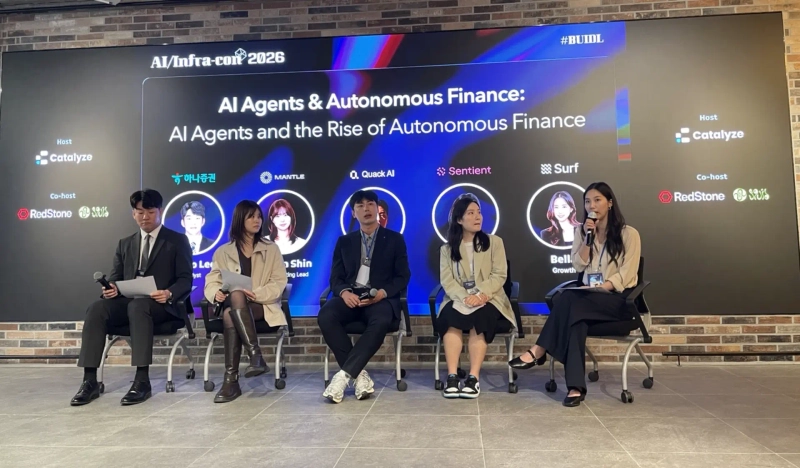
Blockchain and AI industry executives said AI agents are emerging as a core execution layer in on-chain finance, setting off a race to build the payments infrastructure needed to support them. A fireside chat on the convergence of AI and crypto infrastructure was held at AI/InfraCon in Seoul's Gangnam district on Aug. 15.
Gemma Shin, marketing lead at Mantle Korea, said the integration of AI and blockchain infrastructure is structurally inevitable. Traditional financial systems were designed around human-centered authentication, making them difficult for AI to use. Blockchain, by contrast, operates on a command-based structure that makes it well suited for AI to manage assets directly. She added that low-cost on-chain settlement infrastructure will be necessary for AI agents to manage assets in real time.
Lee Jun-ho, an analyst at Hana Securities, said companies are changing how they use AI. In the past, adoption focused on improving efficiency. More recently, specialized agents have begun to emerge that can execute and settle transactions on-chain. Companies are also increasingly seeking to secure operating authority through their own AI models.
Payments infrastructure to support AI agents' on-chain activity is also taking shape. David Lee, Korea lead at Quark AI, said directly delegating private keys carries significant security risks. The company is developing a payment standard that grants asset-management authority only within a predefined scope. He added that an environment is emerging in which AI can autonomously allocate assets and carry out arbitrage. Infrastructure with functions that automatically control activity based on preset conditions is set to expand over time.
The discussion also covered decentralized infrastructure aimed at addressing the limitations of centralized AI. Nam Yu-ra, business development manager at Sentient, said existing AI systems face structural limits because their decision-making processes are difficult to verify. She added that transparency and verifiability will become more important in a decentralized AGI environment. A new authentication framework will also be needed to verify the identity of AI agents.
Bella Park, growth manager at Surf AI, said AI agents are moving into a stage where they can access on-chain data and carry out actual asset management. The use of AI as an execution layer will be central to the expansion of Web3 infrastructure, she added.

Minseung Kang
minriver@bloomingbit.ioBlockchain journalist | Writer of Trade Now & Altcoin Now, must-read content for investors.